 Widely read:


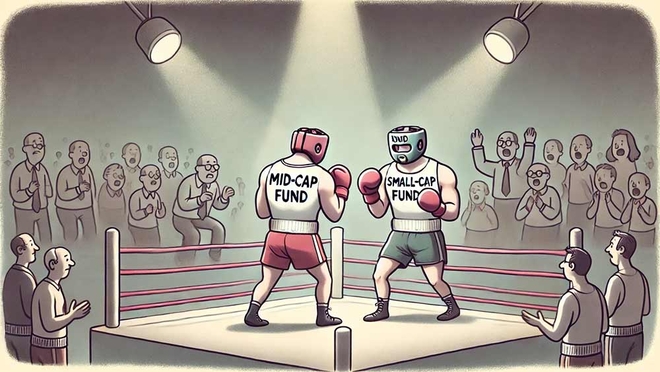

Summary: Mid-cap and small-cap funds may look similar on the surface, but they behave quite differently when markets turn choppy. This story unpacks where that difference really shows up, and why the better comparison is often about portfolio fit, not just returns.
Mid-cap and small-cap funds do not solve exactly the same problem. Both sit in the high-growth end of the equity market, but small-cap funds usually bring sharper upside in bull phases and steeper drawdowns in bad markets, which means the more useful question is not “which one wins?” but “what kind of volatility is a portfolio actually built to absorb?”
SEBI’s mutual fund categorisation framework defines mid-cap companies as those ranked 101st to 250th by full market capitalisation, while small caps are ranked 251st and below. Category mandates then require mid-cap and small-cap funds to invest at least 65 per cent of their assets in their respective market-cap buckets. That makes these categories meaningfully different from broad diversified equity funds, even before performance enters the conversation.
What does market history say about the trade-off?
The cleanest way to compare the two categories is to look at how they behave when the market is under stress and when it is euphoric.
A comparison of the five best and five worst Sensex months shows the pattern clearly: in May 2014, small-cap indices rose 18.41 per cent, ahead of mid caps at 13.02 per cent and the Sensex at 8.24 per cent. But in March 2020, small caps fell 32.84 per cent, compared with 27.34 per cent for mid caps and 22.85 per cent for the Sensex.
That is the core distinction. Small caps tend to amplify market moves in both directions. Mid caps can still be volatile, but their swings have historically been less extreme. Recent market behaviour has followed the same script: from the September 2024 peak to February 2025, the Sensex fell 15 per cent, while mid- and small-cap indices were down 21 per cent and 25 per cent, respectively.
Time horizon matters more than last year’s return
A one-year return table can make both categories look exciting or frightening, depending on the date chosen. A more useful test is how the downside changes as the holding period gets longer. A rolling return study on the average mid-cap fund found that over the 10 years to November 2025, one-year holdings ended in negative returns 25 per cent of the time. At six years, that dropped to zero across the period studied.
That does not mean mid caps become ‘safe’ after a magic number of years. It means that the odds of a disappointing outcome fall sharply when the holding period becomes long enough for a full market cycle to play out. Small caps usually demand even more patience, typically 7-10 years at least.
The nuance many comparison articles miss
A small-cap fund is not always a ‘pure’ small-cap bet. SEBI requires only 65 per cent investment in small caps, and Value Research’s category analysis showed that active small-cap funds, on average, held 82 per cent in small caps and 13 per cent in mid caps as of August 31, 2024. That means some of the diversification readers try to create by pairing a mid-cap fund with a small-cap fund may already exist inside the small-cap fund’s portfolio.
This is where category labels can mislead. Some investors assume that adding both categories automatically improves diversification. Sometimes it does. Sometimes it mostly increases overlap and raises the portfolio’s sensitivity to the same market cycle. A better comparison framework is to examine benchmark, portfolio mix, concentration, expense ratio and direct-versus-regular-plan difference before deciding whether two funds are genuinely complementary.
Value Research’s Mutual Funds Screener and Tools & Calculators can help with that kind of like-for-like review.
What about costs and taxes?
From a tax perspective, mid-cap and small-cap funds are both equity-oriented mutual funds, so the same current equity-tax rules apply. Value Research’s Budget 2024 tax explainer notes that for sales on or after July 23, 2024, short-term capital gains on equity funds are taxed at 20 per cent and long-term capital gains at 12.5 per cent, with long-term gains exempt up to Rs 1.25 lakh in a financial year.
Costs matter too, especially in volatile categories where returns can vary widely across market cycles. Value Research’s recent direct-versus-regular-plan analysis shows the difference between the two is not portfolio quality but cost: regular plans embed distributor commission in the expense ratio, while direct plans do not. That is not a mid-cap versus small-cap issue by itself, but it is highly relevant when comparing funds within either category, because a narrow return advantage can be eroded by persistent cost drag over time.
So how should these categories be read?
The evidence does not support a simple winner. Mid caps have historically offered a somewhat smoother ride than small caps, while small caps have shown greater upside participation in strong rallies and greater downside in market stress. For a DIY investor, that makes this less a return contest and more a question of role: mid caps sit closer to ‘growth with a seatbelt’, while small caps are a more demanding part of the equity spectrum.
The more durable insight is that category choice works best when it follows portfolio design, not recent performance. Investors who focus only on what surged last year often miss what matters more: how long the money can stay invested, how much drawdown can be tolerated without panic, and whether the portfolio is already getting similar exposure elsewhere.
We have also written about when it makes sense to reassess such allocations.
Our take
The data shows that small caps have historically delivered bigger bursts of upside, but they have also been hit harder in bad months.
A mid-cap label does not remove risk; it mainly reduces the extremity of the swings compared with small caps.
A small-cap fund is not always purely small-cap, so category overlap deserves a closer look before readers assume they are diversifying by adding both.
The better comparison is not “which category had the best recent return?” but “which category’s volatility, holding-period requirement and cost structure fit the rest of the portfolio?”
If you are looking for the best mid- and small-cap funds to invest in, subscribe to Value Research Fund Advisor right away. Here, you will get access to in-depth research, tailored recommendations and tools to build a well-diversified portfolio that aligns with your goals. Whether it's mid- or small-cap funds or any other investment option, our insights empower you to make informed choices.
Also read: Active mid-, small-cap funds look smart in this market correction
This article was originally published on December 24, 2024, and last updated on March 11, 2026.
Disclaimer: This content is for information only and should not be considered investment advice or a recommendation.
For grievances: [email protected]
Ask Value Research 
 New episodes every Friday










 New Process Alert
 Seems like you've uploaded a wrong QR code. Please upload the QR code downloaded from MF Central platform.


