




 AI-generated image

You may have come across Nifty 50 and Nifty 100 index funds, which invest in the top 50 or 100 companies by market value. But did you know about the Nifty Top 10 Equal Weight Index? It's an index of the 10 largest Indian companies based on free-float market capitalisation over the last six months.
Moreover, since it's an equal weight (EW) index, each of the 10 companies is assigned a similar weight, roughly 10 per cent each.
The 10 most valuable companies listed on this index are:
Nifty Top 10 Equal Weight Index constituents
| Stock | Weight (%) |
|---|---|
| ICICI Bank | 10.45 |
| HDFC Bank | 10.44 |
| Larsen & Tourbo | 10.22 |
| ITC | 10.11 |
| Tata Consultancy Services | 9.94 |
| Infosys | 9.93 |
| Bharti Airtel | 9.81 |
| Axis Bank | 9.79 |
| Kotak Mahindra Bank | 9.76 |
| Reliance Industries | 9.55 |
| Source: Nifty Top 10 Equal Weight Index factsheet. Data as of October 31, 2024. | |
Sector-wise breakdown of the index
The financial sector currently enjoys maximum heft, comprising 40 per cent of the Nifty Top 10 Equal Weight (EW) Index. Technology comes next with 20 per cent weighting, followed by Communications, Construction, Consumer staples and Energy at 10 per cent each.
Financials and Technology have been the usual heavyweights since 2006. On average, these two have comprised 50-60 per cent of the index since 2006, based on Value Research sectoral classification. The energy sector has had its sunny days, too, peaking at 30 per cent weighting in 2007.
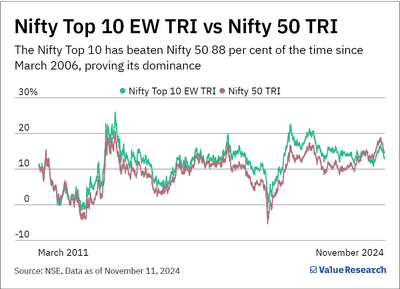
Nifty Top 10 Equal Weight Index performance
The Nifty Top 10 has outperformed the Nifty 50 a whopping 88 per cent of the time from March 2006 to November 2024, based on daily five-year rolling data.
Moreover, since its inception, the Nifty Top 10 EW has delivered an annualised return of 14.22 per cent, compared to the Nifty 50's 12.8 per cent.
Now, let's compare the performance of the Nifty Top 10 Equal Weight Index and the Nifty 50 across different market phases since 2006: bearish phases (with declines of more than 20 per cent), recovery periods and bullish phases.
Bearish phase
Since 2006, both indices have shown nearly identical declines during bearish phases, with only two instances of slight variation. In 2006, the Nifty Top 10 Equal Weight fell 1.94 per cent less than the Nifty 50, while during the February 2016 to April 2017 downturn, it fell 3.61 per cent more. In all other cases, their declines have been nearly the same.
That said, the Nifty Top 10 Equal Weight tends to bounce back with a bang during recovery after a bearish phase, often outperforming the Nifty 50. It's a clear sign that the top-10 stocks are usually the ones that lead the revival.
Bullish phase
There's no clear winner. Out of four bull market phases, the Nifty Top 10 Equal Weight leads in two, while the Nifty 50 outshines in the other two.
During the pre-financial crisis bull phase, the Nifty Top 10 EW returned 54.69 per cent, but the Nifty 50 outperformed with a 71.71 per cent return. On the other hand, during the 2017-2020 bull run, the Nifty Top 10 was the clear winner, with a 65.91 per cent return, leaving the Nifty 50 trailing at 38.46 per cent.
Pros of Nifty Top 10 EW Index
-
Tax efficiency:
Investing in an equal-weighted index fund offers a tax-efficient way to gain exposure to India's top 10 companies. Rebalancing individual stocks to maintain equal weightage can incur short-term capital gains tax, but with an
index fund
, rebalancing happens automatically, making it simpler and more tax-friendly.
-
Exposure to leading companies:
This index gives you exposure to India's top blue-chip companies. As the index is reconfigured semi-annually, any exiting company is replaced seamlessly, keeping your investment focused on the best firms.
- Potential for better returns: In the long run, the Nifty Top 10 Equal Weight Index has often outperformed its parent index, the Nifty 50, as discussed earlier.
Cons of Nifty Top 10 EW Index
-
High concentration:
With only 10 companies in the portfolio, your returns are highly dependent on the performance of this select group. If these companies underperform, your overall returns could suffer.
- Sectoral concentration: The index is heavily reliant on the Financial, IT and Energy sectors. This means your returns will be significantly influenced by the performance of these three sectors, which may expose you to sector-specific risks.
Should you invest in Nifty Top 10 EW Index?
Exposure to the country's 10 biggest companies offers security, and the return of the Nifty Top 10 Equal Weight Index speaks for itself, often outperforming the Nifty 50 over five-year periods.
However, remember that the risk lies in your money being invested in just a handful of companies and sectors.
So, a long-term horizon is crucial if you're investing in this index.
Also read: Nifty 50 vs Nifty 500: Where should you invest?
Ask Value Research 
 New episodes every Friday






 New Process Alert
  Seems like you've uploaded a wrong QR code. Please upload the QR code downloaded from MF Central platform.


