




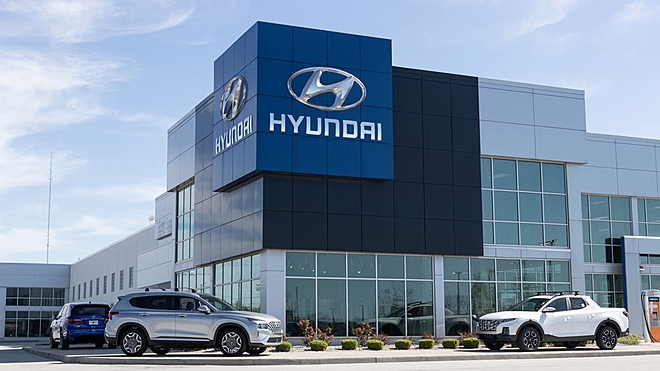

Hyundai IPO, the biggest-ever in the Indian primary market, will open for subscription on October 15, 2024, and close on October 17, 2024. We break down the automobile manufacturer's strengths, weaknesses, and growth prospects to help investors make an informed decision.
Hyundai IPO in a nutshell
-
Quality
: Its three-year average
ROE
and ROCE were nearly 27 and 29 per cent, respectively, during FY22-24.
-
Growth
: Its revenue and net profit grew nearly 21 and 45 per cent per annum, respectively, during FY22-24.
-
Valuation
: Post the IPO, the stock will be valued at a
P/E
and P/B ratio of around 26 and 13 times, respectively.
- Overview: Hyundai Motor is India's second-biggest car maker in the passenger vehicle or PV segment after Maruti Suzuki . The company is poised to benefit from the growing demand for PVs in India, particularly in the premium sport utility vehicle or SUV segment. With a shift in consumer preferences towards high-end models, especially among younger buyers, Hyundai has been doubling down to capitalise on this trend. The growing electric vehicle or EV segment will also provide ample opportunities. However, the company is facing intense competition, which is threatening its market position.
About Hyundai Motor India
Hyundai Motor India is a key subsidiary of the world's third-largest car maker, South Korean giant Hyundai Motor Company (HMC). Hyundai India contributes about 18 per cent to the parent's global sales. With Rs 30,103 crore of investment since inception, it is also the parent's largest supply chain outside South Korea. The company pays the parent a 3.5 per cent royalty on annual sales, consistent with the other global subsidiaries.
Company's strengths
-
Capacity ramp-up:
Hyundai India's production capacity will increase to 10.7 lakh units from 8.2 lakh units with its upcoming plant in Talegaon, Maharashtra.
-
Operational efficiency:
Hyundai sources 93 per cent of its parts locally near its Chennai plant. The proximity to suppliers allows the company to streamline its manufacturing process, reducing inventory costs and improving operational efficiency. Its common platform architecture across its Chennai plants further enables production of multiple models simultaneously, which is why the company had an industry-leading average EBIT margin of nearly 9 per cent during FY22-24.
- Premiumisation strategy : Hyundai focuses on higher-value vehicles. It earned 49 per cent of revenue from cars priced over Rs 10 lakh and around 20 per cent from cars priced over Rs 15 lakh in FY24. This was a result of capturing the growing demand for SUVs. Their share in company revenue has shot up to 67 per cent so far in 2024, up from 52 per cent in March 2022.
Company's weaknesses
-
Receding market share:
Intense competition has been eating into the company's market pie. Between FY20 and Q1 FY25, Hyundai's PV market share has fallen from nearly 18 per cent to 15 per cent. Over the same stretch,
Tata Motors
' share rose to 13 per cent from around 5 per cent.
Mahindra & Mahindra
and Kia Motors (also a Hyundai Group company) nearly doubled their market share to 12 and 6 per cent, respectively.
- Royalty agreement: Hyundai India is obliged to pay royalty fees to its parent, who can increase the fee to 5 per cent without needing shareholder approval. Based on FY24 revenue, a one per cent increase in royalty fee would have cost Hyundai India nearly Rs 700 crore. Any fee increase, therefore, could significantly dent the company's profitability.
Hyundai IPO details
| Total IPO size (Rs cr) | 27,870 |
| Offer for sale (Rs cr) | 27,870 |
| Fresh issue (Rs cr) | - |
| Price band (Rs) | 1,865 -1,960 |
| Subscription dates | October 15-17, 2024 |
| Purpose of issue | Offer for sale |
Post-IPO
| M-cap (Rs cr) | 1,59,258 |
| Net worth (Rs cr) | 12,149 |
| Promoter holding (%) | 82.5 |
| Price/earnings ratio (P/E) | 25.6 |
| Price/book ratio (P/B) | 13.1 |
Financial history
| Key financials | 2Y CAGR (%) | TTM | FY24 | FY23 | FY22 |
|---|---|---|---|---|---|
| Revenue (Rs cr) | 21.4 | 70,550 | 69,829 | 60,308 | 47,378 |
| EBIT (Rs cr) | 44.5 | 7,298 | 6,925 | 5,359 | 3,317 |
| PAT (Rs cr) | 44.5 | 6,221 | 6,060 | 4,709 | 2,902 |
| Net worth (Rs cr) | -20.5 | 12,149 | 10,666 | 20,055 | 16,856 |
| Total debt | -15.9 | 821 | 833 | 1,189 | 1,178 |
|
EBIT is earnings before interest and taxes
PAT is profit after tax TTM is 12 months ending June 2024 |
|||||
Key ratios
| Key ratios | 3Y average (%) | TTM | FY24 | FY23 | FY22 |
|---|---|---|---|---|---|
| ROE (%) | 27.4 | 37.1 | 39.5 | 25.5 | 17.2 |
| ROCE (%) | 29.3 | 40.9 | 42.3 | 27.3 | 18.4 |
| EBIT margin (%) | 8.6 | 10.3 | 9.9 | 8.9 | 7.0 |
| Debt-to-equity | 0.1 | 0.1 | 0.1 | 0.1 | |
|
ROE is return on equity ROCE is return on capital employed |
|||||
Risk report
Company and business
-
Are Hyundai India's earnings before tax more than Rs 50 crore in the last 12 months?
Yes. The company reported a profit before tax of Rs 8,455 crore in the 12 months ending June 2024.
-
Will Hyundai be able to scale up its business?
Yes. The company will ride industry tailwinds, especially in the EV segment, where market penetration is as low as 2.3 per cent. The growing demand for SUVs with increasing disposable incomes will also help the company scale up.
-
Does Hyundai have recognisable brands with client stickiness?
Yes. Hyundai has a recognisable brand. It occupies over 14 per cent of India's PV market share.
-
Does the company have a credible moat?
No. It operates in a very competitive industry with many other large players.
Management
-
Do any of the company's founders still hold at least a 5 per cent stake? Or do promoters hold more than a 25 per cent stake in the company?
Yes. After the IPO, the promoters' stake will be nearly 83 per cent.
-
Do the top three managers have more than 15 years of combined leadership at Hyundai?
Yes. Its managing director, chief operating officer and chief manufacturing officer have over 15 years of combined leadership experience.
-
Is the management trustworthy? Is it transparent in its disclosures, which are consistent with SEBI guidelines?
Yes. There is no information to suggest otherwise.
-
Is the company's accounting policy stable?
Yes. There is no information to suggest otherwise.
-
Is Hyundai free of promoter pledging of its shares?
Yes. No shares have been pledged.
Financials
-
Did the company generate a current and three-year average return on equity of over 15 per cent and a return on capital employed of over 18 per cent?
Yes. Its three-year average ROE and ROCE were nearly 27 and 29 per cent. In FY24, its ROE and ROCE were almost 40 and 42 per cent, respectively.
-
Was the company's operating cash flow positive during the last three years?
Yes. The company has reported positive cash flow during FY22-24.
-
Is the company's net debt-to-equity ratio less than one?
Yes. The company's debt-to-equity ratio was 0.1 in FY24.
-
Is Hyundai free from reliance on huge working capital for day-to-day affairs?
Yes. Although Hyundai operates in a capital-intensive business, it has kept its working capital requirements at comfortable levels. Its average net working capital days were negative during FY22-24.
-
Can the company run its business without relying on external funding in the next three years?
Yes. The company has enough cash and has been generating free cash flow over the years.
-
Is Hyundai free from meaningful contingent liabilities?
No. Its contingent liabilities as a percentage of total equity were around 32 per cent as of FY24.
Valuations
-
Does the stock offer an operating earnings yield of more than 8 per cent on its enterprise value?
No. After listing, the stock will offer an operating earnings yield of nearly 5 per cent on its enterprise value.
-
Is the stock's price-to-earnings less than its peers' median level?
Yes. Post-IPO, the stock will trade at a P/E ratio of 25.6 times compared to its peers' median level of 27.5 times.
-
Is the stock's price-to-book value less than its peers' average level?
No. Post-IPO, the stock will trade at a P/B ratio of 13 times compared to its peers' average level of 4.7 times.
Disclaimer: This is not a stock recommendation. Investors should do their due diligence before investing.
Also read: Hyundai India's mega IPO set to overhaul D-Street records
Ask Value Research 

 New episodes every Friday















 New Process Alert
  Seems like you've uploaded a wrong QR code. Please upload the QR code downloaded from MF Central platform.


