 Widely read:


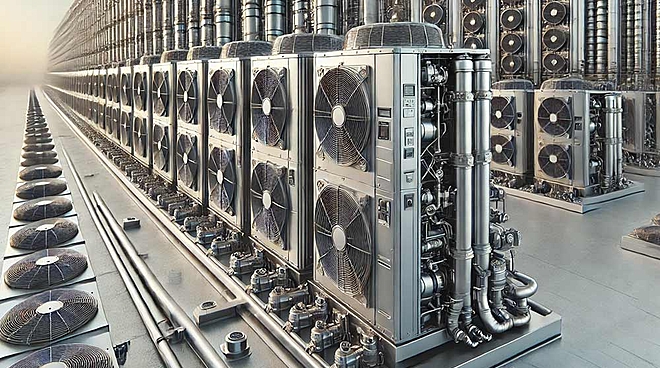 AI-generated image

KRN Heat Exchanger IPO will open for subscription on September 25, 2024 and close on September 27, 2024. We break down the heat ventilation equipment manufacturer's strengths, weaknesses, and growth prospects to help investors make an informed decision.
KRN Heat Exchanger IPO in a nutshell
-
Quality
: Its three-year average
ROE and ROCE
were around 57 and 39 per cent, respectively, between FY22 and FY24.
-
Growth
: Its revenue and net profit grew nearly 41 and 92 per cent per annum, respectively, during FY22-24.
-
Valuation
: Post the IPO, the stock will be valued at a P/E and P/B ratio of 35 and 3 times, respectively.
- Overview: KNR Heat Exchanger , whose products primarily find usage in air conditioning and heat ventilation, is expected to benefit from the rapid growth in real estate, construction, manufacturing and warehousing sectors. The growth in these industries will keep the demand for commercial air conditioning and ventilation buoyant, translation into firm demand for the company's products. However, its high revenue concentration to a handful of customers is a key risk.
About KRN Heat Exchanger and Refrigeration
The company manufactures finned tube heat exchangers, used to improve heat transfer efficiency in the heating, ventilation, air conditioning and refrigeration industry (HVACR). Its product range includes condenser coils and evaporator units, among many others. The company derives close to 80 per cent of revenue from the HVACR industry, which is poised to grow nearly 15 per cent per annum till 2029. Moreover, the domestic heat exchanger market is also projected to clock double-digit growth by 2030.
Strengths of KRN Heat Exchanger
-
Established customer base:
The company serves prestigious air conditioner giants, including Daikin, Schneider Electric,
Blue Star
,
Voltas
and Carrier.
- Forward integration: The company incorporated a wholly-owned subsidiary KRN HVAC Products to increase value-added products in its existing portfolio. It plans to manufacture new types of heat exchangers to cater to a wider range of product applications.
Weaknesses of KRN Heat Exchanger
-
Concentrated revenue:
The company earns 33 per cent of its revenue from its largest customer Daikin, and 55 per cent from the top five customers. Any delay or cancellation of orders by these customers can adversely impact the company. Moreover, the company has no long-term agreements with its customers.
- Rising receivables and inventory: The company's revenue is not translating into operating cash flows as most of the money is stuck in receivables and inventory. Also, the percentage of inventory over cost of goods sold has more than doubled to 37 per cent between FY22-24, indicating an overestimation of demand and inefficiencies in production planning.
KRN Heat Exchanger IPO details
| Total IPO size (Rs cr) | 342 |
| Offer for sale (Rs cr) | - |
| Fresh issue (Rs cr) | 342 |
| Price band (Rs) | 209 - 220 |
| Subscription dates | September 25-27, 2024 |
| Purpose of issue | To fund a new manufacturing facility and general corporate purposes |
Post-IPO
| M-cap (Rs cr) | 1,367 |
| Net worth (Rs cr) | 474 |
| Promoter holding (%) | 70.8 |
| Price/earnings ratio (P/E) | 35 |
| Price/book ratio (P/B) | 2.9 |
Financial history
| Key financials (Rs cr) | 2Y growth p.a. (%) | FY24 | FY23 | FY22 |
|---|---|---|---|---|
| Revenue | 40.5 | 308 | 247 | 156 |
| EBIT | 94.5 | 54 | 46 | 14 |
| PAT | 92.1 | 39 | 32 | 11 |
| Net worth | 127.1 | 132 | 60 | 26 |
| Total debt | 104.4 | 92 | 37 | 22 |
|
EBIT is earnings before interest and taxes
PAT is profit after tax |
||||
Key ratios
| Ratios | 3Y average | FY24 | FY23 | FY22 |
|---|---|---|---|---|
| ROE (%) | 57.2 | 40.9 | 75.9 | 54.9 |
| ROCE (%) | 38.8 | 31.2 | 50.5 | 34.7 |
| EBIT margin (%) | 15.0 | 17.5 | 18.6 | 9.0 |
| Debt-to-equity | 0.7 | 0.7 | 0.6 | 0.9 |
|
ROE is return on equity ROCE is return on capital employed |
||||
Risk report
Company and business
-
Are earnings before tax of KRN Heat Exchanger more than Rs 50 crore in the last 12 months?
Yes. The company reported a profit before tax of nearly Rs 56 crore in FY24.
-
Will KRN Heat Exchanger be able to scale up its business?
Yes. The demand for heat exchangers is directly linked to the economy's infrastructure expansion, which is rapidly growing.
-
Does KRN Heat Exchanger have recognisable brands with client stickiness?
Yes. The biggest customer of the company, Daikin India, has been associated with it since it commenced operations in 2018.
-
Does the company have a credible moat?
No. The company doesn't have any credible moat.
Management
-
Do any of the company's founders still hold at least a 5 per cent stake? Or do promoters hold more than a 25 per cent stake in the company?
Yes. After the IPO, the promoters' stake will be nearly 71 per cent.
-
Do the top three managers have more than 15 years of combined leadership at KRN Heat Exchanger?
No. The company began operations 6 years ago. Its top managers—Chairman and Managing Director Santosh Kumar Yadav and Whole Time Director Anju Devi—have been with the company since its inception.
-
Is the management trustworthy? Is it transparent in its disclosures, which are consistent with SEBI guidelines?
Yes. There is no information to suggest otherwise.
-
Is the company's accounting policy stable?
Yes. There is no information to suggest otherwise.
-
Is KRN Heat Exchanger free of promoter pledging of its shares?
Yes. No shares have been pledged.
Financials
-
Did the company generate a current and three-year average return on equity of more than 15 per cent and a return on capital employed of more than 18 per cent?
Yes. Its three-year average ROE and ROCE were nearly 57 and 39 per cent. In FY24, its ROE and ROCE were around 41 and 31 per cent, respectively.
-
Was the company's operating cash flow positive during the last three years?
Yes. The company reported positive operating cash flow during the last three years.
-
Is the company's net debt-to-equity ratio less than one?
Yes. The company had a net debt-to-equity ratio of 0.57 times as of FY24.
-
Is KRN Heat Exchanger free from reliance on huge working capital for day-to-day affairs?
No. Inventories and receivables currently constitute almost half of its assets. Moreover, the company has taken short-term borrowings to finance its working capital.
-
Can the company run its business without relying on external funding in the next three years?
No. The company's operating cash flow is not adequate due to its poor cash conversion. Thus, it may still need to raise funds to finance its future capex plans.
-
Is KRN Heat Exchanger free from meaningful contingent liabilities?
No. Its contingent liabilities as a percentage of total equity was around 16 per cent as of FY24.
Valuations
-
Does the stock offer an operating earnings yield of more than 8 per cent on its enterprise value?
No. After listing, the stock will offer an operating earnings yield of around 4 per cent on its enterprise value.
-
Is the stock's price-to-earnings less than its peers' median level?
The stock has no listed peers available. It will be valued at a P/E ratio of 35 times.
-
Is the stock's price-to-book value less than its peers' average level?
The stock has no listed peers available. It will be valued at a P/B ratio nearly 3 times.
Disclaimer: This is not a stock recommendation. Investors should do their due diligence before investing.
Also read: Manba Finance IPO analysis
Disclaimer: This content is for information only and should not be considered investment advice or a recommendation.
For grievances: [email protected]
Ask Value Research 
 New episodes every Friday











 New Process Alert
 Seems like you've uploaded a wrong QR code. Please upload the QR code downloaded from MF Central platform.


