




 AI-generated image

If a week is a long time in politics, a month can be an eternity in investing. Ask arbitrage funds, which were on cloud nine between April 2023 and July 2024. In fact, they received over Rs 11,000 crore this July, only to be rudely brought down to earth the following month in August, when they got just over Rs 2,300 crore.
Why? The short-term capital gains (STCG) tax rate was hiked around that time. Now, if you withdraw from arbitrage funds within a year, you'll be taxed at a flat 20 per cent, up from the earlier 15 per cent.
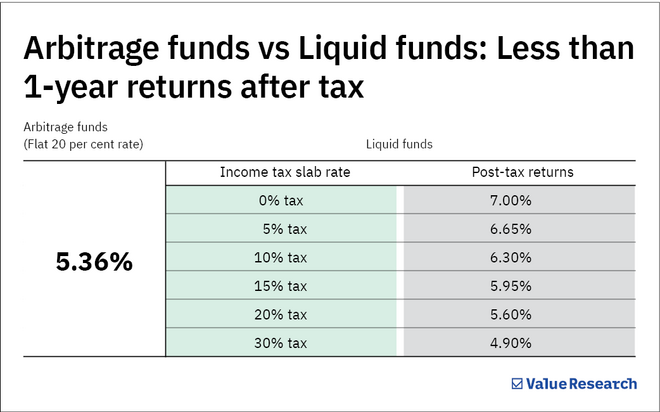
As a result, liquid funds have emerged as a strong alternative, especially for those looking to invest for a short time (a week to a year). So, let's look at the numbers to see which option is better.
If you are investing for less than a year
- If you're in the 20 per cent tax bracket or lower: Liquid funds are likely your best option (see returns table below).
- If you're in the 30 per cent tax bracket: Arbitrage funds still offer better post-tax returns.
- What you need to know: Liquid funds have demonstrated greater consistency in terms of pre-tax returns. They beat arbitrage funds 56.1 per cent of the time based on daily one-year rolling returns since 2014.
If you are investing for a month or less
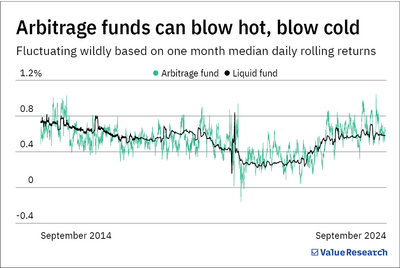
- Arbitrage funds and liquid funds generally offer similar pre-tax returns in such a short time.
- However, the former can be highly volatile over a very short period of time due to their exposure to equity, debt and even derivatives. However, they stabilise in the longer run.
- Therefore, if you are investing for a few weeks, consider your risk appetite before opting for arbitrage funds.
Cost
Liquid funds are generally less costly. Their median expense ratio is 0.15 per cent, compared to arbitrage funds, which can go up to 0.34 per cent. This difference matters, given their post-tax returns are fairly close.
In addition, if you need your cash quickly without incurring a penalty, liquid funds offer a significant advantage. You can access your money without a penalty after just six days, while arbitrage funds require you to wait up to 30 days. So, if you are looking for an early exit, liquid funds are your go-to option.
Quick recap
Arbitrage funds work better if you fall in the 30 per cent tax bracket, provided you don't need the money within 30 days.
For those in the 20 per cent tax bracket or below, it's better to park your money in liquid funds.
Also read: Arbitrage funds: The rich man's liquid fund?
Ask Value Research 

 New episodes every Friday










 New Process Alert
  Seems like you've uploaded a wrong QR code. Please upload the QR code downloaded from MF Central platform.


