


The Reserve Bank cannot just exist; its ability to say 'No!' has to be protected." In a furious public debate about central bank autonomy that seems to span geographical borders, former Reserve Bank of India (RBI) governor Raghuram Rajan's point is the best summing-up of the argument.
Can the autonomy of the central bank be affected by what its owner, the government, milks out of it in terms of dividend? This piece is an attempt to answer this.
First, the basics. RBI makes money by printing currency and taking deposits (also called reserves) from banks. To simplify, this is free money, as the central bank doesn't pay any interest. But it also earns interest from foreign currency assets and government bonds that it buys using this money.
In the three years under Rajan, RBI made a ton of money. Its profit grew at a 7.73% compound annual growth rate, forming a quarter of the government's non-tax revenue. Interestingly, as a percentage of India's gross domestic product (GDP), it is 2%, higher than that of the US Federal Reserve's surplus payment that is 0.65% of US GDP.
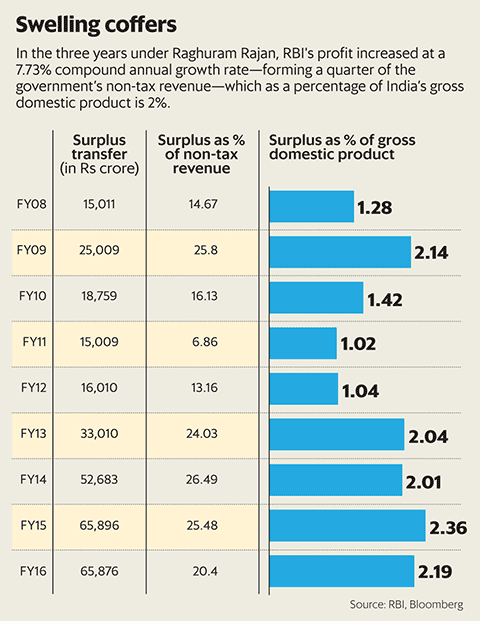
From the point of the government, this is revenue for which it need not sweat at all. Easy money is tempting and so there have been enough voices seeking more dividends from RBI.
The Economic Survey proposed that the central bank's coffers should be used to recapitalize ailing nationalized banks.
RBI took umbrage at the idea, and rightly so.
A central bank asked to pay higher payments to the government will have to basically print more money. Any central bank worth its salt would know the ramifications on inflation and have to compensate by selling government bonds. More bonds in the market would mean higher interest rates, which will bite not just the government, but the public as well. It becomes an indirect tax on the public. In the absence of such sterilization though, a flare-up in inflation would erode public wealth.
For RBI, a preoccupation with generating money for its owner could sometimes mean letting go of prudent measures. In the above case, it can choose not to sell government bonds and spare the owner a higher cost of borrowing. So to answer the question that this piece started with, it is possible that extracting higher dividends out of the central bank would put a shadow on its autonomy. And the central bank should have the right to say No.
In arrangement with HT Syndication | MINT
Ask Value Research 
 New episodes every Friday


 New Process Alert
 Seems like you've uploaded a wrong QR code. Please upload the QR code downloaded from MF Central platform.


