 Widely read:


 Anand Kumar


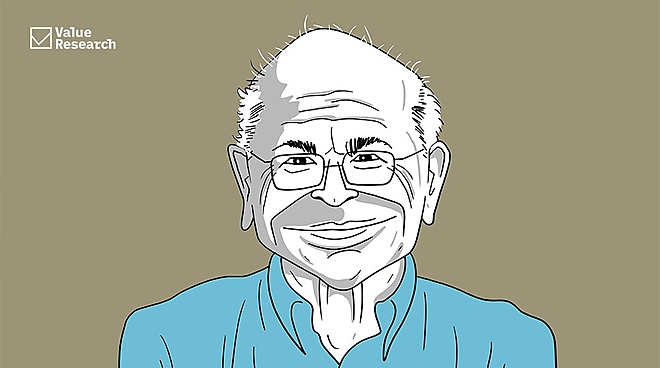
It was more than twenty years ago that I first heard of Daniel Kahneman, who died recently at the age of 90. This was shortly after he was first awarded the Nobel Prize for Economics (yes, I know that the Economics Nobel is not a real Nobel Prize, but let's not be pedantic). Kahneman's ideas, and in fact, the entire field of Behavioural Economics, came to widespread attention outside the field only at about that time. Since then, Kahneman's work, much of it in collaboration with Amos Tversky, has become enormously influential, not just in economics and finance but across a wide range of fields, including psychology, political science, and even medicine. Their groundbreaking research challenged the long-held assumption that human beings are fundamentally rational. Instead, it demonstrated the many ways in which our judgement and decision-making are subject to bias and heuristics.
At that time, I had just launched Value Research's first print magazine, Mutual Fund Insight. We soon did a cover story on Kahneman and Tversky's work titled 'Out of Your Mind?' The subhead of the article was 'Behavioural Economics suggests that for investors, understanding their own psychology is even more important than understanding the markets.' Stated formally, with the weight of the Nobel behind it, this sounds like a new concept and as a part of economics, it definitely is. And yet, instinctively, every investor already knows this. When you first hear it, it immediately strikes a chord, and it feels obvious.
In fact, the core ideas of Behavioral Economics are so intuitive that they have been part of popular wisdom for centuries, if not millennia. Proverbs and aphorisms from across cultures are replete with admonitions against the very cognitive biases that Kahneman and Tversky identified and studied. "Don't put all your eggs in one basket," warns against the lack of diversification. "Cut your losses and ride your profits," cautions against the sunk cost fallacy. "A bird in hand is worth two in the bush" illustrates the concept of loss aversion.
Kahneman and Tversky took this folk wisdom and subjected it to rigorous scientific investigation. Through clever experiments and data analysis, they were able to demonstrate the pervasiveness of these biases and show how they systematically affect our decision-making, often in ways that are detrimental to our own interests.
For all of us who invest, this work is particularly relevant. The financial markets are filled with uncertainty, risk, and emotional stress-conditions that make our cognitive biases stronger. Understanding these biases is the first step towards avoiding their bad effects. For example, by being aware of our tendency to overreact to losses, to follow the herd, or to be overconfident in our own judgments, we can make a conscious effort to counter these biases and make more rational investment decisions.
Of course, the implications of Behavioral Economics go beyond individual investors. The insights from this field are increasingly being applied to other aspects of personal finance, from retirement savings plans to health insurance. By understanding how people actually make decisions, rather than how perfectly rational agents would, people's decisions may be guided, or, as the concept is called, 'nudged'. Honestly, this is not something that I'm enthusiastic about. It's essentially covert manipulation. Those doing the nudging may not have your best interests at heart or may not be very competent.
To me, this whole field is best used as a personal tool to understand and improve our decision-making. By becoming aware of our own biases and mental shortcuts, we can take steps to counteract them when it matters most. This is especially crucial in personal finance and investing, where the consequences of irrational decisions can be severe and long-lasting. By cultivating self-awareness and learning to recognise when our emotions and biases are swaying our judgement, we can become better investors and better stewards of our own financial well-being. That, I believe, would be the greatest tribute to the groundbreaking work of Daniel Kahneman and Amos Tversky.
Also read: Fake patterns in investing
Ask Value Research 
 New episodes every Friday








 New Process Alert
 Seems like you've uploaded a wrong QR code. Please upload the QR code downloaded from MF Central platform.


