 Widely read:


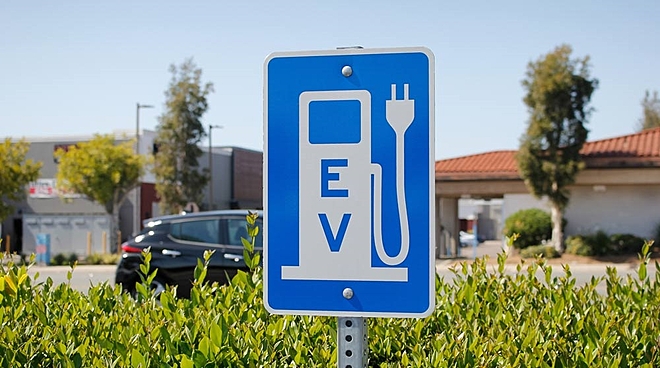
The government has broadcasted to the world that it aims to turn India into a carbon-neutral economy by 2070. Accelerating EV (electric vehicle) adoption is key to achieving this goal. However, it seems like IGL (Indraprastha Gas Limited), one of India's leading city gas distributors, might be collateral damage in this war against pollution.
What may be considered rather ironic is that government policies to counter rising air pollution, particularly in the NCR region, played a key role in IGL ascension and index-beating returns.
So, let's dive into the tale of IGL: how the smog-laden skies of Delhi-NCR turned from its boon to bane.
The ascent of IGL
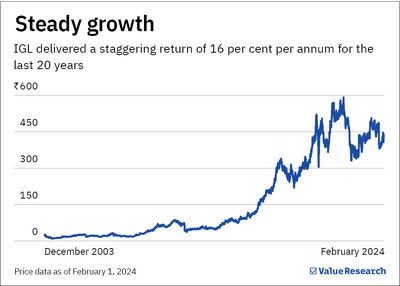
IGL commenced operations in 1999 in Delhi with nine CNG stations and 1,000 PNG (piped natural gas) connections. As of FY23, its capacity has increased to 792 CNG stations, 23.7 lakh residential and 9,000 commercial/industrial connections and expanded operations in NCR, Rajasthan, Maharashtra and parts of Uttar Pradesh.
The company's financials have shown strong growth, with shareholder wealth multiplying more than 18 times in the last two decades.
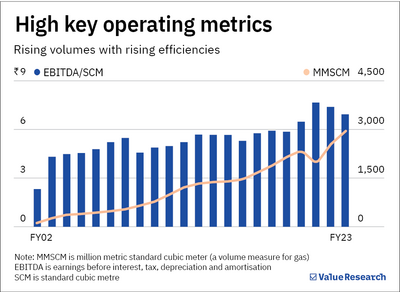
This was aided by favourable government policies. First, the ban on diesel generators and the mandate to use PNG (piped natural gas) for industrial activities contributed to growth. Second, the Delhi government's preference for CNG (compressed natural gas) in DTC buses also helped surge the company's financials (as of FY23, it accounted for around 8 per cent of IGL's total volumes). In addition, IGL negotiated with residential developers to expand its household PNG connections, thus increasing its market share.
Another reason why IGL experienced rapid growth was due to the exclusivity provided by the CGD policy to the existing players. This was of two types: marketing (the right to sell to customers) and infrastructural (the right to establish pipelines and stations). As a result, it became difficult for new brands to enter without incurring a high capex, providing the existing players a competitive advantage.
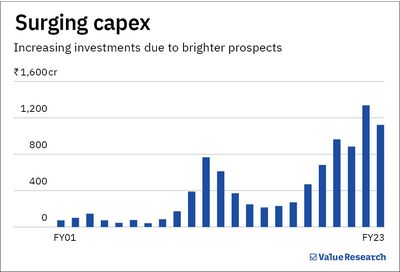
Hence, IGL witnessed positive growth, and its peers like Mahanagar Gas and Gujarat Gas also witnessed growth in their respective geographical areas.
EV adoption: A threat for IGL?
Today, the government policies that gave IGL a fillip now pose hurdles to its growth. A bid to simultaneously promote multiple alternative energy sources, particularly electric vehicles (EVs), may lead to uncertain times for IGL.
Announced in 2020, the Delhi government's EV policy aims to convert its entire transport fleet to electric vehicles in the next 25 years, per Deputy Chief Minister Manish Sisodia.
Besides doling out various subsidies for EV purchases, it has announced the total conversion of its bus fleet into EVs in the coming years. Moreover, the government released a mandate asking all motor vehicle aggregators in Delhi to go electric before 2030 in a phased manner. As per IGL's management, this can impact around 15 per cent of its total volumes.
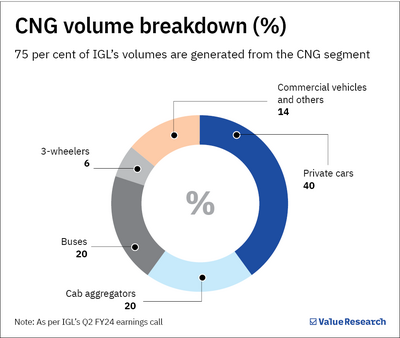
Why does Delhi matter? As of FY24, it constitutes around 60-65 per cent of the total CNG volumes of IGL. Together, these two announcements can potentially wipe out around 20 per cent of its total volumes.
Can IGL deal with this blow?
According to its management, the dependency on DTC buses is slowly decreasing and now stands at about 5-6 per cent of the total volumes as of Q2 FY24. Regarding the aggregator policy, IGL is still waiting for clarity on how this would play out. One of the loopholes that may protect its margins is that vehicle registration will start shifting from Delhi to other adjoining regions, such as Gurugram and Noida, enabling it to surpass the mandate.
What does the future hold for it?
IGL is gradually expanding operations in other regions. Its other operating areas, like Gautam Budh Nagar and Ghaziabad, are witnessing 11-12 per cent growth rates, while newer geographies are growing at 30-100 per cent, albeit on a low base.
Other initiatives, such as foraying into smart gas metre production to reap supply chain benefits and introducing electric charging stations at its pumps, are also expected to keep IGL's financials afloat.
But the question remains how these policies will pan out. IGL's share price has suffered due to these uncertainties, down almost 24 per cent in the last three years (as of February 12, 2024). It also marks a signal for other CGD companies that their exclusivity can become worthless within a short time from the very same authorities that provided it.
Also read: A soaring high Angel
Disclaimer: This content is for information only and should not be considered investment advice or a recommendation.
For grievances: [email protected]
Ask Value Research 
 New episodes every Friday











 New Process Alert
 Seems like you've uploaded a wrong QR code. Please upload the QR code downloaded from MF Central platform.


