





"Is investing in large-cap active funds still worthwhile?" This was the title of our previous story where we compared them with the Nifty 50 index over the last five years. Our analysis stated that large-cap active funds increasingly look like a passive fund, charge you more and give lesser returns. In other words, they lost the plot.
It is indeed a fact that large-cap active funds typically charge a higher expense ratio, a characteristic common to most active funds. However, the year 2023 has surprisingly seen the pendulum swing in their favour, particularly in terms of returns.
A little backstory
The performance of large-cap active funds, until this year, compared to the Nifty 50 index, had painted a grim picture. It indicated that opting for index funds might be a more reliable strategy than investing in large-cap active funds and constantly striving to outperform the market.
Over the span of the last five years, from 2017 to 2022, there was a noticeable dearth of large-cap active funds that managed to beat the Nifty 50 benchmark index. In fact, a significant number of them fell short, with the year 2018 emerging as a particularly dismal chapter. During that challenging period, a mere 1 out of the 24 existing schemes succeeded in outperforming the benchmark.
Back in the game?
However, 2023 appears to be a remarkable year for large-cap active funds as a staggering 93 per cent of them have surpassed the returns of the Nifty 50 benchmark. And, out of a total of 28 large-cap funds, an impressive 26 have outperformed the Nifty 50 benchmark by the end of September 2023.
It's worth noting that even though the large-cap space encompasses the top-100 stocks, most of these funds typically hold around 50 stocks in their portfolios. Hence, for the sake of simplicity, our analysis is based on the Nifty 50 as the benchmark.
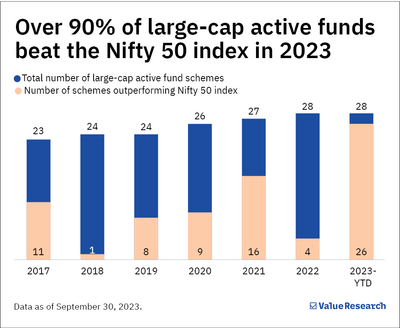
While 2017 and 2021 were decent years too, 2023 stands out as the best year in recent history for the large-cap space.
The extent to which mutual funds outperform their benchmarks is also crucial. For example, if the benchmark returns 10 per cent, a fund delivering 10.5 per cent is considered to have outperformed just as impressive as one delivering 16 per cent. In 2023, many funds significantly outperformed the benchmark, with Nippon India Large Cap Fund leading the way with an impressive 11.15 per cent margin.
Reasons for large-cap active funds outperforming the benchmark
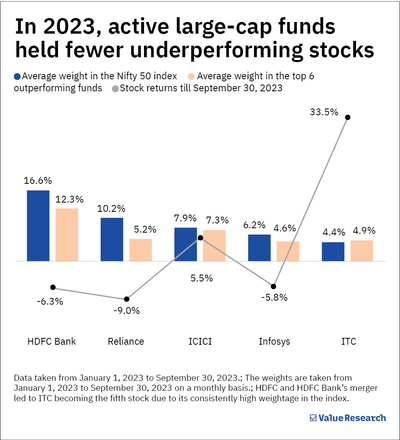
- Large-cap active funds held fewer of the underperforming stocks in their portfolios and maintained equal or higher exposure to strong-performing stocks. HDFC Bank, Reliance, and Infosys, representing roughly 33 per cent of the Nifty 50 index, saw negative returns by September 30, 2023. In contrast, ICICI Bank and ITC, making up about 12 per cent of the index, performed well.
- Top-performing large-cap funds avoided stocks that experienced significant market share losses this year, such as Adani Enterprises Ltd and UPL Ltd.
Some schemes which have outperformed the index Nifty 50 since 2020 for three out of four times are:
- HDFC Top 100 Fund
- Nippon India Large Cap Fund
- Bandhan Large Cap Fund
- Kotak Bluechip Fund
- SBI Bluechip Fund
- UTI Large Cap Fund (UTI Mastershare Fund)
Final word
Is this a short-lived revival or a sign of changing times? Whatever the case maybe, do not make hasty decisions based on this year's standalone results. Over a long time period, the picture still doesn't look promising for actively managed funds. Click here to read a detailed performance analysis of the large-cap active funds over a longer time horizon.
Also watch: Should you dump your large-cap funds?
Ask Value Research 

 New episodes every Friday








 New Process Alert
  Seems like you've uploaded a wrong QR code. Please upload the QR code downloaded from MF Central platform.


