 Widely read:





Derivatives have always caught the eye of retail investors due to their potential for quick profits. For the uninitiated, they are financial instruments whose value is derived from an underlying instrument, such as an index, a stock, a currency or a commodity.
Despite the allure of quick gains, the risk associated with them is often overlooked. We will talk about it later.
However, when it comes to mutual funds, the use of derivatives is a different ballgame. Mutual funds typically employ derivatives for hedging or arbitrage, which is why we've seen hybrid funds like arbitrage funds, balanced advantage funds, and equity savings funds use derivatives extensively. But lately, some equity funds are pulling a different leaf from their playbook, taking significant long positions in stock futures (a common type of derivatives). Let's explore what these funds are, why they're using futures, and what it means for you as an investor.
Mutual funds with significant long exposure to stock futures
Across all equity funds, Quant fund house stands out by significantly using long stock futures in its portfolios since June 2023. This exposure is more than 20 per cent in many of its funds.
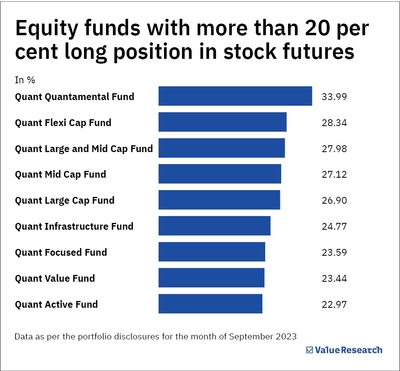
Besides Quant, other equity funds, such as Axis Focused 25 Fund and WhiteOak Capital Mid Cap Fund, also take substantial exposure in stock futures, typically ranging from 10 per cent to 15 per cent of their net assets.
The prominent stock futures in these funds are Hindustan Petroleum, Sun Pharmaceutical Industries, ACC, NMDC, Jindal Steel Power, Grasim Industries, and Reliance Industries.
The leverage risk in derivatives: Retail investors vs mutual funds
Leverage is a tool that allows gaining a large position in a company with a small amount of capital. Normally, to buy 250 shares of Reliance, trading at Rs 2,340 each, Rs 5.85 lakh is required (Rs 2,340 x 250). But with leverage in futures trading, it can be done with much less money upfront, i.e., Rs 1.1 lakh in this case.
However, this also means higher risk. If the share price of Reliance future drops to Rs 2,300, that would result in a loss of Rs 10,000, on a lot size of 250 shares [(Rs 2,340 - Rs 2,300) x 250]. This means, for a mere 2 per cent drop in the price, there is a loss of nearly 10 per cent of the initial Rs 1.1 lakh.
Thus, leverage can amplify gains, but it can also amplify losses, making it a riskier way to invest.
So, in order to protect mutual fund investors from such losses, SEBI permits mutual funds to engage in derivative trading, however, the mutual funds must have the necessary cash to back their derivative positions, ensuring that there is no use of leverage. Taking the earlier example, mutual funds would need to have Rs 5.85 lakh in cash.
Why do mutual funds buy stock futures?
You might wonder why mutual funds choose long future positions when they can buy the actual stocks in the cash market. According to asset management companies (AMCs), this decision is primarily driven by two key factors:
- Liquidity: When the cash market has low trading volumes for a particular stock, mutual funds may take a long future position in that stock. This way, they get the necessary exposure by taking physical delivery of the underlying stock at the contract's expiry.
- Impact cost: Impact cost is the extra expense incurred when executing large trades in the market. For instance, buying 10,000 shares of a relatively illiquid stock can drive up its price. If you end up paying more for the latter shares, the average cost per share increases, resulting in an impact cost. To avoid this, mutual funds can use the more liquid derivatives market.
However, if a fund continues to hold the stock exposure in the derivatives market, it must roll over the future contract, incurring additional costs. There are also brokerage and other charges associated with purchasing a futures contract, contributing to the overall rollover cost.
Drawbacks of using stock futures
- No dividends: When mutual funds buy stock futures instead of actual stocks, investors miss out on dividends.
- No voting rights: Mutual funds don't own the actual shares when they take derivative positions, which means they have no voting rights. This limits their ability to influence corporate decisions or governance matters.
Conclusion
Mutual funds seem to be using stock futures mainly for short-term tactical opportunities, liquidity advantages, and to reduce impact costs. However, as explained above, it comes with a trade off for the investors as they lose certain benefits such as dividends.
Also read: A black hole for your money
This article was originally published on October 19, 2023.
Disclaimer: This content is for information only and should not be considered investment advice or a recommendation.
For grievances: [email protected]
Ask Value Research 
 New episodes every Friday











 New Process Alert
  Seems like you've uploaded a wrong QR code. Please upload the QR code downloaded from MF Central platform.


