




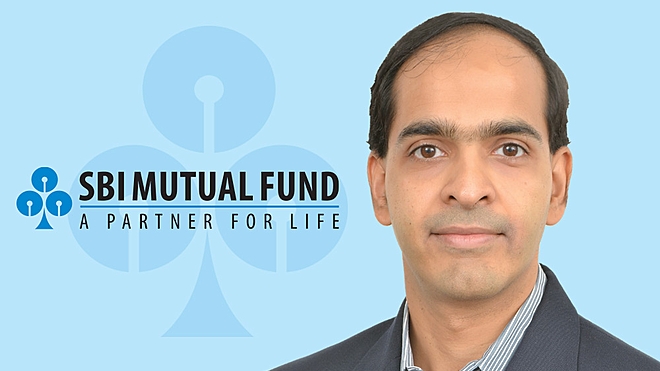

Dinesh Balachandran, Fund Manager - Equity at SBI Mutual Fund, stands out from his peers with a journey that's nothing short of exceptional. Of late, he has gathered massive eyeballs owing to the remarkable performance of SBI Contra Fund, which he took over a few years ago. In this exclusive interview, he reveals the keys to his success, his stock picking strategy, and his views on new-age stocks and gold as an investment option.
Here is an excerpt from the interview.
Your career path as an equity fund manager is quite unique. Starting on the fixed income side and dedicating over a decade to it, please tell us more about your professional journey.
I started my career in the US. I was pursuing my postgraduate education in engineering, initially heading towards earning a PhD and doing something related to engineering. Then, for some reason, I got intrigued by the world of investments and was able to take a few related classes at MIT Sloan. I found them quite engaging, which further sparked my interest in investments. At the time, I didn't have any formal background in finance. However, Fidelity Investments, which is one of the largest mutual fund companies, came to our campus for recruitment. They took a chance on me, and that's how I entered the field of investments as a profession. I began my career working on the quant side for fixed-income analysis. Over a decade in the US, I covered various aspects of the fixed-income market, including municipal bonds, corporate bonds, structured finance, corporate credit, and more.
In 2011, I decided to move back to India, where I happened to meet Navneet, and he convinced me to join SBI Mutual Fund. Due to my background in fixed income, I started working in the fixed income team here as well. After a while, I expressed my interest in exploring something different since I had been closely involved with fixed-income markets for a long time. So, after a couple of years, I transitioned to the role of Head of Research, where I was responsible for both fixed-income and equity research and did that for a couple of years. During this time, I became more familiar with the Indian markets and Indian equities. Eventually, an opportunity opened on the fund management side, and that's when I began my career in equity fund management full-time. I've been doing this for nearly seven years now and continue to learn and grow in the field.
From a risk-reward standpoint, equities offer great prospects. If you do your job right in terms of stock picking, you can easily get a multibagger. From this perspective, now I have become a full-time equity person and am really liking it.
Does your fixed-income background help you run a contra strategy?
It definitely plays some role. Fixed income tends to be much more macro-related. You have to think a lot about macro factors. And when you think about contrarian investing, some amount of top-down analysis comes into play. Particularly in the cyclical sectors, having a perspective about the economic cycle, sort of, becomes essential. In India, I think many people decide that they do not want to think about top-down and want to essentially focus on bottom-up company analysis, which is also a perfectly fine way of doing it. But then I feel, sometimes, you tend to miss out on some of the cyclical inflection points.
I tend to think a lot more with respect to macro factors in the cyclical sectors, and the fixed income background has definitely helped me in managing this.
We have observed that you recently included Nykaa in several funds, including your Contra fund. What makes you interested in these new-age stocks?
Yes, we own companies like Nykaa and Delhivery. I have zero problems with a company reporting loss at this point because, to me, it's about what you think their long-term profit potential is. If the company is investing significantly right now and showing losses on account of that, it is okay. Think about what happened with Amazon. It started in 1994-95. For 20-odd years, it didn't show any profits, but not because it couldn't generate profits. It was primarily because it chose to reinvest all that earnings into newer activities or expanding the business. One has to be careful in labelling all loss-making companies as a sham or anything of that sort. These companies are just trying to expand their reach. So, if Nykaa is not showing profit this year or Delhivery is not showing a profit this year, no problem. What I have to do is to figure out a realistic estimate for their sales and earnings growth.
In lots of these models, there is operating leverage that comes into play, so maybe the profits will start coming in three years from now, which is okay. You have to be convinced that the inherent profitability of the company remains intact, and you have to be comfortable in terms of what assumptions you place for growth and stuff like that and if the current market price justifies that. Nykaa and Delhivery were a no-no for me at the time of IPO. Because at that time, there was too much of a craze going on for new-age stocks, and people just went overboard in terms of their willingness to pay any price. For me, there was no margin of safety at those levels.
What happened later was that growth started taking a hit, and people realised that if they were pencilling in 30-35 per cent annual growth for the next decade, it is unlikely to actually happen. At the end of last year or early this year, people became so disillusioned that they brought down the valuation so much that it gave an opportunity to someone like me, who's a lot more valuation conscious, to get into these companies. But I will make it very clear that loss-making companies are not at all a problem. What matters is whether you believe in the inherent long-term profitability of the company or in the business model.
At Value Research, we view multi-asset funds as overrated though they have garnered substantial investor attention this year. Since you also run a multi-asset fund, what's your take on them?
No one truly knows the future, but if I had to make an educated guess, the coming decade is going to be a lot more about inflation. While the previous decade was all about disinflation with sporadic bouts of inflation, the coming decade is going to be the exact opposite, in my opinion. The moment the central bankers let their guard down, inflation will make a comeback. From that perspective, the probability of something like a stagflationary scenario cannot be ruled out at all. This is where gold does extremely well.
At this point, it's not so apparent because central banks are in a very strong inflation-fighting mode, meaning they're willing to take interest rates higher and higher. But there is a limit to that because they also know that if they overdo it, at some point, the economy can completely go into a deep spiral. So, at some point, they will have to reduce the intensity of the rate hikes. At that point, what happens? Will inflation again make a comeback? This is the crucial question. In my opinion, there is a non-trivial probability that at some point, the central banks are going to make a mistake in one direction or the other. From that perspective I feel very good about having gold as an option in the fund. Multi-asset fund also has fixed income. So, if let's assume I'm not convinced that gold is going to do well, we can keep gold as low as 10 per cent of the fund where it is not going to be big enough to really impact the overall fund returns. But the moment I feel that gold has a much more meaningful role to play, it's a very good optionality to have. From that perspective, I truly believe that multi-asset funds make a lot of sense. All else equal, compared to a generic hybrid fund, I would actually want to have a multi-asset fund because of gold. Gold didn't have any role to play in the last decade, but I think it has a bigger role to play this decade.
You took over the SBI Contra Fund in mid-2018, bringing a remarkable turnaround in its performance. How did you achieve this?
Frankly speaking, some of this goes back to the kind of opportunities...To read the full conversation, where we delve into the intricacies of the investment philosophy that fuels the SBI Contra Fund and Dinesh Balachandran's stock selection framework, subscribe to Value Research Premium.
Also read: Interview with Nippon India's Ashutosh Bhargava
Ask Value Research 
 New episodes every Friday




 New Process Alert
  Seems like you've uploaded a wrong QR code. Please upload the QR code downloaded from MF Central platform.


