




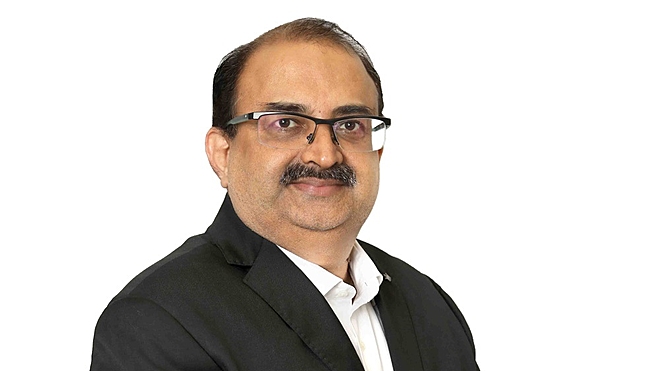

At a time when active funds in the large-cap sector are finding it difficult to generate alpha, Nippon India Large Cap Fund has managed to buck the trend. So, we decided to speak to the fund's manager, Sailesh Raj Bhan, who is also the chief investment officer of equity at Nippon India.
During his interaction, he spoke in great detail about the reasons for the outperformance and why the fund has stuttered in the 2018-2020 period. Not just that, he opened up about the sectors he was bullish on and his outlook on the currently-beaten pharmaceutical industry.
How do you look at the markets now, given the current valuations? Where do you see the opportunity, and which sectors are you bullish or bearish on?
The broader markets have returned to the levels witnessed in September and October 2021. The market recovery is built on expectations of an earnings recovery. Economic growth and profitability have been somewhat sluggish over the recent year. However, the general forecast for the next two to three years appears positive, owing to lower commodity prices, a drop in oil prices and reducing inflationary challenges. It is favourable because of all three structures, though global risks remain.
Also, China, which used to attract capital from foreign investors, is no longer seen positively, which benefits India.
We are currently optimistic about the pharmaceutical, banking, and utility sectors. The valuations for the pharma industry are appealing, and competent banks still have a reasonable runway for expansion.
Utilities are also promising due to the value and development arising from India's energy revolution. As a result, there is a lot of growth visible there as well. Engineering and select consumer staples are two sectors we like for growth but don't like their valuations right now.
As a manager of pharma funds, what do you think is ailing the pharma sector and when do you expect it to make a comeback?
The pharmaceutical industry has faced challenges even before Covid. However, we are presently witnessing significant changes in the sector. Most companies, for example, are increasing their proportion of domestic profits. Because these products are long-lasting, focusing on the Indian market might be very viable for these enterprises. Previously, the majority of profits came from the US or European markets.
We have nearly 30 crore people over 50 who require pharma solutions to improve their quality of life. In addition, we also have a significant population that suffers from chronic illnesses; we are the world's second-largest population inflicted by diabetes. Also, India has the world's second-largest number of cardiac patients. As a result, it is a market with a long runway for volume growth.
Can you explain your stock selection process and how you construct and manage your portfolios?
Equities are purely a function of risk. The rewards earned by equities are the result of taking the right risk. As a result, our emphasis has always been on taking the correct risks and buying growth businesses at a sensible price. We avoid paying exorbitant prices for growth.
Four or five years back, only a few stocks were doing well, and the markets were willing to pay any multiples. So, at the time, we entered into industries (engineering, hotels, corporate lenders) that were out of favour, unloved, and underinvested. Those firms were of great quality and had favourable valuations, but the economic conditions were not conducive to their operation.
We also invest in cyclical businesses that are despised by the marketplace and are available at rock-bottom prices. So, when the cycle turns, we benefit from holding those equities.
Having said that, from a risk management standpoint, we prefer buying business leaders in the cyclical market and not fragile companies. For example, when markets were avoiding public sector enterprises (PSUs), we were quite overweight on India's larger PSU banks, which aided us greatly while avoiding banks with fragile balance sheets.
Nippon India Large Cap Fund has performed well in the past year. What factors contributed to this outperformance?
The outperformance has resulted from some high-conviction calls we made in select industries, including engineering, manufacturing, the hotel industry, and corporate banks. There was a lot of debate in 2016-17 about how retail banks and non-banking financial companies (NBFCs) would take over the banking market. But we were betting on big corporate banks, which were accessible at near-bankruptcy valuations.
(As mentioned earlier) even our call on the select PSU banks worked. Large PSU banks with solid liability franchises and substantial deposits were attractively priced. The market, however, thought otherwise. The market offered a deep value opportunity against even small private sector banks, which were overpriced. The prices of PSU stocks have rerated several times, while retail bank stock has witnessed little price gain in the last three to four years.
Likewise for investments in tobacco and hotels, where leaders delivered good alpha. The engineering sector has aided the fund as well. We began purchasing leaders from this sector in 2014. There were few multinational corporations here, and we had bought during a terrible cycle when the low valuations were very low.
In terms of price appreciation, all of them are now up several times, primarily driven by the recovery in sector interest and growth. To generate alpha in active funds, you need that kind of pre-emptive investments from time to time when valuations are supportive.
Nippon India Large Cap Fund underperformed during the lean period of 2018 and 2020. Reasons?
We do not aim to replicate or hug the index. The focus is to take high-conviction calls within our risk frameworks. We believe that to generate alpha, we must deviate from the benchmarks. So, if you look at the portfolio, we were in a position to profit from the Indian growth narrative in 2018-19, but the pandemic struck, and the growth slowed. Cyclical business like hotels closed down, engineering firms slashed expenses, and these events impacted us.
Without taking the appropriate risk, there is no feasible return in equities. Indexing is not the solution to everything.
Your portfolio shows a bullish stance on the services sector, particularly the hospitality sector.
We invested in those stocks seven or eight years ago at distressed valuations. All these businesses charged one-third of the rates that are there today. These were large leaders, irreplaceable and valued below replacement cost. That was a rationale.
However, at the time, they were in a bad cycle. It was due to the overcapacity in the 2007-2012 period, and later, India saw a slowdown for another six years.
India's largest hotel chains were trading at below replacement value. One could own the two largest listed hotel chains at Rs 12,000 crore. Imagine a country of India's scale where established leaders in the hospitality space are attractively valued with large runways for growth. There were non-replicable businesses at distress valuations because of the economic environment then.
HDFC Bank-HDFC merger took place recently. You now have a significant holding in the company. However, the bank's stock has underperformed in recent years. Are there any concerns?
While not commenting on specific situations, when major events occur in any company, there are usually some concerns in the investors' minds. But, as previously stated, for us, every such temporary uncertainty is an opportunity to create alpha in world-class businesses.
Also read: Interview with Rohit Singhania of DSP Mutual Fund
Ask Value Research 
 New episodes every Friday


 New Process Alert
  Seems like you've uploaded a wrong QR code. Please upload the QR code downloaded from MF Central platform.


