 Widely read:






There has always been a lot of noise surrounding cyclical stocks. From their proposed ability to ruin your portfolio to conjuring up mammoth losses every time the economy falls, the investing world's view on cyclical stocks often borderlines on superstition.
However, a closer introspection would reveal that a lot of these sentiments surrounding cyclical stocks stem from misinformation about what they are.
So, in this story, we look at what cyclical stocks are and if or when to invest in them.
What are cyclical stocks?
Cyclical stocks are businesses whose performance is tied to how the overall economy is faring. In simpler terms, these businesses prosper if the economy is doing well. However, when the economy is in the doldrums, these businesses often go on life support.
As a result, these businesses are often highly volatile, and go through cycles, i.e., a periodic rise and fall in their earnings.
For example, the steel industry is often considered a highly cyclical industry. The graph below shows the cumulative earnings of four major steel companies, Tata Steel, Jindal Steel & Power, JSW steel, and SAIL, in the last 20 years.
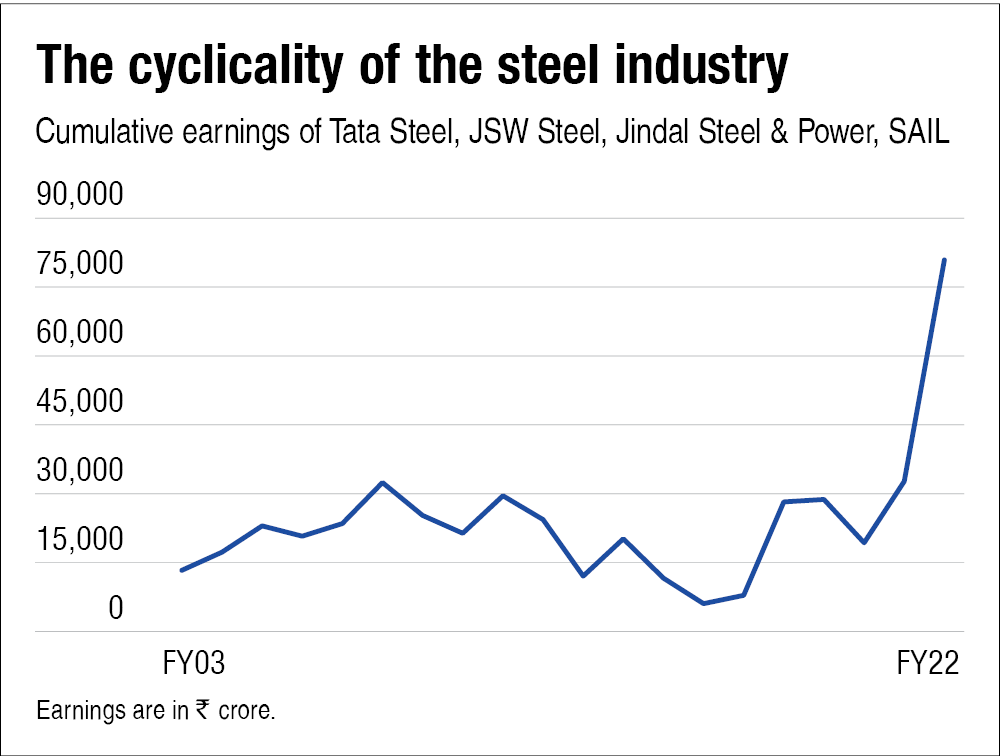
As you can see, there's a clear cyclical trend in their earnings.
Types of cyclical stocks
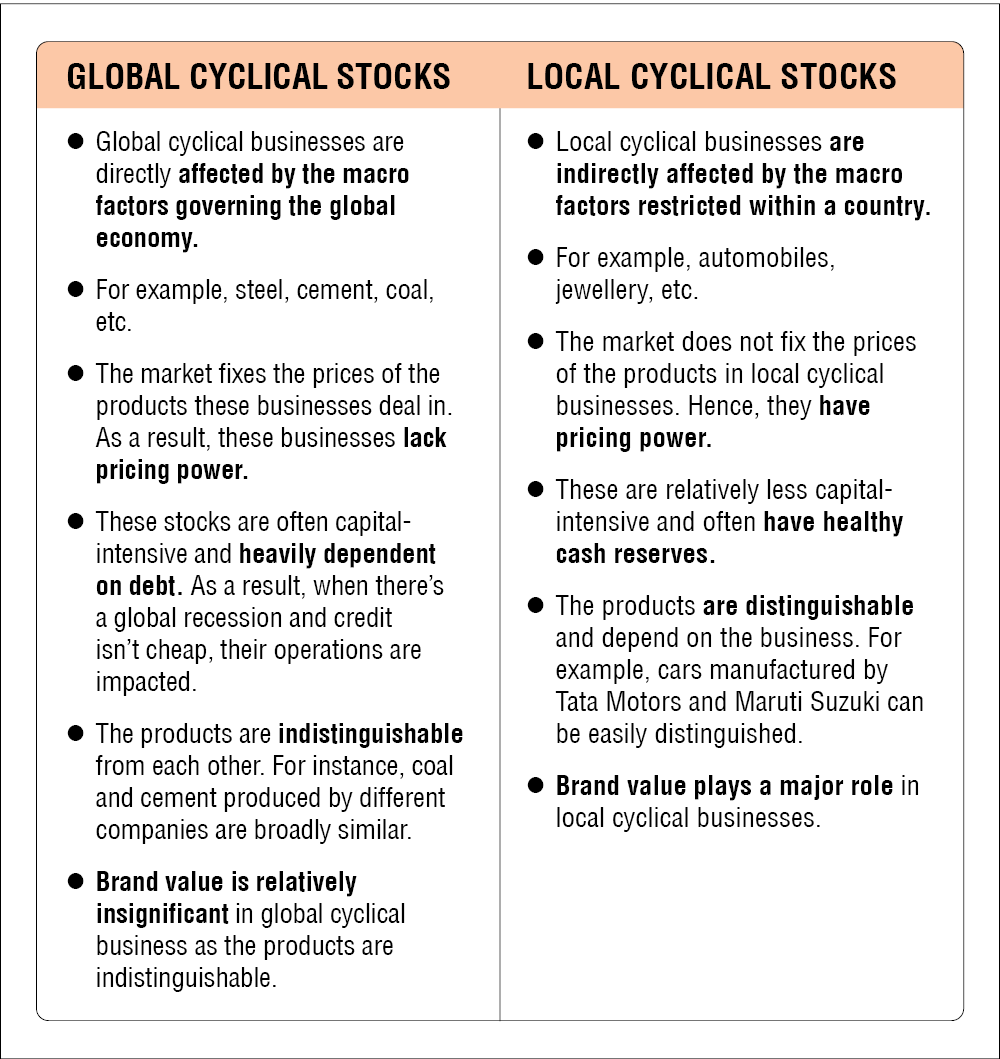
While the primary characteristics of all cyclical stocks is their high sensitivity to macro factors, they can be classified into two types based on the factors causing their cyclicality.
Should you invest in cyclical stocks?
The claims about cyclical stocks being volatile and risky are not unfounded. However, that does not mean they cannot give you good returns.
Cyclical stocks have the potential to reward investors if one can enter and exit them at the right time.
Take the example of steel companies, such as Tata Steel, JSW Steel, and SAIL. They posted abysmal returns between 2008 to 2013 in the wake of the 2008 financial crisis (average return of -8.7 per cent per annum). However, in the last three years, the same stocks witnessed an upcycle and posted annual average returns of 36.7 per cent.
Thus, if you had invested in these businesses in their downcycle and held them till today, your portfolio would look pretty hefty.
However, this is easier said than done. The cycles these stocks go through are decided by a plethora of factors. This makes predicting the upcycles and downcycles extremely difficult and often a gamble.
Moreover, even if you enter these stocks at the right time, you have to hold them through prolonged periods of underperformance. If the fundamentals of these businesses are not strong, the headwinds might crumble them before the upcycle even starts.
Thus, if you are planning to invest in a cyclical sector, the market leaders of that sector are far safer bets.
Furthermore, as local cyclical stocks, unlike global cyclical stocks, are less dependent on debt, they usually are much less risky. Case in point is Maruti Suzuki, which even during a period of economic stagnation between 2009 and 2014, posted positive returns (4.1 per cent per annum).
To sum up, as is the case with most equity investing, whether to invest in cyclical stocks depends on your risk appetite and time horizon.
Suggested read: Capex champs
Ask Value Research 

 New episodes every Friday










 New Process Alert
  Seems like you've uploaded a wrong QR code. Please upload the QR code downloaded from MF Central platform.


