 Widely read:



Price correction is a common term in the investment world. It refers to a decline in the price of a security. Obviously, you lose money when your stock price-corrects. Apart from price correction, there is another form of correction that influences your returns: time correction.
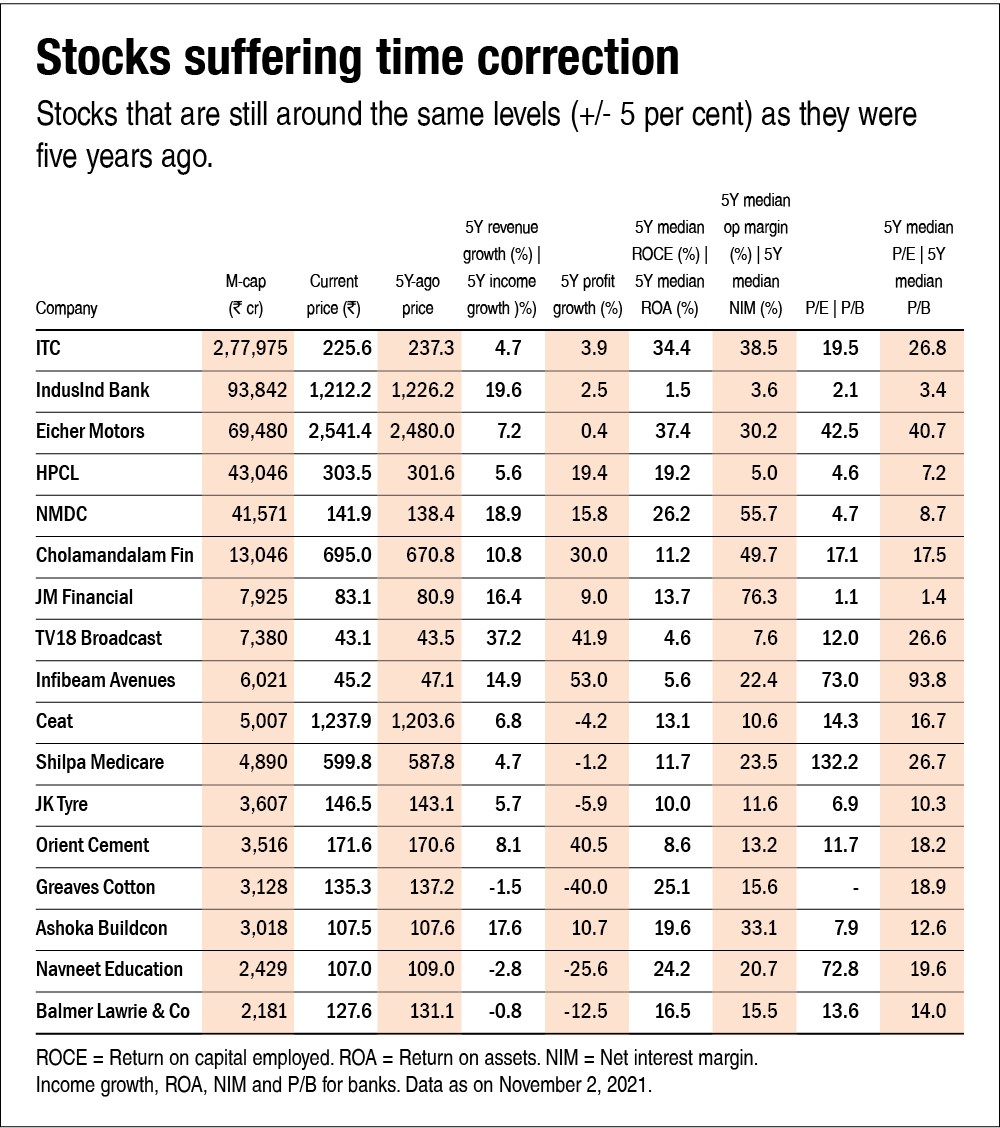
Your stock time-corrects if it doesn't go anywhere for a long period. There could be many reasons for time correction: overvaluation, bleak prospects, little investor interest and so on. A classic example is ITC. The FMCG giant's stock price has been at the same level where it was five years ago. This is possibly because investors are sceptical of the company's earnings-growth prospects, as it generates a majority of its revenues from the tobacco business, which is always under the government's radar. Even though its other segments have started performing well, their contribution to the total revenue is much lower than that of its tobacco segment.
If you are invested in a stock that is suffering time correction, you may not be losing money on paper but you would be incurring significant opportunity cost. For instance, an investment in HPCL five years ago would have returned 0.1 per cent every year. However, the same amount invested in a fixed deposit would have given an average of 6.5 per cent. Adjusted for inflation, the returns from a stock that undergoes time correction would actually be negative.
We have compiled a list of BSE 500 companies that have suffered time correction. Their stock prices are around the same level as they were five years ago (within a band of +/- 5 per cent). Some of these companies could very well be value buys, while others could continue to be value traps. Thus, one should thoroughly research before investing in them.
Disclaimer: This content is for information only and should not be considered investment advice or a recommendation.
For grievances: [email protected]
Ask Value Research 
 New episodes every Friday












 New Process Alert
 Seems like you've uploaded a wrong QR code. Please upload the QR code downloaded from MF Central platform.


