




The price-to-earnings ratio (P/E) is one of the most widely used valuation multiples. It tells us how much investors are willing to pay for every rupee earned by a company. For example, Infosys trades at a P/E ratio of 30. This means that for every rupee earned, the investors are willing to pay Rs 30 to Infosys. A stock may command a high P/E ratio due to multiple factors, such as future growth prospects of the company, good management, anticipation of higher earnings due to expansion, a dominant market share, etc.
Like many other things, the P/E ratio of a stock also changes with time. There are several factors which may lead to a P/E re-rating or even a de-rating. A re-rating occurs when the P/E ratio of a stock increases or expands, which implies that investors have gained even more confidence in the company and are thus ready to pay a higher price per rupee earned. About a year back, Infosys' stock had a P/E ratio of 20 times. However, now its stock trades at a P/E ratio of 30. This could be attributed to an increase in the demand of IT services due to the disruption caused by this pandemic. P/E expansion is highly desirable for investors as it results in even more gains than just price appreciation at a constant P/E.
In contrast, de-rating happens when the P/E of a stock contracts. This can lower the gains as investors are not willing to pay the same amount of money for one rupee of earnings of the company. A de-rating can happen due to uncertainty regarding the company's future, a possible disruption, poor track record of the management, etc.
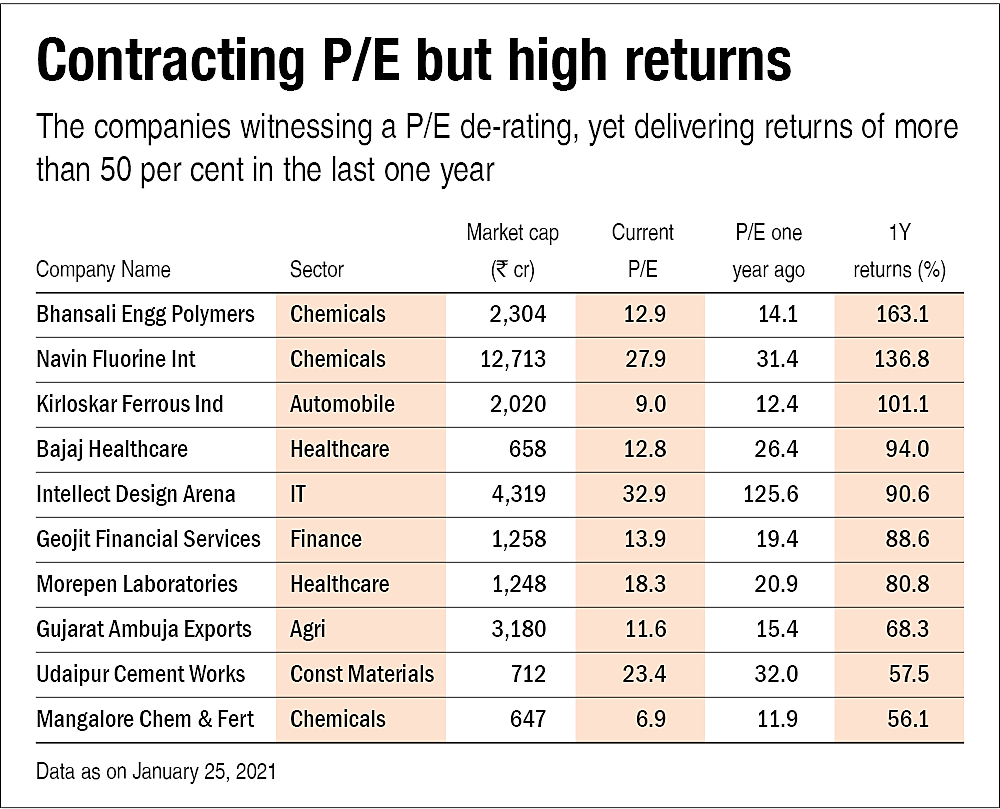
The companies compiled below have witnessed a de-rating in their P/E ratios in the last one year but have still been able to deliver good returns. This could be attributed to a significant increase in their earnings. Do note that we have removed the effect of any exceptional items or tax write-backs from their profits.
So, if these stocks attain their older P/Es, that could result in potential gains for investors. For that to happen, these companies must maintain the momentum in their earnings growth. Keep an eye on them.
Ask Value Research 

 New episodes every Friday








 New Process Alert
  Seems like you've uploaded a wrong QR code. Please upload the QR code downloaded from MF Central platform.


