





While analysing a company, keeping track of its shareholding pattern holds much significance, as it provides insights into the company. For example, promoters know their company inside out. So, if there is any change in their shareholding, it indicates their increasing/decreasing interest in the company. An increase in promoter holding sends out a positive signal to investors, while a decrease in holding sends a negative message, raising concern over the company's growth and future potential.
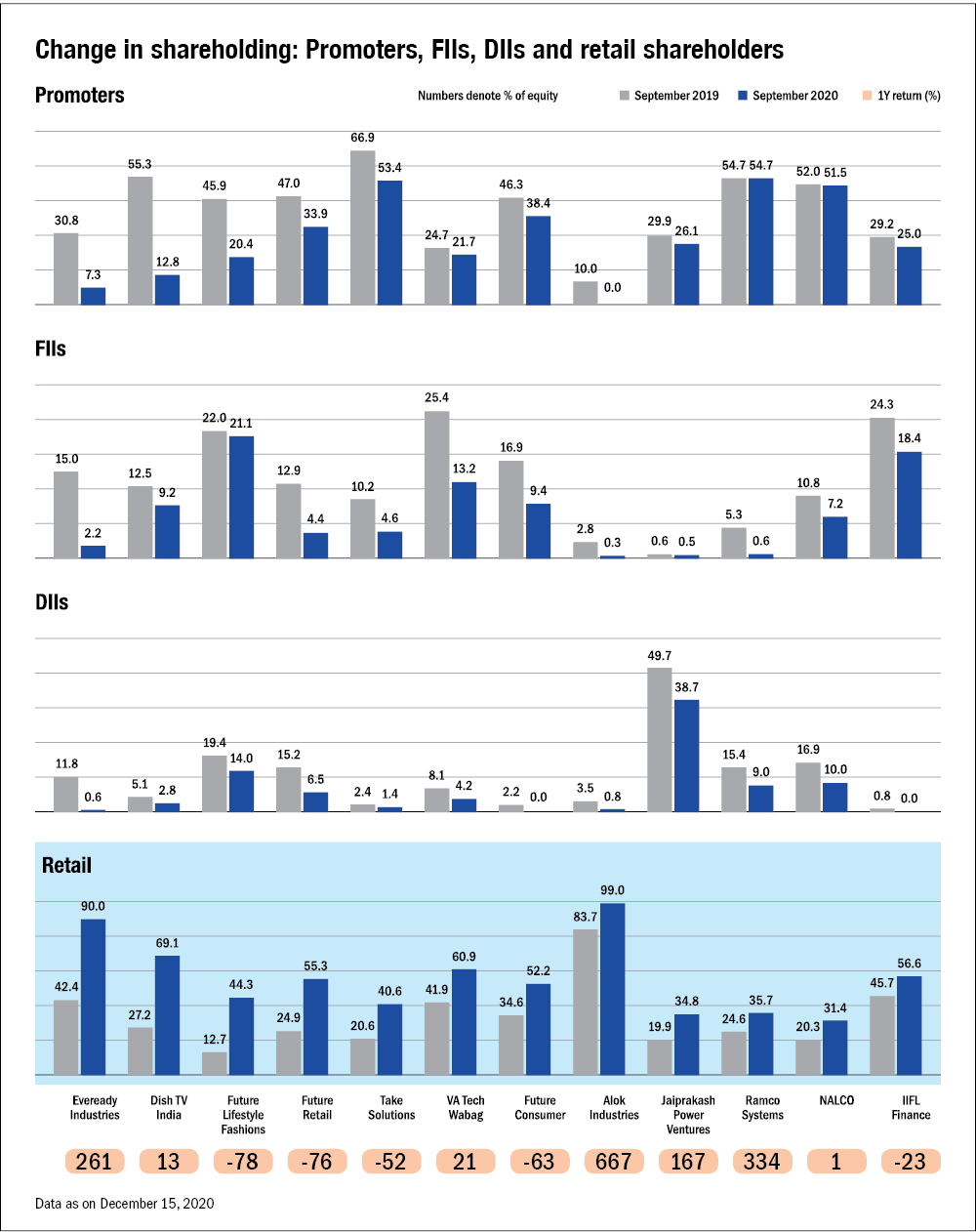
Foreign institutional investors (FII) and domestic institutional investors (DII) are another class of investors. Their investments are backed by in-depth research into a company's fundamentals. They also conduct meetings with the company's management to get more details about the company and therefore, they often have more information about the company than an individual. Thus, tracking the shareholding patterns of these well-informed investors goes a long way in making your investment decisions. However, it appears that retail investors often do the opposite. The table mentions companies in which promoters, FIIs and DIIs have reduced their stakes but retail investors have raised theirs.
Why do retail shareholders get trapped?
Retail investors often take their investment decisions based on the share price instead of the fundamentals. They tend to buy what looks 'cheap' and get influenced by the news around a company. They often see a large fall in share price as an opportunity. However, such investments often end up becoming value traps. A huge price decline may not always be due to a temporary issue but also due to a permanent dent in the company's prospects. Also, a sudden surge in the stock price attracts retail investors. They then invest in such a company, without paying much attention to its fundamentals. Curiously, the lower the ticket size of the share, the more interested retail investors become.
All these are wrong reasons to buy a stock. A stock should be bought because the fundamentals of the underlying company are robust. Tracking the activity of promoters, FIIs and DIIs can be a useful input in determining this.
Ask Value Research 
 New episodes every Friday











 New Process Alert
  Seems like you've uploaded a wrong QR code. Please upload the QR code downloaded from MF Central platform.


