


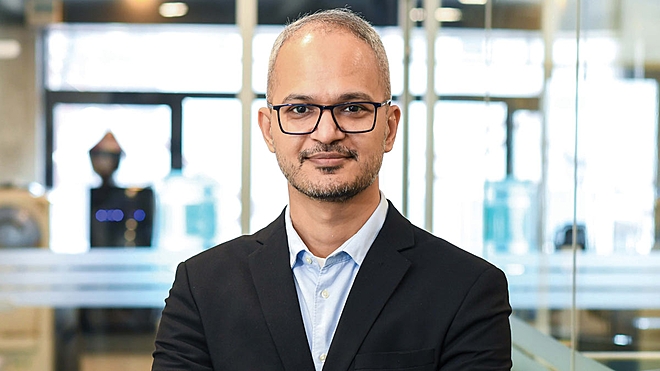
 Photo: AMC
Summary: Four months into running DSP Value Fund, Abhishek Singh has made one big change: a sector his fund had avoided now fills about a third of the portfolio. This interview covers how he values businesses without forecasting growth, why he treats cash as an option rather than a view, and how he sizes global bets after a holding that rose about sevenfold. It also covers where he is still undecided on Indian IT, and the habits he builds to avoid holding on for too long.
Summary: Four months into running DSP Value Fund, Abhishek Singh has made one big change: a sector his fund had avoided now fills about a third of the portfolio. This interview covers how he values businesses without forecasting growth, why he treats cash as an option rather than a view, and how he sizes global bets after a holding that rose about sevenfold. It also covers where he is still undecided on Indian IT, and the habits he builds to avoid holding on for too long. Four months into running DSP Value Fund, Abhishek Singh has done the one thing the fund had never done. He has bought banks, and bought them in size: 35 per cent of the portfolio, from almost nothing. He explains why he does not forecast growth, why cash is a call option and not a market view, what a seven-bagger memory stock taught him about sizing, and why he still cannot decide whether Indian IT is cheap or finished. The Fund DSP Value Fund was launched in December 2020 and manages about Rs 2,225 crore. It is a value-oriented fund with a mandate that most peers do not use: it can hold foreign stocks, and until recently about a fifth of the fund sat in US, Chinese, Japanese and European names. It can also sit in cash. The fund’s benchmark is the Nifty 500 TRI. Abhishek Singh took charge on May 16, 2026, succeeding Aparna Karnik, who had run it since May 2022. Over three years, the fund has returned 15.4 per cent a year against 9 per cent for the index, with a beta of 0.66. It holds a five-star rating from Value Research. The Manager Abhishek Singh is Vice President, Equity Investments, at DSP Mutual Fund. He trained as an engineer at IIT Kanpur and took a management degree at IIM Lucknow. Before DSP, he worked in systematic and proprietary trading and structured products at Edelweiss Capital, Kotak Securities and Kotak Mahindra Investments. At DSP, he ran the Large Cap Fund from June 2022 to May 2026, is a named manager on the Equity Savings, Conservative Hybrid and Aggressive Hybrid funds, and has run the Value Fund since May 2026. He has published his investment and valuation frameworks on DSP’s website, and writes in the fund house’s quarterly publication, ‘The Transcript’. He describes himself as an intrinsic-value investor who does not forecast. The fund held 15 per cent in cash when we spoke, and ran closer to 20 per cent before that. Macro is not the worry, you say. Then why the cash? I do not think of myself as a macro investor. Cash is a residual. You try to find enough ideas that pass your risk and return filters, and whatever is left over becomes cash. The market segments I think will contribute if markets do well, we already own enough of. I don’t have a positive view on the rest, which has done well. That shows up as cash. I don’t spend much time thinking about it. If I find three or four good ideas tomorrow, it comes down on its own. It has already come down from 20 per cent. People worry about opportunity cost only when markets do really well. If markets fall another 20 per cent, nobody will call cash a lost opportunity. Cash is a call option on opportunity. The broader market has been flat for two years, so anyone who raised cash two years ago has lost nothing, and some of it sits in arbitrage earning a return. If the expected return on your ideas falls below what cash earns, cash is the better option. I have never shied away from it. Your published framework says you do not forecast growth. What do you do instead? I do not think management can forecast their own businesses over the medium term either. So the only way to operate is to work out a conservative value for the business. Three inputs go into valuing anything:
 New Process Alert
 Seems like you've uploaded a wrong QR code. Please upload the QR code downloaded from MF Central platform.


