





October 25, 2019, was the day that most shareholders of two leading telecom companies-Airtel and Vodafone-would never forget. On that day, the Supreme Court gave its verdict on a long-standing dispute in favour of the Indian Government and ordered both the companies to pay a combined sum of more than 60,000 crore as spectrum usage charges. Following this, Vodafone's share price crashed by about 36 per cent and the company posted the loss, which was the highest ever reported by an Indian company.
The event undoubtedly caused shockwaves in the Indian corporate world, leaving investors on edge. Amid all this destruction of wealth, the question that arises is whether there is any way to avoid investing in such companies. And the answer is an absolute YES.
The secret of avoiding such mishaps lies in a relatively obscure number called 'contingent liabilities,' which are hidden deep underneath all the fancy numbers reported at the top of a company's annual report.
What is a contingent liability (CL)?
The dictionary definition of the word 'contingent' means depending on something that is not certain. In very simple words, a contingent liability is a debt that may need to be paid in the future and the catchword here is 'may'. In the case of a normal liability, the amount to be paid is generally ascertainable. For example, if a bank loan has to be repaid after five years, then there is absolute certainty about two aspects: firstly, whether money has to be paid or not and if the answer to the first question is yes, then the amount that needs to be paid.
But when it comes to a CL, both these aspects are somehow unclear. For example, if there is a dispute with tax authorities, the certainty associated with the regular tax liability will be missing because it is very difficult to predict the outcome of a case. In fact, even if the company loses the case, it would not be easy to estimate the amount to be paid.
Why do companies have CLs?
Usually, accountants, who are primarily involved in keeping track of what has actually happened, are not very comfortable with probabilistic events that may or may nor occur in the future. In a bid to ensure that the books of accounts reflect only the events that have already occurred, accounting rules (IND AS 37 to be more specific) prohibit companies from recognising liabilities before their materialisation. In fact, in some cases, the rules don't even allow companies to make any provision for these liabilities.
Here we also need to shed light on what a provision is. A provision can be considered as a small bank account where we save up for a rainy day. In this activity, a company sets aside some money for unforeseen circumstances. So, in a way, a provision counteracts the effect of a contingent liability. If a company feels that there is a possibility of a future liability a.k.a a contingent liability, then the company has an option to set aside some money and in that way, even if the liability materialises, the money from the provision can be used to meet the required payments.
Examples of CLs
CLs may be the outcome of several situations, such as guarantees given to other entities, pending disputes regarding statutory payments ( taxes and other fees) or litigation over any payments due to vendors. At times, there are certain operational reasons, such as giving consumers a warranty (because the amount liabilities would depend on how many defective claims are received) or employee dues towards gratuity (a payment made to employees who have worked with a company for more than five years. It is contingent because the amount of gratuity is calculated based on the number of years the employee has been associated with the company at the time of resignation, which is an unforeseeable event).
What should investors do?
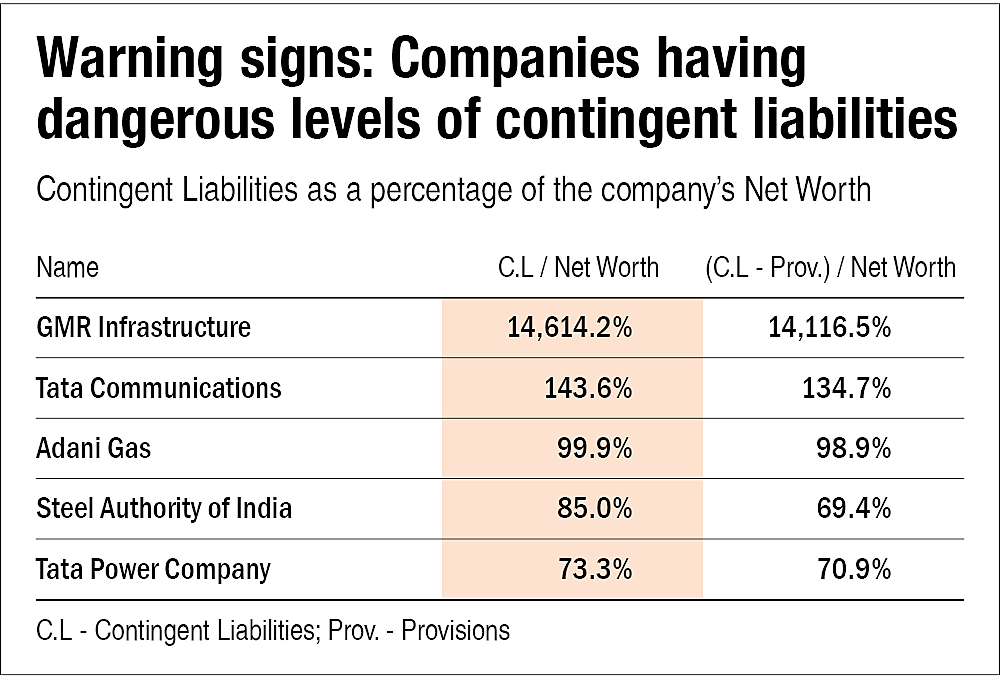
Investors need to first see how much contingent liabilities are disclosed in the annual report of a company and then compare that amount with the total net worth of the company. This would give them an idea about how big the contingent liabilities are as a proportion of the amount of equity. Ultimately, it will help investors predict what would happen if these contingent liabilities materialise. Now the next important thing is to check the extent to which the company has provisioned for this contingent liability. This is because even if a company has a higher amount of contingent liabilities but it has already provisioned for a large chunk of these contingent liabilities, then it would not have any meaningful impact on its bottom line during the materialisation of these liabilities. More importantly, if this contingent liability does not materialise, this would be a significant trigger for the company to get re-rated because it would transfer all the money that has been held as provisions to its profits, which would give a nice one-time boost to its earnings.
How to interpret CLs?
While the quantum of CLs is definitely important, the nature of the CLs should also be taken into consideration. For instance, a CL arising because of a performance bank guarantee in an EPC company is not necessarily a bad thing, as it is normal in the course of business. But if there are contingent liabilities on account of loan guarantees given to non-subsidiaries or related parties, that could be a concern. This is because of the asymmetric nature of the payoffs, which defy the fundamental laws of finance i.e the higher the risk, the higher the expected returns. In this case, if the borrower company performs well, then its shareholders will reap all its benefits but the shareholders of the guarantor company won't get anything. But if the borrower company performs poorly and defaults on its loan obligations, it would then completely fall on the guarantor company to make repay the unpaid money. So, the guarantor company's shareholders bear all the risk, while the guarantee company's shareholders take all the rewards. This is a classic example of a corporate governance issue.
Bouncers: Unrecognised CL and estimates
Now if an investor thinks that all he/she has to do is to read an additional table in the footnote, he/she could still be in for a shocker. That's because there is another category of CLs which are not mentioned in the usual table. The logic is that the probability of this category of CLs materialising is so remote that it's not even worth classifying them as CLs in the first place. In these cases, the company discloses them in the footnotes but doesn't add them to the table, along with the other higher probability CLs.
And finally, investors need to realise that the values given in the annual report are just the management's estimates. It means there is a possibility of these numbers being inaccurate. For example, Vodafone only recognised about 7700 crore in its 2018-19 annual report, but its actual liability after the Supreme Court's judgment came out to be 44,160 crore.
Takeaway
Before investing, investors need to thoroughly research the company. Since CLs are not mentioned in the balance sheet, a cursory glance of the financial statements is not going to give the true picture of any nasty surprises that may arise in the future. There is simply no substitute for getting your hands dirty. A little effort initially will go a long way in reducing avoidable mistakes in the future.
Ask Value Research 
 New episodes every Friday









 New Process Alert
  Seems like you've uploaded a wrong QR code. Please upload the QR code downloaded from MF Central platform.


