




Investors love to see cash on the balance sheet. Sure, there are advantages of high cash balances. When a liquidity crisis hits the markets - like the one in September 2018 - a company with high cash reserves is less likely to be impacted. A high-cash company can sail through an economic downturn while protecting its expansion plans without any external funding. Besides, it can set a floor for its share price in a tough market by buying back its stock.
But cash also has its downside. It is probably the lowest-yielding asset that a company can have. It has high opportunity costs; one can expect a maximum return of just around 4 per cent from it. As Warren Buffett said, "Today people who hold cash equivalents feel comfortable. They shouldn't. They have opted for a terrible long-term asset, one that pays virtually nothing and is certain to depreciate in value." Also, a high level of idle cash is a drag on the return on equity (ROE), which is defined as net income divided by shareholders' funds. Higher cash bloats the denominator - shareholders' funds - and pulls the ratio lower. This is especially relevant for companies in mature industries. Although these companies are able to churn out large doses of cash periodically on the back of their strong business models, there is little use of this cash because of the absence of any high-yielding projects.
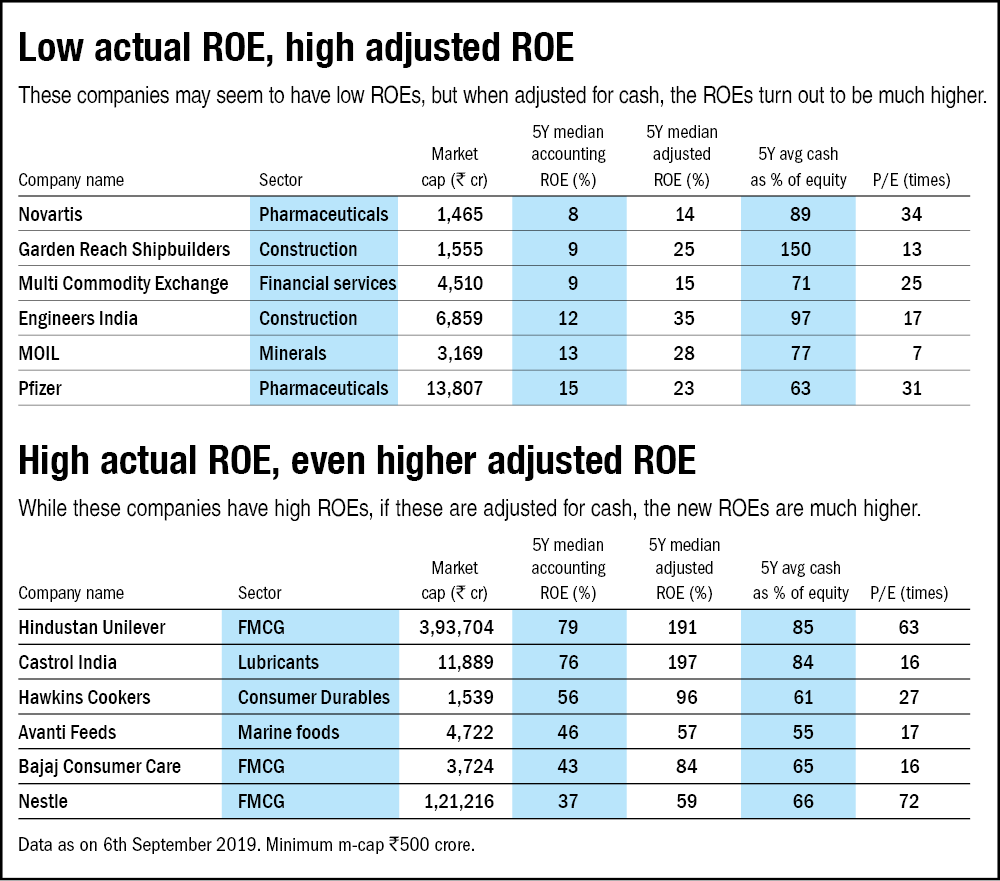
The tables below list companies with net cash equivalents (including short-term investments) of more than 50 per cent of net worth (five-year median). The first list comprises those companies that seem to have low ROEs but their cash-adjusted ROEs are actually quite high. This indicates that they have low growth prospects and are unable to find any earnings-accretive projects to invest in. In addition, they have chosen not to return the cash to investors in the form of dividends or buybacks. The second list, on the other hand, comprises companies with high ROE. These companies are mature and have been giving good returns to investors. However, their investors are deprived of even higher returns due to the cash on the books.
How we arrived at these lists
The cash-adjusted ROE has been calculated in the following manner:
- Deduct profit after tax (PAT) by 4 per cent (post-tax cash yield).
- Deduct net worth by 80 per cent cash (20 per cent assumed to be cash left for working-capital requirements)
- Divide adjusted PAT by adjusted net worth to arrive at the cash-adjusted ROE.
Ask Value Research 

 New episodes every Friday








 New Process Alert
  Seems like you've uploaded a wrong QR code. Please upload the QR code downloaded from MF Central platform.


