




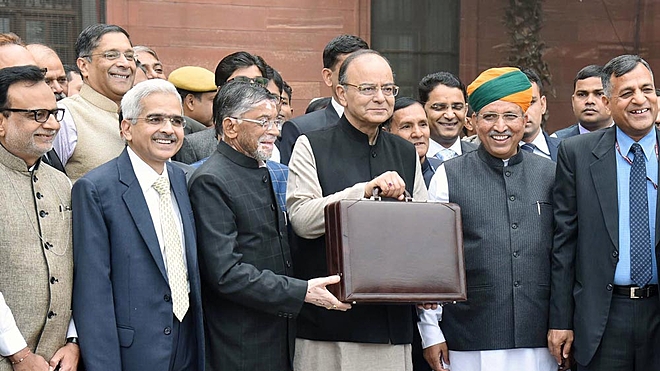
In the 53 months and four budgets that have gone by since Arun Jaitley presented this NDA government's first budget, the most significant thing that has happened is that the budget has become a lot less significant.
This is not incidental. Rather, it's the direct result of one of the most challenging goals that the government had set itself in those early days--that of implementing GST. Perhaps three decades after it was first talked about, GST has finally become a reality. The impact on what the budget means for businesses is huge. Whereas earlier, ever since the Union Budget started being presented, the changes in indirect taxation were a major aspect of the whole exercise. In fact, for a vast majority of Indians, even middle class ones, indirect taxes were more important than income tax.
During the 90s, this became somewhat less important. However, now, in almost full GST'ed economy, the budget is utterly irrelevant to indirect taxes. The GST council meets every month, and changes are announced and implemented on a continuous basis. Even so fundamental a decision as the enhancement of the qualifying revenue below which business do not have to pay GST does not have to wait for the budget.
Of course, GST is still in the fine tuning stage and there is a fairly high volume of changes right now, both in the goods and services' slabs as well as processes. In a year or so, even this will trickle to nothing and the budget will have nothing whatsoever to do with indirect tax. In fact, since monthly GST revenues are also revealed on a continuous basis, even the previous years' indirect tax revenue data (revised estimates) are substantially known before the budget. Stability of indirect taxes is of huge importance to businesses. Even though the switchover to the GST and the fine-tuning has been an unstable period, it's leading to more stability of taxation down the road.
For the budget, that basically leaves direct taxes and most importantly, the expenditure side of the budget, which is as it should be. Actually, when you look back at what's been happening, big changes in other areas, of the sort that would have waited for a budget earlier, have been coming a la carte, so to speak. In the last one year, by far the biggest regulatory change that can have a financial impact on the individual saver came just a about month ago, in early December. This is a personal taxation change, just the kind of thing that would have waited for the budget in the old way of doing things.
I'm referring of course to the abolition of tax on NPS withdrawals. The fact that NPS withdrawals on retirement were taxable while EPF and PPF were not was always an absurd anomaly in the taxation of personal savings. At least as far back as 2009 or 2010, there has been a rumour before every budget that this would be fixed in the budget. That this finally happened less than two months before a Union Budget and unconnected to it underscores the declining utility of awaiting the big event with bated breath.
Still, that's not to say that the annual marquee has no relevance to personal savings and finance. There are plenty of issues that can be tackled in the budget alone. The biggest is the nature and kind of long-term and retirement savings that people are doing. These are still largely driven by the kind of tax-breaks available and are also subject to the taxation of returns. The long-awaited NPS tax break has brought back focus on the imposition of long-term capital gains on equity investments that Mr Jaitley brought in last year. This tax is unfair. The fact that it is not graded according to the length of the investment and lumps everything from 1 year upwards as 'long-term' means that its impact on saver behaviour is quite counterproductive.
Of course, the fact that one can legitimately expect the coming budget to be an 'election budget', whatever that means, means that there will probably be no googlies in it, but then again, who knows. Sometimes, straight balls can also spin like googlies.
Ask Value Research 
 New episodes every Friday

 New Process Alert
  Seems like you've uploaded a wrong QR code. Please upload the QR code downloaded from MF Central platform.


