



Certain sectors in the market, such as FMCG, IT, and pharma, are termed 'defensive'. They are called so because they fall less in bear markets. Many investors like to seek refuge in such sectors when the market falls. But how lucrative is it to invest in such sectors? After all, if they just limit the downside and don't provide much upside, what's the point in investing in them?
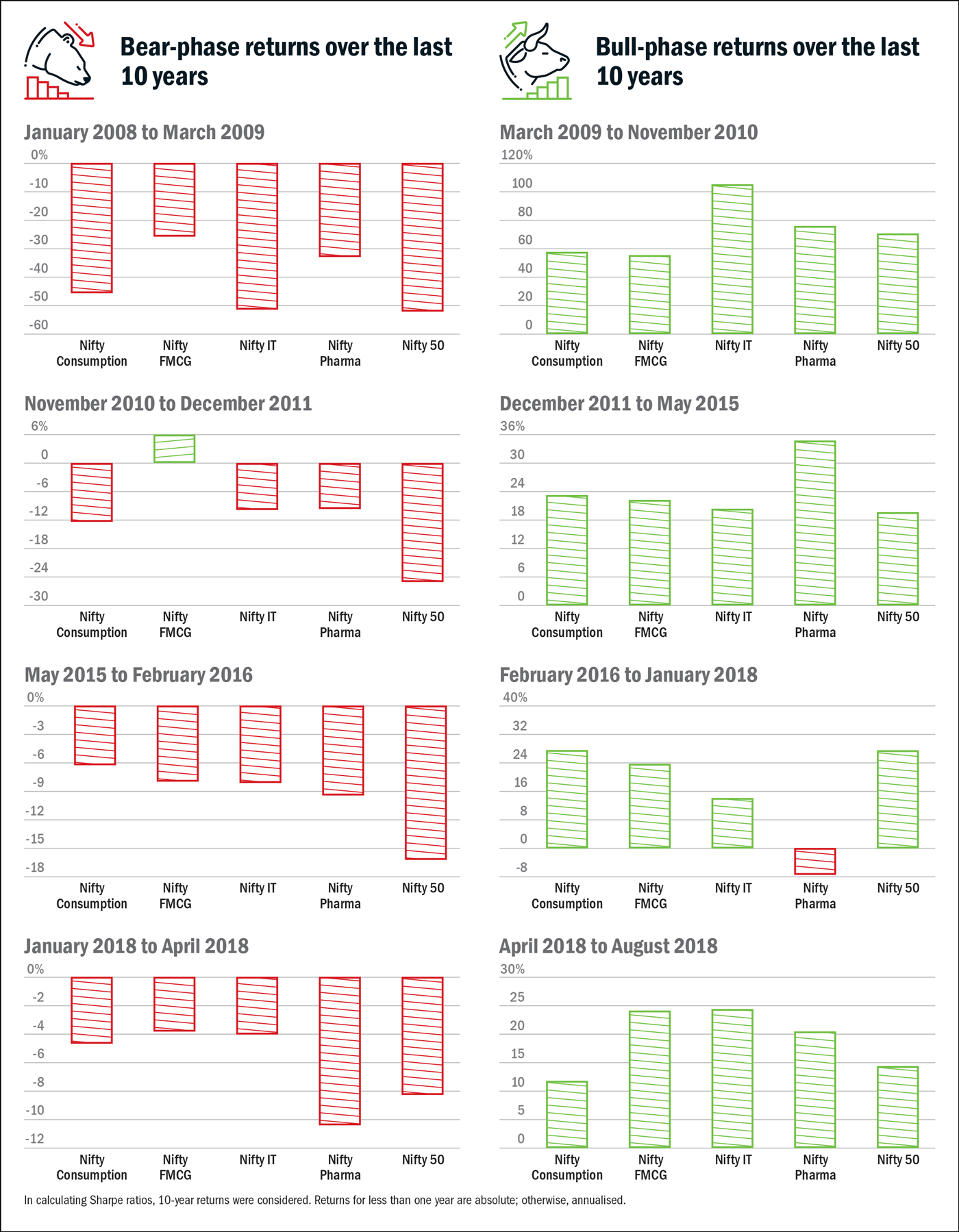
We set out to see how defensive 'defensives' really are and whether you lose on the upside by investing in them. Here are our observations:
1. Over the long term, defensives have beaten the market hands down (see the first and second charts).
2. In terms of the Sharpe ratio, which measures risk-adjusted returns, defensives outscore the Nifty 50. This means that for the same risk taken, defensives provide better returns than the market. The risk-free rate used in our calculation is 8 per cent. (See the third graphic.)
3. The next eight graphs show the performance of defensive sectors against Nifty 50 in various bull and bear markets. Here too, defensive sectors tend to outperform the market.
The verdict is clear. Defensives are indeed so. They limit the downside in your portfolio but that doesn't mean lack of an upside. The upside is decent as well. The reason for this is also quite obvious. Defensives belong to the evergreen sectors and have demand visibility. They may also belong to popular sectors that seldom sees a shortfall in investor interest.

Ask Value Research 

 New episodes every Friday



 New Process Alert
 Seems like you've uploaded a wrong QR code. Please upload the QR code downloaded from MF Central platform.


