





Matrimonial portals, like Matrimony.com, are the new way of connecting prospective brides and grooms. They also provide a wide variety of options such as community-based filters, birth-chart matches and region-wise matches. They also provide allied services like photography, venue, etc. Matrimony.com listed on the Indian stock exchanges in 2017. It is the only listed company in its sector.
The business model
Matrimonial portals earn their revenues in the following ways:
Matchmaking services: These are the primary source of revenue for matrimonial portals. Matrimony.com provides differentiated matchmaking services with customised offerings: basic matchmaking services under BharatMatrimony.com, community-based matrimony services under CommunityMatrimony.com and personalised matchmaking service under EliteMatrimony.com.
Marriage services: These are other marriage-related services. For instance, Matrimony.com's MatrimonyDirectory.com includes listings of wedding-service providers. Matrimony.com also has different portals for photography, apparels, venue selection, etc.
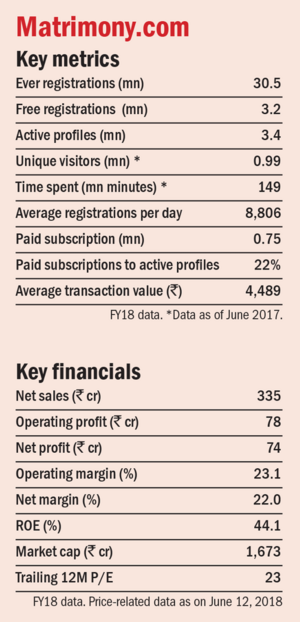
Key metrics
Here are some key determinants of this business:
Ever registrations: It is the total lifetime registrations till date, including free registrations.
Free registrations: These are non-paying users who have registered during the year.
Active profiles: Those users who have logged in at least once during the last 180 days.
Unique visitors: Unique users visiting the portal during a period.
Time spent by users: If users are spending more time on a portal, it indicates superior content.
Average registrations per day: This is the average number of users that get added on a daily basis.
Paid subscriptions: This is the most important metric. It tells us how many users are seriously looking for a match and are contributing to the portal's revenues.
Paid subscriptions to active profiles: This is the ratio of active users who have converted into paid users.
Average transaction value (ATV): It is the average revenue earned per user (total subscription amount divided by number of paid users). A high ATV indicates increasing demand for premium services and the company's power to pass on the costs to its consumers.
This article is part of a series on how to assess new business models.
Ask Value Research 
 New episodes every Friday


 New Process Alert
  Seems like you've uploaded a wrong QR code. Please upload the QR code downloaded from MF Central platform.


