




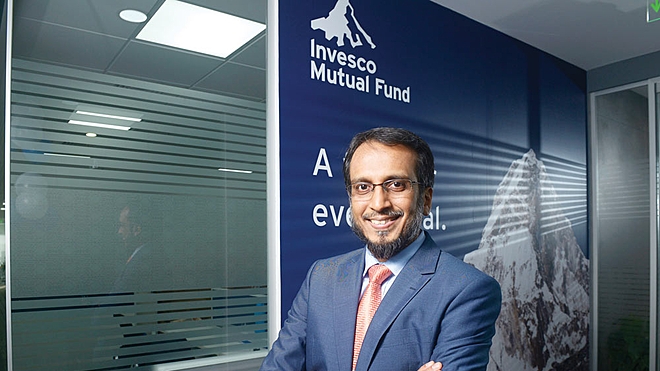
With over 23 years of experience in the Indian equity markets, Taher Badshah has seen multiple market cycles. Markets may have moved up, down or stayed flat, but that hasn't impacted his investing style: owning good-quality stocks at reasonable valuations. In an interview with Kumar Shankar Roy, he talks about the impact of rupee depreciation and rising crude prices on his portfolio and mid-cap valuations after the recent market fall.
It's been more than a year since you joined Invesco Mutual Fund. So, how much have you had to change your style? Have new systems and processes brought any change in your focus?
At Invesco, too, the focus continues to remain on buying good-quality businesses at reasonable valuations, which one can hold comfortably for a reasonable period. To that extent, for me, it is a continuation of style and has not necessitated any major transformations. Besides this, Invesco as a fund house has always been significantly process-driven, with considerable focus on internal research capabilities. This has been to my comfort. Being 'true to mandate' has been an important part of the Invesco investment philosophy and therefore stock selection and portfolio construction are considerably influenced by individual scheme mandates.
There are a lot of headlines about rupee depreciation and oil on the boil. Do they have any serious effect on your fund portfolios? Should these risks be hedged?
We do own a few businesses which are levered to oil prices and currency and some of those stocks have displayed volatility in the recent weeks. However, we do not think it has created any meaningful impact on the overall portfolio performance.
From an equity-market point of view, domestic inflows have remained strong for many months now. But foreigners continue to sell. What are they missing about the Indian equity story?
FPI [foreign portfolio investors] flows are significantly influenced by global market considerations and alternate opportunities. Hence, over short periods, divergence in trends between domestic and global flows is not entirely unexpected. From our domestic-market perspective, the rising trend in domestic flows will likely cushion volatility as the nature of these flows is stickier and long term in nature.
You manage a popular contra fund. Can you tell us about the fund's philosophy?
Invesco India Contra fund follows a value-oriented strategy, which avoids expensive valuations. Given its value bias, it prefers stocks that are in a turnaround phase and are trading below their intrinsic fundamental value or intrinsic growth and this drives the broad stock selection and the overall construction of this portfolio. Also, apart from the top holdings by weight, i.e. stock selection, the fund also focuses on its top overweight positions vis-a-vis the benchmark as its alpha engine.
For Invesco's funds, how did you handle the SEBI recategorisation and rationalisation process in terms of rejig? What are the gaps in Invesco's equity portfolio which we might see being filled in the days to come?
For Invesco, SEBI's categorisation exercise has been very smooth. In fact, post the SEBI regulations, we have identified hybrid and small-cap categories as the gaps in our bouquet of products. We intend to fill them.
Would you agree that the recent reclassification of funds as per new SEBI guidelines lends large-cap and mid-cap funds limited scope of outperformance over the medium term due to the limited stock universe?
While the universe for these categories is limited, I would like to think that hereon, apart from stock selection within this universe, portfolio construction and sector positioning will likely play an important role in differentiating one fund from another.
Are multi-cap funds best placed, with no restriction and flexibility for the fund manager?
One can say so. But having said that, there could be limitations in terms of flexibility to move across the market spectrum to avoid conflicts/overlaps with the other large- or mid-cap funds.
Most of the equity funds managed by you are fully invested. Is there a cash-call strategy for the funds? Are overall market valuations important to you when you are looking for stocks for your funds?
Barring Invesco India Dynamic Equity Fund, which is mandated to take cash calls by design, all our other strategies generally require us to be fully invested at all times and we do ensure that cash levels within those strategies do not exceed 5 per cent. Overall market valuations do serve as a guidepost but most of our portfolio decisions are bottom-up and based on individual stock-level considerations.
In terms of corporate earnings, every quarter starts with hope, and then some sector, especially banks, doesn't perform well. What is holding back all the corporates from reporting good earnings?
As we are aware, GST, demonetisation, implementation of RERA have been one-off events in the past 18 months, which have made the overall corporate environment challenging. Besides this, the weak investment and credit cycle and the recent surge in commodity prices, especially oil, too have held back system growth. As we move over some of these issues and as India integrates more tightly into the global growth cycle, we would expect more uniform corporate-earnings recovery.
How do you view consumption-oriented stocks for your fund portfolios? Have they become expensive?
Consumer discretionary as a segment is an important part of many of our investment portfolios. While this is a diverse segment by itself, for us it largely comprises stocks in the auto/auto-ancillary, retail and consumer-staples sectors. In a few cases, we have seen valuations expand in the recent past, though they have been well-supported by strong underlying business models, which have an ability to display longevity and potential to compound earnings.
Mid- and small-cap stocks have corrected quite a bit in the last few days. Are you a buyer at these levels, or are you waiting for lower entry points?
The recent correction in mid caps does present itself as an opportunity, albeit selectively, and in pockets where the valuations have turned more reasonable. However, I do not think that valuations out here are still very comfortable for the entire mid-cap segment per se despite their promises for better growth.
Amidst a subdued equity market and a volatile debt market, what is your advice to investors?
Fixed-income market volatility in recent times reflects the anxiety with regards to the direction of inflation and the interest rates. And yes, some of these concerns have also spilled over to equity markets.
In our view, over the next 12-18 months, investors would do well to keep return expectations modest and brace for relatively higher volatility. In this backdrop, we would recommend investment strategies or funds that emphasise valuations or have the flexibility to alter asset allocation in line with changing market dynamics.
Ask Value Research 
 New episodes every Friday

 New Process Alert
  Seems like you've uploaded a wrong QR code. Please upload the QR code downloaded from MF Central platform.


