




Your savings account deposits are fetching lower returns. It was SBI which first cut the rate to 3.5% from 4%. Now, a bevy of banks including HDFC Bank, BoB, PNB, Axis Bank, Yes Bank, Union Bank, Indian Bank and Dena Bank have taken similar measures. For someone with Rs 10 lakh in savings bank deposits, the interest drop from 4% to 3.5% means a interest loss of Rs 5,000 per year. With savings bank deposit rates clearly headed down, there is now a strong case for savers to look at similar offerings from mutual funds. Value Research spoke to experts from the fixed income side to understand the nuances.
Superior returns
Debt fund investors assume both credit risk and interest rate risk (the risk of bond prices falling when interest rates rise) and are hence compensated by higher returns.
Notwithstanding the current scenario, Bekxy Kuriakose, head - fixed income, Principal Pnb Asset Management Company feels that savers & investors should have flocked to debt funds a long time back. "One would say the case was always there given the superior return, tax and liquidity benefits offered by debt funds. Broadly the investor can look at ultra-short term, short term and dynamic categories within debt funds."
Returns from bank fixed deposits are interest income and as such have to be added to the investor's normal income. Since many investors are in the top (30%) tax bracket, this takes away a large chunk of their returns. "Banks also deduct TDS on interest income from fixed deposits. The tax rates are similar for debt funds held for less than 36 months (though TDS will not generally be deducted). However, for debt funds held longer than 36 months, returns are classified as long term capital gains and are taxed at 20 per cent with indexation," Saravana Kumar, CIO, LIC MF says.
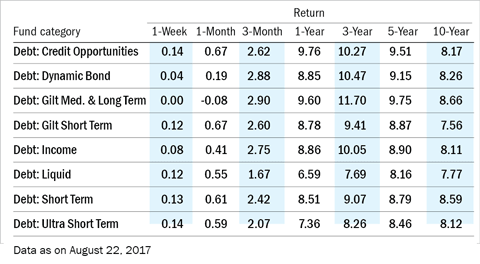
Debt funds comes in 5 broad types - liquid fund, short term fund, income fund, dynamic bond fund and gilt fund.
Liquid funds invest in very short term debt and money market instruments. This is among the ideal options for people who would like to invest idle savings with relative liquidity and stability.
Short term funds primarily invest in short term debt instruments. These funds are ideal for investors who want to benefit from short term interest rates and have short term investment horizon.
Income funds aim to generate regular and steady income for the investors by investing in medium to long term debt and money market instruments. These funds aim to benefit from falling interest rates by providing price appreciation opportunities.
Dynamic bond funds, as the name suggests, change their exposure in short and long term papers depending upon the expected interest rate scenario in the near future with an objective to earn capital gains. These funds are mostly preferred when investors expect a volatile interest rate environment.
Lastly, gilt funds put money in the government securities which are considered to have the least credit risk as they are backed by the government.
Horses for courses
If you are planning to generate regular income, a fixed income fund could be considered. Earning a monthly income from investments is one of the most important needs of many investors, particularly for retirees whose pension is not sufficient.
Depending on the investment purpose, one should select the product. Saravana Kumar says investors could look at MIPs. "These MIP funds are fairly stable because they invest around 80% of their corpus in debt options such as bonds and corporate deposits. The balance 20% is invested in equities to help the fund run ahead of inflation. The result is stable growth which outperforms the returns from debt funds but carries far lower risk than an equity fund."
"In case you have suddenly received a windfall of money and are yet to decide where you wish to invest, you can consider a liquid fund for the time being. A liquid fund is a good substitute to consider for a savings account to park your funds," he adds.
Mahendra Jajoo, Head- Fixed Income, Mirae Asset MF says: "Lower savings rate will perhaps require investors to look for other attractive alternatives. With near term outlook of a sustained pause by RBI on rate and a likely upward movement in inflation combined with likely commencement of liquidity withdrawal by Fed, bond markets may witness some volatility. As such, we believe dynamic bond fund offer an optimal solution in such an environment."
For short term goals (2-3 years) like planning to buy a car, one can start an SIP (Systematic Investment Plan) in a short-term debt fund and keep adding to the fund. Though bank deposits are the preferred instrument to save for short-term goals, debt mutual funds can be a better alternative. They are more tax-efficient if held for more than three years and can even generate higher returns for investors.
Avnish Jain, Head - Fixed Income, Canara Robeco Mutual Fund says that debt funds have a whole range of products to offer to a discerning investor.
"Ultra-Short term / short term funds have lower average maturity with focus on providing returns via higher portfolio yields. Dynamic/gilt fund have higher duration with focus on capital gains through active duration management. Retail investors could look to invest in debt funds depending on their risk-return profile and investment horizon," remarks Jain.
Ask Value Research 

 New episodes every Friday


 New Process Alert
 Seems like you've uploaded a wrong QR code. Please upload the QR code downloaded from MF Central platform.


