





Public-sector banks (PSBs) have been suffering from non-performing assets (bad loans) and low profitability for the last few years. They haven't just given poor returns to their investors but they have also reduced their investors' say in them. This has happened due to continued equity infusion.
As per the RBI's guidelines, unlike other companies, banks also have to maintain a minimum level of net worth, which is in proportion to the loans disbursed by them. With more infusion of new equity in PSBs, existing shareholders' proportionate holdings have fallen substantially.
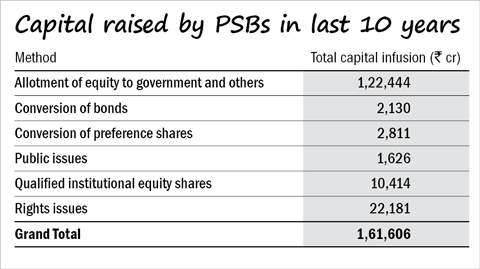
In the past 10 years, Rs 1,61,000 crore has been infused into PSBs through various mechanisms (see the first table). A major share of this has come from the Government of India.
The second table mentions listed PSBs and the per cent of dilution in them. This dilution has happened in the range of 20 per cent to as high as 80 per cent. To show the extent of dilution, we have taken a hypothetical scenario. We have calculated the current value of the stake of a shareholder who owned 10 per cent of the total equity of a listed PSB ten years ago.
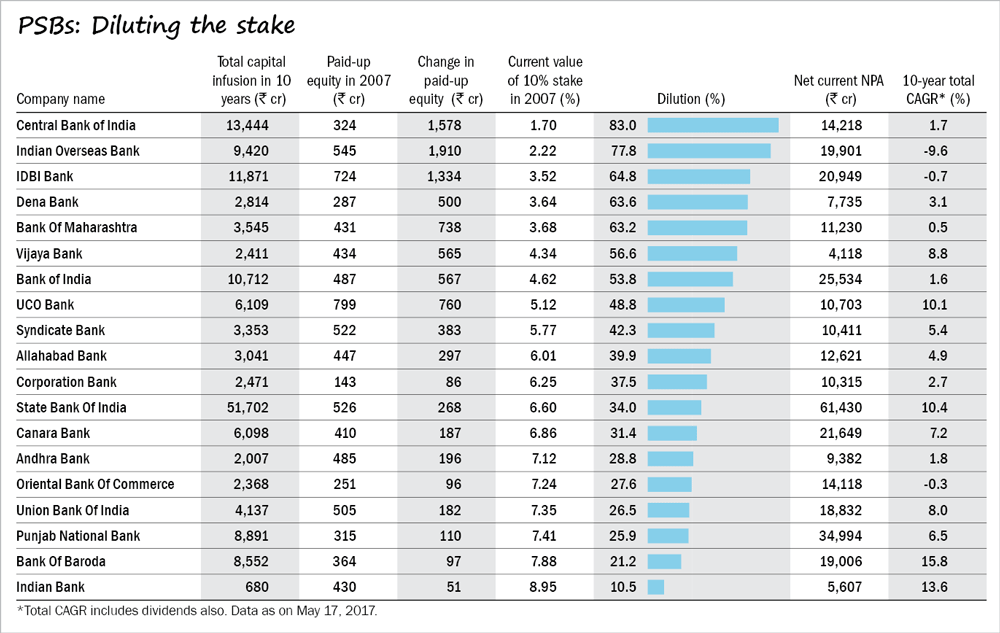
Are we anywhere near the end of the problem? High net NPAs of PSBs portend that further dilution of equity is very much probable.
Ask Value Research 

 New episodes every Friday


 New Process Alert
  Seems like you've uploaded a wrong QR code. Please upload the QR code downloaded from MF Central platform.


