





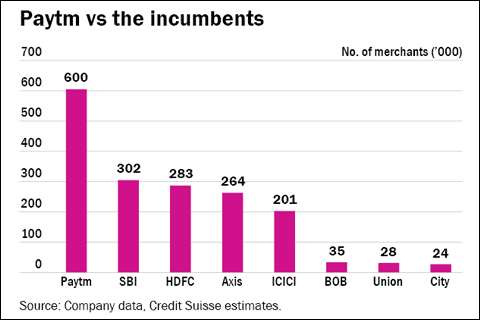
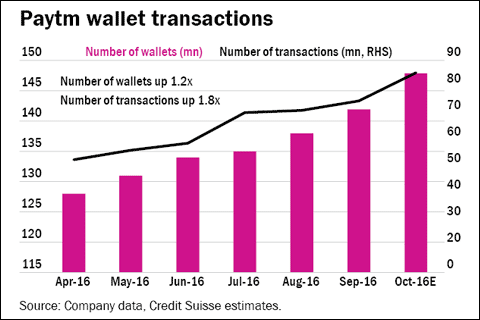
Every action has some unintended consequences. The removal of `500 and `1,000 notes as legal tender has forced an increase in the use of digital payments across India wherever the required infrastructure exists. Even earlier, the use of 'wallets' was increasing rapidly. Data from Paytm, largest among them, reveal that aggressive marketing, low or no transaction cost and a simple mobile interface had led to the rapid adoption of digital wallets.
The numbers have only multiplied since November 8. It can be expected that even when cash will become more easily available, the use of digital payments will remain sticky. BCG, in a study, had forecast that non-cash payments in India would rise from 22 per cent in 2015 to 59 per cent in 2025, with digital making up 37 per cent. Perhaps the time frame will be compressed meaningfully.
India's digital infrastructure: Ahead of the rest
India has developed a unique digital infrastructure based on the biometric-based identification system created by Aadhaar. Called the 'India Stack' and available under the Open API policy to application developers, it allows creation of financial applications that can rapidly scale without requiring personal verification of identity.
The creation of National Payment Corporation of India (NPCI), set up jointly by the RBI and the Indian Bank's Association, has led to the setting up of United Payments Interface (UPI), which offers architecture and a set of application-programming interface (API). The UPI setup stitches all services - IMPS, automated clearing house to RuPay - into a common platform. UPI allows the use of a single identifier like email ID, mobile or Aadhaar number to make payments. The open architecture provides access to all payment service providers - banks, payment banks, financial technology companies, etc.
While digital payments in the form of credit and debit cards will increase, the largest increase - given the preponderance of cell phones - is likely to be mobile payments. India will likely jump a couple of stages in digital payments, going directly to mobile banking without the wide adoption of 'plastic' and internet banking.
The changing financial-sector landscape
While the tech geek may be all excited about the digitisation of payments, what does it mean to users? Why would someone forego the simplicity, zero cost and anonymity of cash payments and use digital.
From the merchant viewpoint, increased sales, 24×7 access and convenience of handling are the reasons for adoption. Increasingly, as consumers demand digital payments, merchants have to accept them for competitive reasons.
End users can be motivated by the ease of use, no need to carry cash/change and expense tracking.
Widespread adoption of digital payments will allow businesses to go from 'data poor' to 'data rich'. Currently, end-user data on consumption trends are unavailable except at the last point of sale. Here too, data are not 'captured', only informally tracked by the retailer. Understanding consumer requirements and purchasing patterns will allow significant changes in production patterns and tailoring of consumer loyalty programs.
A very significant opportunity that opens up is in the form of financing of trade, small and medium enterprise financing, and consumer financing. Digital tracking of purchase and payment trends can build financial profiles of small businesses not available today. This will bring these businesses to the formal sector and make credit available at a lower cost. One study estimates SME and consumer credit to grow fivefold over the next ten years.
An agenda for payment service providers
A recent study by BCG, in association with Google, has defined a ten-point agenda that payment service providers (PSPs) have to keep in mind to make the adoption successful. The most relevant among them are building for a clearly identified user base, making transactions convenient and intuitive while keeping them safe, building a ubiquitous network, and finding additional revenue streams to keep the costs low.
BCG's survey revealed that 75 per cent of merchants believed that adopting digital payments helped increase sales. This belief can drive growth. However, as more merchants adopt digital payments, relative competitive advantage will drop. Credit cards charge about 200 basis points, while debit-card charges are about half of that. For low-margin categories, unwillingness to pay what amounts to a significant part of margins may deter merchant adoption. Zero merchant discount rate, currently offered by most digital-wallet providers, is perhaps a key reason for digital wallets gaining traction at merchant outlets.
It is imperative that transaction costs to merchants be reduced through additional services that can increase revenues. Developing loyalty programs that offer targeted offers based on purchase history, along with easy redemption options for such programs, is one such possibility.
Disruption
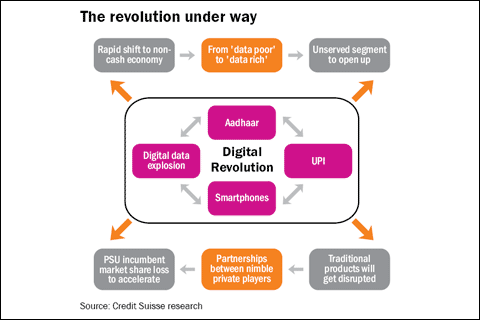
The financial-services space in India has already witnessed significant changes over the years. State-owned banks have consistently lost market share as they have lagged behind in providing services relevant to customers and in the early adoption of technology. Digital payments are set to further change the competitive landscape - payment banks and wallets will reduce the use of traditional bank accounts for consumers, savers will continue to move towards investment products - accelerated by the development of personal-finance management providers and aggregators. Lending, especially to small-scale and small-ticket consumers, will be a high-growth business but will require technology to offer instant credit analysis and disbursal. While markets expand, benefits are likely to be captured by newer players rather than incumbents. A look at the payment-related landscape in India will reveal largely new names. As Bob Dylan sang, the times they are a changin!
This article was originally published on February 03, 2017.
Ask Value Research 

 New episodes every Friday


 New Process Alert
  Seems like you've uploaded a wrong QR code. Please upload the QR code downloaded from MF Central platform.


