 Widely read:


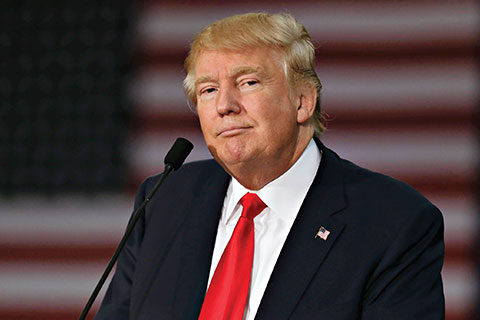
Donald Trump is set to become the 45th President of the United States. And the fact of the matter is that most of the mainstream media in the United States did not see this coming. They all expected Hillary Clinton to win; they backed her all the way; and they expected her to win big time.
Even Indian analysts who for some funny reason had been following the American elections very closely expected Clinton to win. In fact, one Indian economist who likes dabbling in predicting elections even wrote a couple of columns predicting Clinton's win. He and many others have now ended up with eggs on their faces. Their only consolation is that Clinton won a greater share of the popular vote, but Trump won the electoral-college vote, which decides the American presidential elections. It is expected that Trump will get 1.2 per cent fewer votes than Clinton.
One reason now being offered for the media being way off the mark is that most mainstream media in the United States is based out of the East Coast and given that, they were out of touch with what middle-class and rural America was thinking.
This is a tad like India, where the national media is based out of New Delhi. Hence, anything happening outside Delhi and the metros does not get much play in the national media. A few good examples of this are the yearly floods in Assam and Bihar. At the same time, anything happening in Delhi gets played up big time. We all remember those days when it rains in Delhi and TV channels go on an overdrive reporting it. The same enthusiasm is rarely shown for any other city other than Mumbai. Typically, the worldview of the national media in India starts in Noida and ends in Gurgaon.
Getting back to the Trump win, most of the mainstream media in the United States was based out of the East Coast, even when the last few presidential elections happened. But back then, they did get their predictions right and were not as off the mark as they were this time around. So, if this reason did not matter the last time around, how it matters this time around is a question worth asking.
In fact, a cottage industry has emerged around trying to explain why Trump won and why Hillary Clinton lost, who almost everyone was sure would win. A whole host of reasons are being offered and some of these reasons are similar to the points discussed by Ryan Avent in his book The Wealth of Humans: Work and its Absence in the Twenty-First Century.
As he writes, "Inequality in the rich world has grown for several decades....A generation ago, the median household may have earned the same income, adjusted for inflation, that it does now." The real household median income in the United States in 2015 was $56,516. This was the same as the income in 1998, at $56,510.
So, what this means is that the median household income in the United States is the same now as it was nearly two decades back. This has translated into frustration among rural and the working-class Americans and this is something that Trump has been able to cash in on. Or so we are now being told after his win.
As The New York Times pointed out after Trump's win, "[He] won the presidency by riding an enormous wave of support among white working-class voters." Avent makes a similar point in his book in a more sophisticated way. As he writes, "Political battles will increasingly feature narratives about how to restore us all to a world in which people work at purposeful jobs for good pay. Those narratives will be thick with bogeymen: the malevolent forces denying voters access to that 'good life'. Conniving foreign governments, job-stealing immigrants, greedy bankers and incompetent politicians all star in such roles."
As Avent further writes, "To win over the median voter, politicians will probably need to offer a plausible explanation for what has happened to the 'good life'." Trump's political narrative was pretty much structured along these lines. Or so we are now being told by those analysing the reasons for his rather dramatic win.
The point is that if the analysts, pollsters and journalists offering reasons for Trump's win were so sure of these reasons, why didn't they offer them earlier. Why didn't they clearly say that Trump was going to beat Clinton? Or did their personal hatred for Trump essentially let them not see what was happening in front of their eyes? Of course, nobody is going to get around to answering these questions.
Further, everything is obvious, once you know the answer. And that is what is happening here. But that clearly doesn't stop people from coming up with more and more explanations for Trump's success.
A few years ago, a book called Eats, Shoots and Leaves became a bestseller. Many reasons were offered for its success. Nevertheless, there was only one reason for its success. As Duncan J Watts writes in Everything is Obvious: Once You Know the Answer, "In the end, the only honest explanation may be the one given by the publisher of Lynne Truss's surprise bestseller, Eats, Shoots and Leaves, who, when asked to explain its success, replied that "it sold because lots of people bought it."
And how does this apply in the case of Trump? Trump won because he got more electoral votes than Hillary. I guess that is all that matters though we can keep coming up with reasons for his win till kingdom come.
Vivek Kaul is the author of the Easy Money trilogy. He can be reached at [email protected].
This article was originally published on January 07, 2017.
Disclaimer: This content is for information only and should not be considered investment advice or a recommendation.
For grievances: [email protected]
Ask Value Research 
 New episodes every Friday


 New Process Alert
 Seems like you've uploaded a wrong QR code. Please upload the QR code downloaded from MF Central platform.


