




Many top managers at India Inc like to talk of taking the road less travelled. But Leo Puri, managing director of UTI Asset Management Company, has practised it.
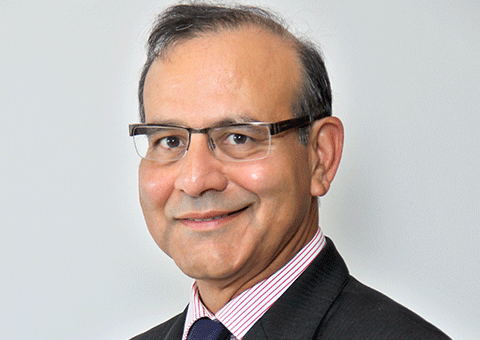
Armed with postgraduate degrees from Oxford and Cambridge and having served as managing director with private-equity giant Warburg Pincus and consulting colossus McKinsey & Co, Leo elicited many raised eyebrows when he decided to join UTI Mutual Fund as its managing director in 2013.
He has not only stayed on, proving the sceptics wrong, but has also steered UTI through a pretty turbulent phase for both the stock and bond markets. UTI's schemes have, in fact, proved consistent, low-risk options for investors in this period.
No stars
So catching up with him on the phone on a blazing summer afternoon, I pop the dicey question first. Having quit 'plum' jobs at global firms to take over the helm at UTI Mutual Fund, did Leo have to make big changes in his working style?
Leo is careful not to give the impression that the move to UTI Mutual Fund was, in any way, a compromise for him. "I'd first like to say that UTI AMC is a very unique institution in the Indian capital markets and it is a privilege to work here. Over a couple of decades, I have been advisor to many different types of companies - multinational, private and government - and had exposure to many diverse work cultures. There was nothing that one had not seen or experienced elsewhere."
So what areas of UTI AMC did he devote his attention to? Leo cites research and customer interface as the two key areas.
When he joined, UTI already had a strong equity research team in terms of skills, size and experience. He put his shoulder to strengthening it. "We avoided the star-asset-manager culture. We worked at having high-performing managers, but anchored that [style] to an institutionalised process. We support diversity of style, too," he says.
But are UTI AMC's compensation structures able to compete with the private peers? Its head of equities, Anoop Bhaskar, exited recently, I point out.
Leo is cool in countering this. "Anoop was there with us for a good eight years. We have a very strong bench with four-five well-established fund managers. Our preference is to grow our fund-management talent internally. Yes, we have quite a competitive pay structure."
Leo points out that there are fund managers across the industry who have apprenticed at UTI over the last ten or 15 years. "We are an independent fund-management house. We are not a subsidiary of a bank or a stock broker. We have no external pressures impacting how we manage our money. That reputation for independence and objectivity has helped us in attracting talent," he states.
Really retail
I note that no other fund house or financial institution, save the LIC, has managed to replicate the original UTI's retail footprint in India, despite initiatives like the B15 drive. So are there lessons from this for others?
Concurring that UTI has a quarter of the total industry folios even today, Leo thinks the retail base of UTI is owed to two factors. "One, we have simple products that offer less volatile returns. Take our MIP [monthly-income plan], our ULIP [unit-linked insurance plan] or balanced funds. Two, we have always had a symbiotic relationship with the IFA [independent financial advisor] community, which really helps bring in retail investors. Banks and digital platforms are not the natural way for first-time investors to come on board."
Leo also holds the not-often-heard view that customer service can be a big differentiator for fund houses. "At UTI Mutual Fund, we have taken a very hard look at our documentation process and put considerable effort into simplifying non-financial transactions, like change of address, that prove very frustrating for investors. I have personally monitored this effort in the last two years. The feedback suggests that these processes are dramatically easier now."
Even as Leo makes this point, the call suddenly drops and I, swearing at my mobile service, redial his number.
Listing
Given that UTI AMC, unlike most other fund houses, has four public sector promoters and T. Rowe Price as strategic partner, aren't there too many sponsors pulling at the strings? Leo disagrees and explains that this is one reason why he is keen that UTI AMC must become a publicly listed company.
"For a financial institution, whether a bank or an AMC, the best model for governance is to be an independent, board-managed, widely held entity. In India, we have ICICI Bank, HDFC and others that amplify that. Globally, you'll find institutions like BlackRock, T. Rowe Price, Schroeders, which are similarly governed. So I do think that this is a preferable structure for good governance and avoiding conflicts of interest."
He is, however, candid enough to add, "But we do have a tactical issue at UTI in that our public-sector shareholders have a conflict of interest as they have their own asset-management companies. They are, therefore, in breach of SEBI's requirements. This was intended to be an interim arrangement and not a permanent one. Therefore, it is essential to offer them some form of exit from UTI AMC. Listing will offer them a fair form of price discovery and value creation."
That's the cue for a second call drop that has me reconnecting.
Not a big bull
I have a new question. In contrast with its past, UTI AMC has transformed into an ultra-conservative fund house in the last five years. It doesn't take outsized mid-cap bets or risky credit calls. Does this reputation work against UTI in bull markets?
Leo denies this and counters, "You should be guided by the mandate of your funds on how you make money. For instance, while running large-cap diversified funds, we have seen some fund houses taking concentrated mid-cap bets. You are then running a very significant risk. At UTI, we see the need to track the volatility and quality of stocks through which performance is being delivered."
Leo draws my attention to UTI Midcap Fund which has been a top-quartile fund for three and five years. "The fact that we have one of the most successful mid-cap funds in the market demonstrates that when the mandate permits us we have no hesitation in taking risks."
Due credit
On debt funds, Leo points out, "We have been less convinced than many market participants that the RBI will be aggressive in its rate cuts and this reflected in our duration view. We were also careful not to take credit risks in funds where we believe people are looking for accrual. Others who have tried to smuggle in lower-rated paper into their flagship funds may have shown better performance for a while, but they have had to pay the price for this." It is hard to deny that this strategy has worked out in favour of UTI.
But Leo is gentlemanly enough not to rubbish the credit strategy. "It may be tempting to throw out the baby with the bath now and say, 'let's not have any lower credit exposures'. But I do believe that the industry needs to create good credit funds as there are investors who will want to knowingly add alpha to their debt portfolios. But the labelling and marketing must be done right," he adds.
On the record
A third call drop makes me switch to the landline and after much teeth-gnashing, I am relieved to find Leo patiently waiting to resume the interview.
Seeing how unflappable this CEO has been throughout this chat, I put the one question that many of his peers like to take 'off the record'. What does he think of the SEBI constantly tightening the screws on mutual-fund distributors, apropos of the recent move on commission disclosure? I ask.
Leo feels that the intent of the regulator is not to squeeze intermediaries. "The way I read recent regulations is that they are intended to encourage intermediaries to add more value as investment advisors. I don't think the move is intended as a hostile salvo."
But he does make a sharper point, in his diplomatic fashion, "I do think that some of these measures would benefit from a little more discussion and a longer transition period for intermediaries. For instance, there could be unintended consequences from commission disclosures on the already-disappearing breed of IFAs. I do think that we need more IFAs for better financial inclusion."
No stress
Segueing to personal stuff, I ask if Leo works long hours, 'burning the midnight oil', as we Indians like to say. He sticks to a predictable schedule, coming in before 9 and getting back home mostly by 8 pm for dinner with his family.
"I have found that there is very little need to carry your work home with you," he says, surprising me. "I think efficiency and decisiveness can help you leave office with all tasks completed."
Isn't this rare in an industry where top guns like to tune in 24/7? "That's a function of how diverse your interests are. Ultimately stressful situation at work are just as big or small as you make them out to be," he says, turning all philosophical on me.
"It is not that I don't think about work outside of office; I do. But I often find that a little detachment can allow a more mature reflection of issues. It's very important that you find enough time for other interests, family and intellectual pursuits," Leo adds.
An avid reader from childhood, he admits to working steadily through English classics (Shakespeare, Charles Dickens) when he was young and loving V S Naipaul, Amitav Ghosh and Salman Rushdie later.
Leo also loves political biographies, even unbending enough to say he likes light-hearted and slightly gossipy books too. Tavleen Singh's 'Durbar', an account of India's first family, had a very "insightful account of how Delhi actually works," he notes.
His money
So how does manage his personal money? Conservatively, he says, via diversified equity funds (UTI's, of course), with no direct stocks. On the debt side, he doesn't play the duration game and prefers stable income funds.
Any investing mistakes he regrets? "In this country one inevitably ends up being overexposed to real estate. It is because you both own and end up inheriting a home. And real estate tends to be an illiquid sticky asset and one tends not to do much about it," he rues.
Leo seems far more animated when I ask him about passion investments. Does he have any - wine, art? "I have accidentally acquired a sizeable art portfolio, with contemporary paintings and ancient Indian sculptures," the latter being his current passion.
Even before I ask my standard question on fitness, Leo explains that he loves golf and walking, but that's about it. "I am not a great gymmer or someone who does a lot of exercise."
He does love family holidays that entail trekking though. He has been to both Ladakh and the Everest Base Camp with his family in the last three years. "The Base Camp was very enjoyable. I want to do it again before I'm 80," he says.
Wow! Isn't that a tall ask? Can someone like me, not exactly in top form, attempt it, I ask?
Leo is kind enough to encourage the idea. "I highly recommend it. If you just enjoy walking and have some amount of determination, you can manage it. I am not intentionally fit but I managed it," he says.
That gives a good insight into Leo's personality as a leader. He's not just a person who walks the talk himself. He is also patient and determined enough to motivate you to walk it!
This interview appeared in the June 2016 Issue of Mutual Fund Insight.
Ask Value Research 

 New episodes every Friday

 New Process Alert
  Seems like you've uploaded a wrong QR code. Please upload the QR code downloaded from MF Central platform.


