


As I write this, the BSE Sensex has dropped 11 per cent from January 1, 2016. FII flows are negative, while domestic-investor inflows have slowed. Investor mood has turned less optimistic if not bearish. Indian markets are linked to global flows not only in terms of investment flows but also in terms of earnings - over 45 per cent of the earnings of index companies are now globally determined. In this context, the weakness of European markets, in particular European banks, is worth examining.
Stoxx 600, an index representing large-, mid- and small-cap companies across 18 countries of the European region, made a triple top in April 2015. Since then, the fall has been brutal, 27 per cent by mid-February 2016.
A key risk to markets is Deutsche Bank (DB). With a balance sheet amounting to 57 per cent of German GDP, DB is no minnow. A leverage of 31 times common-equity capital (tier 1) and full-year loss of 6.8 billion euros in 2015 has made markets nervous. While gross derivative positions are not the best way to look at exposure, and net positions are what matters, it does however become relevant in case of counter-party default. DB has a gross derivative exposure of 75 trillion euros - almost 20 times the German GDP. It has raised almost $32 billion in capital from investors during 2010-2014, yet it suffers an estimated capital shortfall of 7 billion euros. The DB stock is trading at a 30-year low - below its level in 2008 financial crisis. HDFC Bank's market cap of $36 billion is higher than DB's $23.65 billion, by 50 per cent.
Central-bank action of reducing interest rates to stimulate economic activity hurts banks. Low or negative interest rates will not allow banks to make enough spread to turn profitable. The soaring prices of DB's CDs (credit default swaps) suggests that the market is concerned about its counter-party status.
Banking: not just an Indian problem
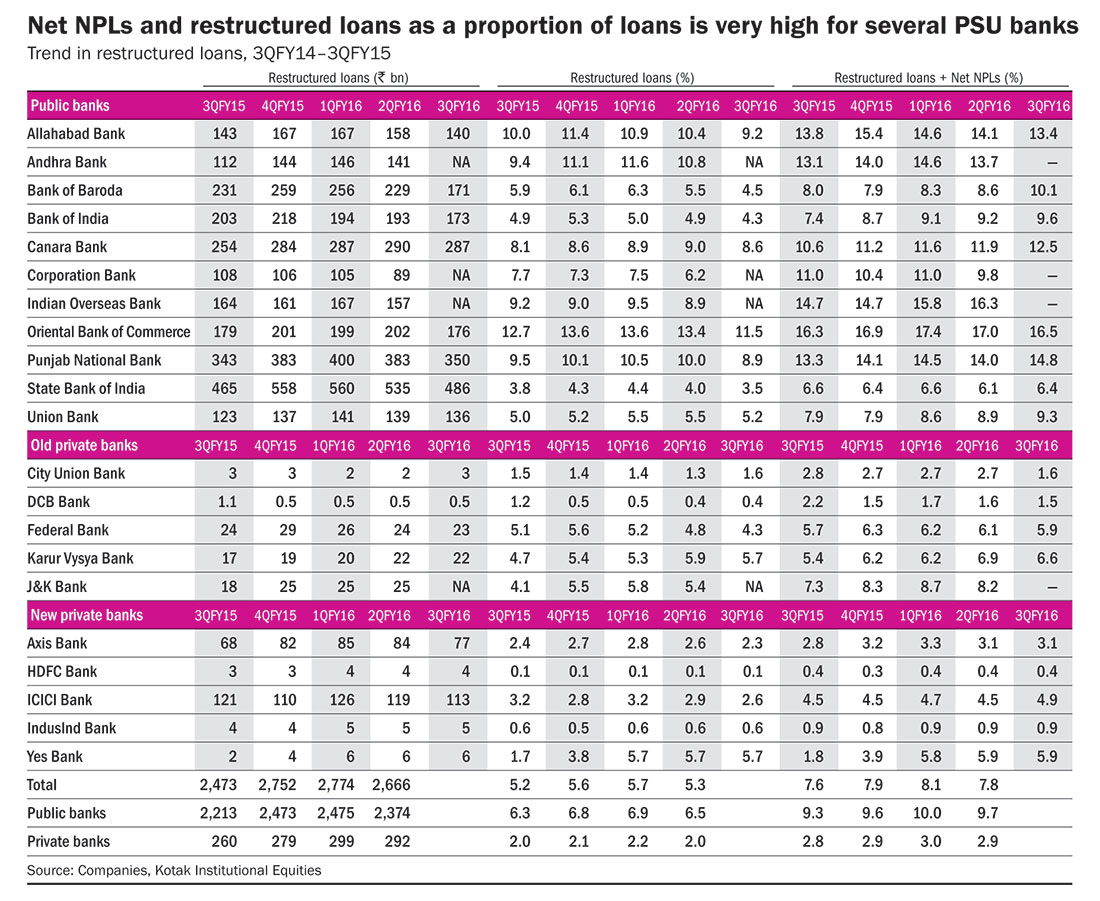
The recent push by the RBI to get banks to clean up their books has resulted in losses appearing across the entire sector. Despite the sharp fall in profits, it is estimated that a further provision of almost ₹1 lakh crore will be required to account for bad loans.
In the current economic slowdown, there is nothing to suggest that more loans will not turn bad, or new loans being advanced at this stage will not become stressed sometime in the future.
Public sector vs private sector
Much is made of the fact that Indian private banks fare better than public banks. While there may be a sliver of truth in this, this statement also suffers from the survivorship bias. There have been several recent cases of private banks - Global Trust, Centurion, Times Bank - which have needed to be rescued and merged with other banks to sort out the lending mess. Success of HDFC and Kotak cannot be taken as a rule.
Globally, and in India, ownership of banks has not led to lower risk taking and every economy has suffered from it at some time in the past 100 years.
Banks: long-term solution?
The government has attempted to make changes to governance of banks by attempting to create a 'bank board bureau', meant to take decisions about strategic issues in banks. This is laudable but grossly inadequate. While it does distance the ministry and bank boards somewhat, such structures tend to fail under ministers who have a desire to make more direct decisions.
By the time this article is published, the finance minister is likely to have laid out more measures to make banks more accountable. In all this, the fundamental question remains of the business of banking - that of borrowing ten times capital and on-lending. No business that is so heavily leveraged can achieve public confidence without backing of either the sovereign or its agent (the central bank). This instantly creates a moral hazard - risky lending has no cost. If advances are returned, yields are better, if they fail, the government has to step in.
Perhaps its time to look at radical measures like severely lowering leverage allowed. This will, of course, reduce credit availability, but will that be sorted out by other methods. Most importantly, lower leverage can be accompanied by a clear statement of no sovereign guarantees - implicit or otherwise. This will force depositors to take a view on riskiness of each entity, thereby rewarding those that grow business prudently.
Another clear requirement is to restrict the size of individual banks. While the problem of entities that are 'too big to fail' was recognised in 2008, no remedy was applied under pressure from surviving banks. Instead, surviving banks have become bigger.
Lastly, there is a need to separate risk-taking investment banks from banks that are simply deposit taking or offering commercial credit. Using market-traded instruments to lend, borrow and deposit will lead to much higher levels of market scrutiny as well as early recognition of problem accounts.
All this will essentially make banking a boring business with relatively low returns and the dominance it has unfortunately acquired in stock-market portfolios will sharply reduce. But a boring business is what lending should be!
Anand Tandon is an independent analyst.
This column appeared in the March 2016 Issue of Wealth Insight.
This article was originally published on March 22, 2016.
Ask Value Research 

 New episodes every Friday


 New Process Alert
 Seems like you've uploaded a wrong QR code. Please upload the QR code downloaded from MF Central platform.


