





The central government has attempted to kick-start the economy through several measures. These include increased capital expenditure on railways, quick clearances to road projects, restarting stalled mines, increasing coal production through Coal India, getting stalled gas-based power plants working through a subsidy on gas to enable servicing of interest on loans, and working towards making state-owned banks function more like private ones through a more professional board. Many of the initiatives involve the participation of state governments. For example, the ambitious project to reduce losses in state electricity boards requires the concurrence of states. The one area, however, which is solely within the purview of the central government is defence procurement.
Defence procurement: A huge market
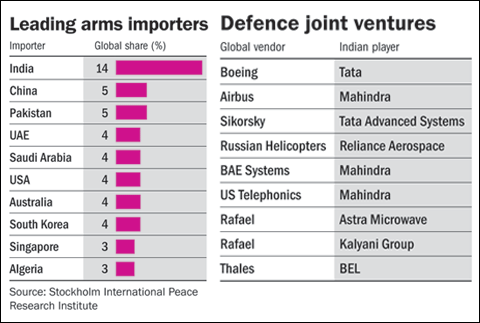
India is the largest importer of arms in the world. Over 2009-2013, India accounted for 14 per cent of global share of imports.
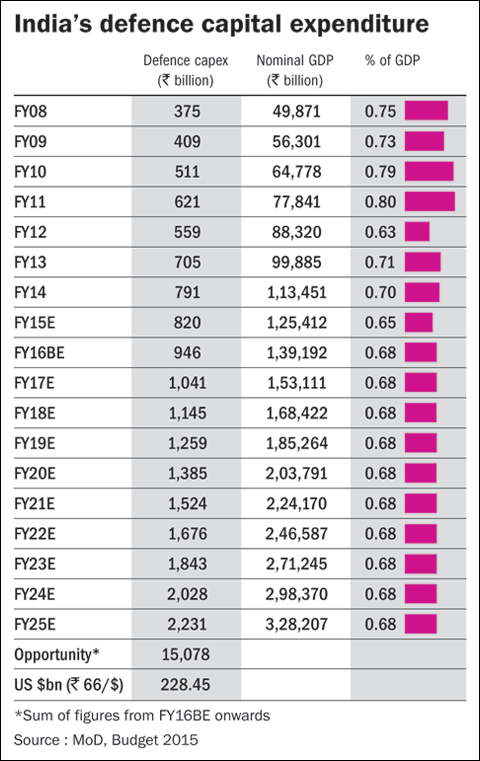
Despite this, E&Y, in a recent report, suggested that almost 50 per cent of equipment with Indian defence forces is obsolete. India roughly spends 0.75 per cent of GDP on defence capex. Even assuming a more conservative 0.68 per cent spend over the next few years, this could turn out to be an opportunity of approximately $228 billion over the next decade.
Defence procurement: Little private participation
Since independence, production of defence equipment has been the exclusive preserve of public sector. This has led to serious gaps in production capabilities. While India has made great strides in some areas like space and missiles, where no country was willing to share technology with India, it has made little progress in most others. Leave aside complex areas like aircraft and sea-based platforms, Indian armed forces are dependent on imports for bulletproof vests, night-vision glasses and other basic necessities.
While India has pursued a policy of encouraging technology transfer to Indian partners, the reality is that Indian PSU's, like BEL, have developed little ability to absorb technology. Indian 'production' capability remains largely one of assembly of imported sub-assemblies, which also suits the technology supplier, since dependence on them persists despite 'technology transfer'.
The defence-procurement policy (DPP) has long tried to encourage private participation. Inadequate clarity of purpose and unwillingness to take on board private sector concerns has resulted in policy failing to achieve much private participation. Defence is a single-buyer market. Without permission to export, any investment in defence production needs to be certain of orders to justify investment. The USA, for example, has a policy of engaging private sector from the initial planning stage. Private participation is invited at the design level, with the certainty that the design that is approved will get orders of a quantum that will justify initial investment in research and in setting up production facilities. In India, inter-departmental differences between defence R&D and defence production restrict the development of private vendors even for defence PSUs, thereby curtailing capability of the private sector to develop the required skill sets.
New initiative, new enthusiasm
The current government seems more focused on encouraging private participation. The new liberalised policy of foreign direct investment allows 49 per cent foreign ownership by default. Higher foreign participation is allowed where serious technology transfer takes place. Already, joint ventures have been set up by a variety of companies.
While the opportunity is indeed large, it is important to remember that time taken from design to production is often 12-15 years. This long cycle requires that most defence suppliers are large companies with deep pockets and staying power. There are, however, several opportunities for small and medium companies to enter into this segment as well. Much like the ancillary model of car manufacturing, most end-suppliers are essentially designers, assemblers and quality assurers of the final product. The product is built by tier 1 and tier 2 suppliers who provide the sub-assemblies and components that go into the final product. This is where SME clusters can develop to feed into the final producer.
Investment opportunity
Defence is one of the most exciting new opportunities. Listed companies with capability to service defence markets are not many. Those that exist often have a diffused holding structure. For example, the Tata group has, through its various companies, probably the broadest range of capabilities - from aero structures through to software development, embedded systems, etc. However, these are spread over several group companies not necessarily listed. Similarly, Bharat Forge has set up a privately owned company to act as the holding company for its foray into defence. While the listed entity will certainly benefit from any order flows, it will not necessarily capture the entire defence business of the group. Among larger groups it appears that the Mahindra and the Anil Ambani groups have the highest exposure in the listed parent companies.
Smaller companies offer more immediate opportunities. Some of them have been servicing defence markets for a while and have the required certifications, quality and manufacturing practices to benefit from an uptick. The names that suggest themselves are Dynamatic Technologies, Premier Explosives and Astra Microwave. However, markets, as usual, have pumped up these stocks in anticipation, leaving little in terms of margin of safety.
Private participation in defence production has gone through many false starts. It is possible that this new attempt will also lead to disappointment. However, extant information suggests that this may finally be the point from which the industry takes off. With a bit of patience, investors can hope for significant gains in this exciting new emerging industry.
Anand Tandon is an independent analyst.
This column appeared in the February 2016 Issue of Wealth Insight.
This article was originally published on March 04, 2016.
Ask Value Research 

 New episodes every Friday


 New Process Alert
  Seems like you've uploaded a wrong QR code. Please upload the QR code downloaded from MF Central platform.


