




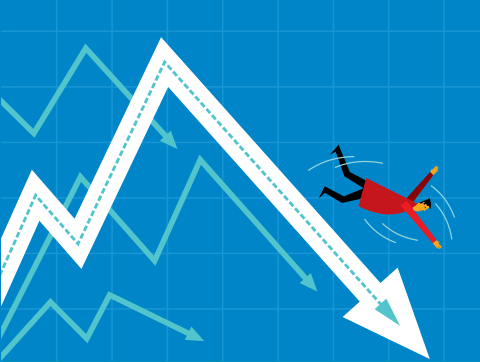
You are likely to read this column in the first half of September, when the seventh anniversary of the latest financial crisis will be just around the corner. While it is difficult to put a date to events as far-reaching as the latest financial crisis is, it is safe to say that the world at large started to realise that there was something not quite right with the global financial system, on the day Lehman Brothers went bust.
Lehman Brothers was the fourth largest investment bank on Wall Street and it filed for bankruptcy on September 15, 2008. The irony is that Lehman was the only big bank or financial institution that was not rescued at that point of time by the American government and the Federal Reserve of the United States. They, on the other hand, rescued companies like Bear Stearns, Fannie Mae, Freddie Mac, AIG and Citigroup, to name a few. In Europe, quite a few financial institutions were rescued as well.
The reason offered was that these financial institutions were too big to fail and if they were allowed to fail, the entire financial system would come to a standstill. And hence, they had to be rescued.
The question to ask is how things stand seven years later. Are these institutions now smaller than they were? Or are they still too big to fail?
As James Rickards writes in The Big Drop: How to Grow Your Wealth During the Coming Collapse: "In 2008 all we heard was too big to fail. Today, however, the banks that were too big to fail in 2008 are bigger. The five largest banks have a higher percentage of the total assets in the banking system. They have much larger derivatives books and a high concentration of assets that would seem to be moving in the wrong direction."
A fundamental problem is the way the banking system has evolved over the centuries. John Plender explains this point beautifully in his book Capitalism: Money, Morals and Markets. He calls the business model of banks a 'confidence trick'. Banks keep only a small portion of the deposits they raise as reserves. These are meant to be returned to depositors in case they want their money back.
Other than the money kept aside as a reserve, the bank lends out the remaining money. And this is where all the problems start. As Plender writes: "The bank transfers temporary ownership of the money to borrowers despite the depositors retaining the right to claim back these funds and despite the bank providing a guarantee that all deposits can be withdrawn on demand. This leads to the curious position where both depositor and borrower are entitled to control over the same funds simultaneously."
In a situation where many depositors want their money back simultaneously, there is a problem. While banks don't see old-fashioned bank runs anymore, a version of it does play out now and then. During the months leading to the financial crisis, many large financial institutions (including Lehman Brothers) ended up in trouble when many of their large lenders refused to continue lending to them.
What also causes problems is the fact that banks have very little of their own money (i.e. capital) in the business. As Walter Bagehot, the great editor of The Economist wrote in his 1873 book Lombard Street: A Description of the Money Market, "the main source of profitableness of established banking is the smallness of requisite capital."
And things have only gone worse since then. The inadequacy of capital was one of the major reasons why several big financial institutions came close to collapsing in 2008. As Plender points out: "Between 1990 and 2007, global bank balance sheets increased fourfold in size. On the eve of the crisis they had reached $75 trillion, or 1.5 times the output of the entire planet. At the same time, the amount of capital in those balance sheets - the cushion banks need to protect themselves from losses - was shrinking."
Over the years there has been a dramatic fall in the total amount of capital that banks need to maintain against in their assets. Alan Greenspan makes this point in his book The Map and the Territory. In the 1840s, banks had to maintain a capital buffer in excess of 50 per cent of their assets. In the late nineteenth century, this number had fallen to around 30 per cent of the assets.
Plender also makes this point: "In the second half of the nineteenth century, it was normal for banks to maintain a capital buffer of 20 to 40 per cent of the total balance sheet. In the interwar years, this was down to 10 per cent. By the 1990s, around 5 percent was the norm. When the crisis erupted, some big banks were operating with as little as 2 or 3 per cent. In other words, the bank assets had only to fall in value by 2 or 3 per cent for the bank to be wiped out."
Given this, it is not surprising that so many banks and financial institutions all across Western countries had to be rescued by the government and central banks. And much hasn't changed seven years later.
Basel III norms (named after a town in Switzerland where banking regulations are often discussed), which come into force by January 2019, require a bank to maintain a capital of 7 per cent against its risk-weighted assets.
As a proportion of their total assets, banks need to maintain a capital of 3 per cent. While this is an improvement on the earlier Basel II norms, it still is not enough. In this case, if the value of the assets of the bank falls by one percent, one-third of its capital will be wiped out. And given that, it won't be surprising if governments need to come to the rescue of financial institutions all over again.
Vivek Kaul is the author of Easy Money. He can be reached at [email protected]
This column appeared in the October 2015 Issue of Mutual Fund Insight.
This article was originally published on October 16, 2015.
Ask Value Research 

 New episodes every Friday



 New Process Alert
 Seems like you've uploaded a wrong QR code. Please upload the QR code downloaded from MF Central platform.


