




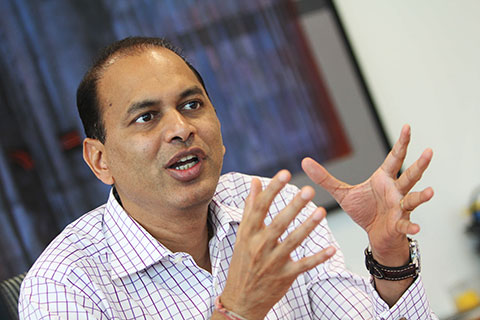
A government with absolute majority has fuelled hope and optimism for the markets according to Sunil Singhania, CIO Equity Investments, Reliance Mutual Fund. In this interview with Chirag Madia, he shares his outlook for the markets and the strategy that he plans to adopt in the times to come.
Has your outlook for equity changed with the change in government?
Very clearly we have been positive on equity markets even before the elections. Things have started looking positive in the past few months. Currently we are in a scenario where current account deficit came down from 5 per cent to 1 per cent, fiscal deficit is more or less under control, Indian Rupee has fallen from its peak and inflation is likely to ease from current levels. Interest rates appear to have peaked out and are set to come down in the times to come. Positive news also came from global markets and despite tapering concerns we continued to attract inflows. The US markets touched all time high, Europe did fine and even some parts of Asia are doing well. So the global environment was quite good in the last one year. December was the first quarter when corporate profits exceeded expectation by a small bit. As we speak for March quarter the profit growth is already more than 16-17 per cent. Clearly reflecting that despite the challenging times, companies have been able to restructure themselves and bring profits back on track.
This election result has brought in a fresh wave of optimism. One is obviously elated because since 1984 this is the first time that a single party is coming to power with a clear majority. With no baggage of allies, there is hope and optimism that, government will be able to take some concrete steps to improve the situation. I also believe that the beginning has been quite positive; the new PM has a history of governance as CM of Gujarat for 13 year, which is also positive. Initial announcements are also good and as we speak announcements are being made every day.
Overall this mandate has only amplified an already improving scenario. If we look at 2000-2008, Sensex earnings grew from 270 to 800, which is approximately 3 times growth. From 2008 to 2013 earnings grew by 8 per cent at compound annual growth rate (CAGR) and that was contributed by only two sectors namely: IT and Pharmaceutical. Now as we speak we expect markets to give at least 15 per cent growth in terms of corporate earnings, I am of the view that it might touch 20 per cent. It is because the government will push a lot of projects which are stalled and interest rates with lag will start to come off, so profit growth can go up to 20 per cent. So we remained positive in the past few months and with such a clear mandate we are quite bullish on prospects of Indian markets going forward.
How does it impact your investment strategy?
We remain quite positive on the markets and that is the reason we were fully invested. Obviously, in the run up to the elections we had done some restructuring in the portfolio. Though we continue to have some exposure in IT, but we have trimmed some weight in that sector. Similarly we were hugely overweight on pharmaceutical sector and there also we have cut some exposure. We were always underweight as far as consumer durables were concerned because we believe prices were quite rich given the growth. Stocks can't have 30 times price to earnings (PE) for a company that grows at 5 per cent, that was our simple logic. Our view is that, it's a great sector and has immense opportunity, but either there has to be price correction or time correction. We have already seen time correction and we might also look at some price correction going forward.
What changes have you made or going to make in your portfolios?
Very clearly from the perspective of investment, we were all along trying to see what the downside is, but now the strategy is what the upside is; which is also the broad change in the strategy. There are some announcements like bullet trains, providing sanitation, river up-linking and more reforms in telecom and the broadband sector. So I am saying that there are lots of announcements being made, but it can't be taken at face value to make investing decisions based on such announcements. But it makes lot of sense to start focusing on what can be the upside opportunities if these announcements fructify. We have been quite aggressive in our investment decisions and still believe that valuations of many mid- and small-cap companies are very attractive. So, across our funds wherever we have the mandate of investing in these kinds of companies we have been aggressively investing in such kind of stocks. I would say that currently the index is higher by 15 per cent than what it was in 2008. But midcap index and smallcap index are still lower by 15 per cent and 35 per cent respectively than what they were in 2008. As I said it's an ongoing process, we are looking at increasing allocation towards sectors that are related to domestic economy like capital goods, financial and power where we feel there is lot of opportunity.
In your view, which segment of equity market is most promising?
Frankly speaking there is opportunity across the board. If India has to grow, from here on domestic oriented sectors have to do well. As I mentioned capital goods, infrastructure and power related stocks look promising, along with financial and cements. Here I would say that I am more bullish on power sector because their balance sheets are good, projects are on ground, they only need some push and they will once again start generating positive returns. We even continue to remain positive on the IT front because valuations are quite decent. Though we have trimmed our exposure in the pharmaceutical sector, we still feel that this is one segment where earnings growth of 15-18 per cent looks very visible.
In your view, which segment of equity market is most vulnerable?
Smaller companies, especially in infrastructure and construction segment which are being bought just because they have fallen a lot, but where fundamentals and balance sheets still remain under big stress, we tend to avoid such stocks. They had seen sharp fall because balance sheet of those companies were irreparable. I would like to advise retail investors to be little more cautious while dealing with such companies.
What worked the most for Reliance Small Cap Fund making it among the best performing equity fund?
There are two aspects, firstly we have benefited because the index has also done superiorly well. Secondly, in the last four-five years, investors ignored all companies and had focused only on top 10-15 companies. But, we saw opportunity in many small cap businesses. What we were always trying to do is to figure if these companies as a business were exciting? Because when we start to look at companies as a business, the investment decision becomes very strong. When we just look at the price, one gets swayed by near term price movements. I think the downward trend enabled us to create a very good portfolio and as soon as the markets started to get conviction that the economy was bottoming out, the stocks started to perform.
Frankly speaking it's also a team effort. We have the largest equity team in the industry. We track over 450 companies in-house very extensively; another 250 companies are tracked reasonably extensively, so we have always been strong on our stock picking ability. We have to also remember that in small cap we have to buy these companies when no one else is buying. It is only because of our conviction and hard work by the team that we are able to do well. In terms of portfolio, we have a fairly diversified portfolio and top six-seven bets paid off quite brilliantly in the last one year. So whether it was small IT company or the chemical sector as a theme or auto ancillary sector; all have helped us generate strong returns. So across the board it has helped, and we still believe there is huge potential on the small cap side.
What is your investment approach for Reliance Small Cap Fund?
First and most important thing to look before investing is whether it has strong business case? I always look it from the perspective of a businessman, if I am buying into a business why am I buying? If I am convinced about the business then only I proceed further. Obviously you look at the track record of promoters and lastly the scalability. If you feel that in the next 3-4 years, companies can double the size, then you have two baggers in terms of profit and even more if there is re-rating. So I think that is the basic premise, that business has to be good, there should be growth potential and honest management. We also focus a lot on balance sheet and avoid companies where balance sheets are stretched.
What factors do you keep in mind while selecting stocks for Reliance Small Cap Fund?
Financial factors such as return on equity (ROE), return on capital employed (ROCE) and returns on investments (ROIs) are looked into. But more importantly, many times when we buy a company there might be some near term stress, though the company has the potential to do very well, but in the near term their fundamentals are weak. Ultimately, we look for potential of the company in its future growth prospects. Secondly, we want a diversified portfolio and we stay away from having any particular stock or sector having dominating factor in the portfolio. By nature, small cap attaches more risk and if we have any sector bias then the portfolio can become very volatile. So we try and cap a stock to about five-six per cent of the portfolio and that's our risk measure. Thirdly, we want to invest in companies that have clean balance sheets. If we are convinced that a company will grow at a reasonable pace then all the factors such as ROE, ROIs and ROCE will fall in place.
What kind of stocks you generally avoid in the Reliance Small Cap Fund?
Stocks which would regularly dilute its stake for equity, defeats the purpose of long term investments and reduces return of existing shareholders. We try and stay away from such stocks. Secondly, we would like to invest in growth companies with proper risk management. So, we try and stay away from stocks with high debt and cyclicals unless it becomes very attractive in terms of valuations. We would like to have value stocks but with reasonable growth attached to it. To give an example, we invested in chemical companies which were deep value buy and gave us very good returns because growth came in and our strategy paid off.
How do you approach midcaps for Reliance Long Term Equity Fund?
It has more or less a similar approach as Reliance Small Cap Fund. I personally manage three funds; Reliance Growth fund which focuses on large-cap and midcap stocks, Reliance Long Term Equity fund which invests in mid- and small-stocks and Reliance Small Cap fund which solely focuses on small cap stocks. The idea is to have diversification across all the spectrum of the market. India is a diversified country with lot of entrepreneurship building and we grow because of them. We have many listed companies and there are opportunities across the segment. We don't want to miss the opportunity and that is the reason we have created separate portfolios. It also gives us the flexibility to stay focused and investors also know where they are investing. As I said, the fundamental approach of investing remains the same, but obviously kind of risk you take in each portfolio will be different. But in this fund there would be more sector allocation and we ensure there is enough exposure in each sector according to the benchmark.
How long is your mid and small cap watch list which is not part of your portfolio? How do these stocks enter your portfolio?
There are around 450 companies which also includes some larger companies which are extensively covered in-house. Out of which half of the stocks are not in our portfolio, and that is our watch list. Stocks which are on the watch list are tracked comprehensively by sector analysts and midcap analysts. Fund manager's also looks at them on a continuous basis. So, whenever stocks or themes start looking attractive, it is pointed out and then based on the risk and the portfolio manager's view the investment decision is made.
While research process across our universe of stocks are common, in case of mid- and small-cap stock selection we play more on earnings growth and if we get lucky we also get price to earnings (PE) growth. To give an example, we had invested in a tyre company which was trading at 2 times its historic earnings. We knew that earnings will surprise us because of good replacement demand and softening rubber prices and that's what happened and our call went absolutely right.
Given the spurt in stock prices in recent weeks, are you finding it difficult to spot opportunities? This is the first move of the current bull market, so clearly many people think that prices of stocks have moved up too fast. But even now I believe there is lot of opportunity across the board, especially in the mid and small cap side of the segment. I would like to give an example; we have an auto ancillary company which we bought at ₹300 when it was trading at just 4 times price to earnings (PE). When we invested our view was that, earnings will double and with re-rating it will be a three bagger. But surprisingly, the stock got doubled in the last six months and earnings increased by 30 per cent than what we had expected. So, even with 100 per cent rise in the price of the stock, the company is still trading at 7 times price to earnings (PE), so from current levels also it has a fair chance to go up by another 100 per cent. So, I think we have to see what is the future rather than what has happened in the past. Recently we did a study till March 31, 2014, where we tracked the top 800 stocks and half of the companies were trading below 10 PE, and almost 45 per cent of stocks were trading below the book price, so there is lot of opportunity. But one has to be patient when dealing with small cap stocks. If the economy grows, smaller companies will always tend to grow faster and we have seen that scenario in the past.
What is the biggest risk while managing the mid and small cap funds?
I would say that experience while managing the funds has taught us a lesson. In the past we made few mistakes and had burnt our fingers. Going forward we might again make some mistakes, but with every passing day we are becoming more wise. There are some risks while managing the small cap funds, so we try and stay away from stocks whose balance sheets are stretched. We only take those risks which we can manage. Many times some stocks which are attractive but have some risks attached to it, we try and take minimal exposure of around 1-2 per cent in our portfolio. There are many stocks which might have run-up too sharply in the short run, even in such a situation we trim our positions. As I said earlier, we don't try and hike exposure of one stock to more than five-six per cent in the portfolio because we don't want one stock to become dominant to change the fortune of that particular fund. These are some risk measures which we always keep in mind while selecting the stock. Apart from that, if stocks enter the portfolio then it has to be actively tracked by analysts and portfolio managers and we emphasise more on factory visits and company meetings.
This interview appeared in the July 2014 Issue of Mutual Fund Insight.
Ask Value Research 
 New episodes every Friday

 New Process Alert
  Seems like you've uploaded a wrong QR code. Please upload the QR code downloaded from MF Central platform.


