




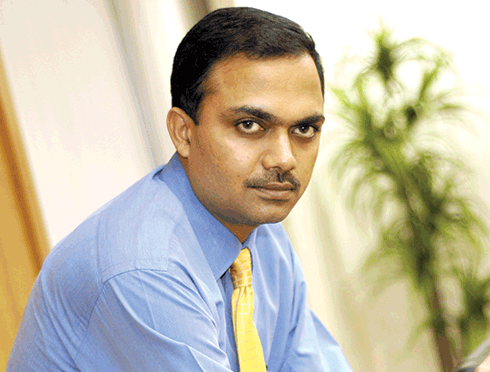
Over the past two decades, HDFC Mutual Fund's Chief Investment Officer, Prashant Jain, has seen more ups and downs than anyone else managing equity mutual funds in India. Last month, Jain sat down for a freewheeling conversation about the past and future of equity investments in India and the funds he manages.
Markets have been volatile and are trading at all time highs. How do you assess this?
Equity markets are simply volatile and it is very hard to forecast them, particularly over short to medium periods. The perception of high volatility in recent past is probably due to large movements of indices in absolute terms. The chart (Truth behind volatility) gives the yearly high, low and average levels of S&P BSE Sensex since 1991 and it can be observed that, even though it is counterintuitive, volatility in the last few years has actually been low.
The impression of volatility is probably due to the developments of 2013 around tapering that impacted India unexpectedly and had two fallouts:
- Gold prices fell sharply in both USD and Rupees in the first half of 2013. This resulted in a spike in gold imports of the order of US$10 billion.
- FII's sold Indian debt securities to the tune of US$10 billion between June and Sep 2013.
These two cumulatively impacted the Balance of Payments (BOP) by ~ US$20 billion in a short period leading to sharp depreciation of the rupee against the dollar. RBI increased rates by 3 per cent in July 2013 to steady the rupee. These unexpected developments adversely impacted the economy, fixed income and equity markets. However, things are now normalising. Not only has the Current Account Deficit (CAD) come down sharply, interestingly, post confirmation of tapering in Dec 2013, FII debt flows have also been positive.
As far as equity markets are concerned, though indices are at historic highs, PEs are below long term averages. In fact, S&P BSE Sensex is where it was six years ago in Jan 08 and in this period the GDP has nearly doubled in rupee and nominal terms. PEs have thus moderated and given the below average PE multiples that the markets are trading at and given the improving economic outlook as suggested by improving current account, inflation and GDP growth numbers. There are reasons to be optimistic about the medium to long term prospects of the markets.
HDFC Prudence Fund has completed 20 years and you have the distinction of having managed it right through. What are your key thoughts on this interesting milestone?
It has been great to be associated with HDFC Prudence Fund right from its inception in Jan 1994 till date. Despite some challenges and difficult periods, it has been a very fulfilling and enriching experience. A lot of what I have learned about equities and fixed income, I owe it to this fund.
Some key learning's and observations from my experiences:
- A 19 per cent CAGR over 20 years has turned ₹10 to ₹352 (adjusted for dividends declared prior to creation of Growth and Dividend Plans as on March 31, 2014). When I started my career, I had only read Einstein on compounding, but now I have actually experienced it. If this can be repeated for the next 20 years, the outcome will be very interesting.
- This 20 year journey has seen many ups and downs for India, for stock markets, for the NAV, but over time as the Indian economy has grown despite occasional setbacks or slowdowns, the NAV has also grown despite periods of underperformance once in a while. Unfortunately, not many have benefited from this compounding as only about 23 per cent of investors in the fund have a holding period of more than five years. There are about 2,500 exceptions though. These investors have stayed with the fund for these 20 years and have benefited accordingly.
- Asset Allocation is the key: the vast majority focuses on timing and on fund or security selection and ignores asset allocation, which is in fact the key to successful investing. For example, a great timer who invests 1 per cent of wealth in equities hardly benefits compared to someone who invests 20 per cent of wealth in equities for the long term even if his timing or fund selection is not the best. Unfortunately, most Indians have a very small portion of savings invested in equities and thus earn less than optimal returns.
- Good and bad times do not last: I have experienced this on several occasions. For instance, from 1994 to 2014, three years viz., 1995, 2008, 2013 etc were not good for performance. This led to a lot of introspection, some valuable insights, corrective action and improved performance subsequently.
What are the differences between HDFC Equity Fund and HDFC Top 200 Fund? Is size a constraint for performance and has it impacted performance?
HDFC Equity Fund and HDFC Top 200 Fund are reasonably different in terms of investment strategy and positioning. The key differentiators are:
Benchmark: HDFC Equity is benchmarked against CNX 500 Index whereas HDFC Top 200 is benchmarked against S&P BSE
200 Index.
Market Cap Strategy: HDFC Equity is a multi-cap oriented fund while HDFC Top 200 is predominantly large-cap oriented fund.
Investment universe: For HDFC Top 200 is very tightly defined (BSE 200 or the top 200 capitalised companies) while for HDFC Equity, the investment universe is wider.
From all these, it is evident that these two funds are reasonably different. In fact, the difference in portfolios has been 30-40 per cent over the last five years. However, this is not visible to a casual observer who looks at just the top holdings. Several top holdings of not only these two funds, but any two large-cap oriented funds will be common creating an impression of similarity. This is so because the number of really large cap companies or index heavyweights is limited. ITC, Infosys, Reliance Industries, ICICI Bank, HDFC Bank, HDFC, TCS, L&T, Tata Motors, Sun Pharma and ONGC etc. Caveat: these companies are not recommended by HDFC Mutual Fund or HDFC AMC. The fund may or may not have any present or future positions in securities or instruments of these companies.
Coming to the issue of size of funds, India's equity market capitalisation is over ₹69 trillion (Source: Capitaline, as on Feb 28, 2014). Compared to this, a ₹10,000 crore fund is tiny (0.15 per cent). So, there are no large funds in India at all. In fact, all mutual funds in India collectively own just ~ 2.5 per cent of the markets.
Size, in my opinion is therefore not a constraint for any equity fund in India. In fact it can be argued and data will support that performance of smaller funds is not superior to larger funds. However, like smaller funds, even large funds have times of average performance; and when the performance of a large fund is not good, it is noticed by a large number and the first instinct is to blame the size as that is the most obvious differentiator.
It is true that 2013 was an average year for both these funds. I had an optimistic view of the economy and the unexpected tapering concerns adversely impacted the economy, the rupee, fixed income and equity markets as elaborated earlier. This did affect the performance for some time, particularly in the first half of 2013, but as things stabilised, the performance recovered and in fact HDFC Equity fund beat its benchmark in 2013, even though by a small margin. 2013 marked the 17th year of out-performance in 19 years of HDFC Equity fund's existence, a track record that is virtually unmatched.
Finally, what has optically impacted the performance compared to the peer group is the underperformance of the benchmarks of these two funds versus the S&P BSE Sensex or the Nifty in 2013 as can be seen in the table (Index Watch). The performance of the different indices tends to converge over time and as the indices of these funds catch up with the S&P Sensex or the Nifty, that should work to the advantage of these funds.
In 2013, returns of duration funds have been unsatisfactory. What is the outlook for 2014?
Key drivers to interest rates are Inflation, Fiscal Deficit and stability of the rupee. High food and vegetable inflation is behind us and core inflation has been moderating. With slowing demand, stable commodity prices and rupee, in my opinion, inflation in 2014 is expected to be lower than what it was in 2013.
However, given the high inflation over last several years, a bigger challenge is to moderate inflationary expectations and that will certainly take time. On the Fiscal front, over the last few months, diesel price hikes have continued despite upcoming elections. Continued diesel price hikes will play an important role to reduce fiscal deficit in FY15 and beyond. CAD and BoP have also shown sharp improvements and would continue to do so in FY15 based on faster export growth and slower import growth led by improving growth of software services and lower or stable oil prices. This should lead to a stable rupee. India is one of the very few geographies in the world, where interest rates are higher than pre- Lehman or global financial crisis levels. This points to the substantial room available for lower rates when inflationary expectations have been moderated.
In summary, in my opinion, the key indicators point towards lower interest rates in FY14 and beyond. However the exact timing and extent of fall will depend at the pace at which inflation and its expectations are moderated. In view of this, in my opinion, there is merit in being patient with duration funds, despite the less than satisfactory returns in 2013.
Gold has occupied a large allocation in households over last several years. What explains this and what is the outlook?
In my opinion, the vast majority of investors simply practice what may be termed as investing based on extrapolation of past returns. I have observed on multiple occasions that whichever asset category gives high sustained returns for few years, it tends to attract large interest and vice versa. Whether it was equities in 1992, IT stocks in 1999, infrastructure stocks or funds in 2007, gold in last few years all adhere to this theme.
Post the Lehman crisis or global financial crisis, driven by large supply of dollars and low interest rates, USD prices of gold multiplied several fold. Post tapering, though USD prices of gold have fallen, rupee prices of gold continue to be supported by the rupee depreciation, hike in customs duty (presently 10 per cent) and a physical premium of nearly 8 per cent due to import restrictions. These drivers of gold prices in the past are not relevant for the future - tapering and stable or rising US interest rates are not good for USD gold prices, sharp improvement in CAD should lead to rupee stability and at some point customs duty or physical premium will drop. All the factors thus, that have been supportive of gold prices in rupee terms, will not be so in the future. Hence, there is merit in shifting resources from gold to fixed income or equities depending on individual preferences or risk appetite.
What lies at the core of the investment philosophy at HDFC Mutual Fund?
At the core of the investment philosophy at HDFC Mutual Fund are the following:
- Invest in line with the investment mandate of the respective funds and do not compromise with this even under competitive pressure.
- Stay focused on quality investments in equities and fixed income.
- Avoid assets for which the understanding is not satisfactory.
- Invest with a long term view.
- Remain effectively diversified.
While the above is not a guarantee to best in class performance, it has certainly enabled us to avoid large mistakes, to deliver superior performance across our range of equity and fixed income products over the medium to long term.
This interview appeared in the May 2014 Issue of Mutual Fund Insight.
Ask Value Research 

 New episodes every Friday


 New Process Alert
 Seems like you've uploaded a wrong QR code. Please upload the QR code downloaded from MF Central platform.


