


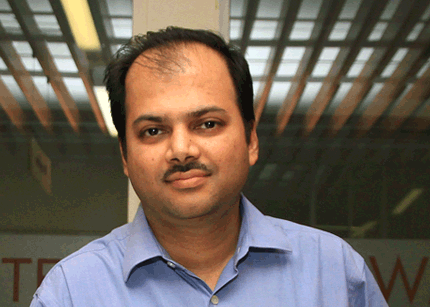
Pankaj Murarka, head-equities at Axis Mutual Fund tells Chirag Madia, that the economy is in a work in progress phase and a few quarters down, things will only improve for the markets and investors.
Given the current situation, what is your outlook of the Indian Equity markets?
At any given point of time in the economy, we might face some concern or the other. Even today we are worrying over slowing growth. But I think the big picture is that over the last three years we have seen significant deceleration in our growth momentum. Numbers suggests that the GDP has come down from 9.5 per cent to 4.5 per cent in the last few years. Primary reason why we are in such situation is only because we run significant macro economic imbalances on various aspects of our economy for very long period of time.
Having said that, in the last 12 months the government has started addressing those macro imbalances such as laying our prudent fiscal plan and steps to tame inflation. Such steps will ensure that interest rates come down and growth kicks up. I think we are in a classic 'work in progress' scenario, where we will take another three-four quarters to correct those imbalances and once we have resolved it, the floor will be set for the next growth cycle. We firmly believe that, 4-5 per cent growth for a country like India is an 'outlier' and it can't sustain at such a low pace. Given the way we are poised as a country and demographics, we can't be growing at such a speed of below 5 per cent.
Next, we are in an election year and we are hoping to get a stable government. We need to realise that subsidies and government dole-outs will not solve the problems. The present government doled out subsidies and we have reached a stage where the government is running out of money. Growth and higher growth is the only solution to most of our problems. Any government that comes to office after the elections has to take a 'pro-growth' approach.
Finally, our view on equities remain quite constructive; equity as an asset class has significantly under performed other asset classes like real estate and gold for the last 3-4 years. But we believe that the worst is over for equities and we will see far better returns from equities than any other asset class going forward from a medium term perspective.
In such a scenario what is you overall investment strategy?
Our investment philosophy is very simple and doesn't change according to the market cycles or dynamics. The strategy focuses on high quality companies that can deliver sustainable higher growth over the medium to long term. As a fund house we are growth buying investors and we always look for superior companies with continuous growth momentum. As long as these two aspects remain intact, probably we look forward to buy them at fair prices and this is our only key strategy.
How do you approach large-caps for Axis Equity Fund?
As I said earlier, we always look for companies that deliver high growth, which can grow at 1.5 or 2 times than the nominal GDP. When I say we invest in superior companies I mean that we look at companies that generate strong return on capital employed (ROCE) and is a leader in its sector. The company needs to have competitive advantage, pricing power and above all strong and sound management.
Apart from these, as a fund house we tend to have a longer time horizon of at least three-five years on any company and try to think of businesses very holistically; how they will transform in that particular duration. We have a risk process to understand valued business and we then manage risk in our portfolio.
We are sector agnostic and our view on sectors changes from time to time with no bias. We believe that most sectors go through different cycles and we have to change our portfolio in line with the situation. To give you an example, we were overweight on consumer for the past three years, but, today we are underweight on it. We believe that valuations of many of those stocks have become too expensive and growth has been slowing in many of those companies.
What kind of strategy do you adopt while managing your mid-cap fund?
Our objective in the mid-cap funds is to look and invest in those companies that can over a period of time turn into large caps. We firmly believe that in high growth cycle of companies moving from mid-cap to large-cap can create enough value to stakeholders and that is what we look while identifying the mid-caps. Though investing in mid-caps has their own set of risks, so here we try and focus more on larger mid-cap companies having market capitalisation of more than ₹2,500 crore. In mid-caps we don't worry about valuations, here we are even ready to pay higher valuations if they fit in our criteria.
Does your investment parameter differ when choosing small cap compared to mid-caps?
Primary theme of all our investment is to focus on growth, be it large-cap, mid-cap or small cap. The only thing for us is to have confidence in that business and ability of their management to deliver the growth numbers which we expect. Our aim is to give immense value to our investors by picking high quality companies. Typically in mid and small caps, there are many companies at times which deliver high growth but end up destroying share holder's value and this is what we don't want to get into. Though there are some risks in managing the small cap fund as compared to other funds; we do believe that even in the small-cap space we have some terrific high quality companies and contrary to belief, they are less risky than what people in general think of them.
How do you plan to manage your close ended small cap fund? What is the rationale behind having cash of around 50 per cent in your close ended fund?
We wanted investors to come into this small cap fund with a clear time horizon of five year. Even in this fund we are not doing anything different and our strategy is to 'buy and hold' rather than churning the portfolio on a continuous basis. The idea here is to invest in good quality businesses and hold them for longer periods because if growth comes back, these companies will be giving their shareholders superior returns. We are all aware that during any downturn in equity markets, small-cap stocks get more impacted than their large-cap counterparts. We are looking at such high quality companies that are beaten down because of the slowdown with immense opportunity in those companies that are now available at fair prices. We are very excited about the kind of value we see in the small cap segment currently.
There exist an opportunity to make disproportionate returns by investing in small-cap and we want to capture returns through this fund. In terms of investment, we are positive on financials, we believe the domestic economy is weak and the financial sector has taken the brunt of the crisis an all the stress is lying in the balance sheet of financial companies. As we see recovery in the domestic economy, financials will be the biggest gainers and we are betting on that particular sector. We are equally positive on domestic manufacturing like Auto and Auto ancillary as we think, as and when growth recovers these sectors will see a sharp recovery.
On having high cash; I would say there are issues like liquidity and we have to invest gradually. Over the last 3-4 months even small caps have run very sharply, so we didn't wanted to take a plunge. We are in the process of building a portfolio of the fund and currently we are about 75 per cent invested in stocks.
How long is your mid cap and small cap watch list which are not part of your portfolio? How do these stocks enter into your portfolio?
There are around 200 companies under the mid and small cap universe which we track. So we look at some of the filters like their business should have potential to grow at reasonably high rate and sustain it. I mean, companies should grow at 20-25 per cent CAGR; businesses should generate decent ROCE and return on equity (ROE). We like businesses that generate cash rather than companies that require cash and should have competitive advantage over its peers. Valuations are the last thing we look at because our focus is more on good quality business.
What is the biggest risk when choosing stocks in the mid- and small-cap category?
I think the biggest risk in managing the mid and small cap funds is the mortality rates. There are lots of mid-cap and small-cap companies that change in every economic environment. If we look back at the various bull markets, there are lot of mid- and small-cap companies that come to the fore. But as soon as the bull markets ends, such companies are not around. For us, the biggest concerns is sustainability of the business and companies. It is always believed that businesses can be created during the up-cycle, but the main challenge is to survive the downslide or bear markets. So as I said, we don't invest in companies having market capitalisation less than ₹2,500 crore because they are unlikely to vanish. In the past 20 years, there were many mid-cap companies that became 'darlings' of the bull market but are nowhere to be seen today and that is the biggest worry for us.
What kind of stocks never enter your portfolio?
To be very candid, my experience in equities has taught me 'never say never'. We are in a scenario of frequent changes in management, environment, economy and ownership. But as a sound investment manager we should keep our eyes and ears open and be willing to accept the change. Having said that, we are less inclined to buy business's with poor economics and appalling corporate governance issues.
This interview appeared in the April 2014 Issue of Mutual Fund Insight.
Ask Value Research 

 New episodes every Friday


 New Process Alert
 Seems like you've uploaded a wrong QR code. Please upload the QR code downloaded from MF Central platform.


