




When the RBI Governor, Raghuram Rajan, unveiled the monetary policy, he said, “Inflation is also a tax that is grossly inequitable, falling hardest on the very poor.” This was followed by his announcement to increase interest rates. Rajan reframed the conventional growth (low rate) vs inflation fighting (high rates) debate by emphasising that low inflation was a pre-condition for growth to come back. The point he made, which was adequately appreciated, is that it is impossible to lower rates in the face of high inflation, not the least because it's unfair to savers.
Revised Action Plan
- Interest rates are likely to stay higher in the present market scenario, and an increase in interest rates causes a fall in bond prices, while the bond yields increase simultaneously.
- In the prevailing rising interest rate cycle, investors are going to benefit by investing in shorter duration bond funds until a reversal takes place.
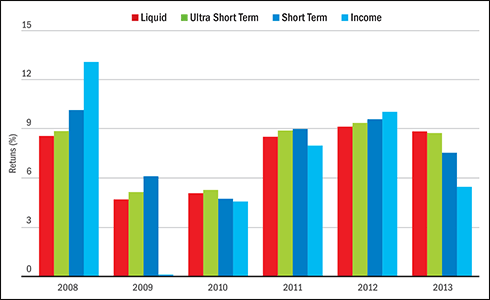
- Short term debt funds have generated higher returns than their longer duration counterparts when the 10-year GOI sec yield has been on an upward trend since the beginning of 2009.
- Liquid funds and ultra short term funds have managed to generate around 9 per cent return in 2012 as well as 2013 when the interest rates have risen or stayed constant.
- Short term funds have generated an average 8.5 to 9 per cent return in 2012-13.
- Taking cue from the prevailing rates, liquid/money market funds have seen a positive flow of funds in the last two months while the reverse is true for income funds which have a higher average maturity.
Since the early 2000s when fixed income fund investing came of age in India, it has been a fairly dull and predictable activity. There have been some surprises, like in 2008, obviously, but by and large fixed income investing has been a placid activity. The central bank's rate changes, which are the immediate drivers behind returns, have been mostly predictable. Almost always, the consensus of the talking head economists has been correct. The RBI has done what the conventional wisdom of the day has been. There may have been some mild surprises on the magnitude of the action, but hardly ever on the direction. However, now a new element of risk has entered fixed income investing. It may be small compared to equity but within the context, it is just as significant, and it's not going to go away.
Rajan has made it abundantly clear that interest rate cuts will only follow inflation. As and when inflation comes down, interest rate will come down. We are hopeful food inflation will come down, which will lead to wage inflation coming down. But we have to endure high interest rates for some time. We are at growth rate which is lower than which we are used to and that will also lead to some price correction. We have already seen that auto companies are cutting prices. This entire thing will also lead to lower inflation.
Ask Value Research 
 New episodes every Friday

 New Process Alert
  Seems like you've uploaded a wrong QR code. Please upload the QR code downloaded from MF Central platform.


