


The international fund category has been growing rapidly in recent years, with several new fund offerings that provide investors a wide variety of options to invest in them. There are several advantages of investing in these funds and given their track record and performance, there is a compelling reason to invest in them that goes beyond the traditional global diversification rule. Given the opportunity when investing in these funds, it is in your interest to understand the nitty gritty of investing in global funds to make the most of the available options.
In today's globally inter-connected world, it is irrelevant to ask if one invests abroad. For instance, you may be in India, Brazil, China or the US and you may be as much of a consumer of Gillette razors or guzzling Coke or browsing on Google chrome. It is in this context that the idea that any investor's returns are linked only to one country is such an old school thought. Today, top American companies use Infosys-developed software, Tata Motors owns Land Rover and Bharti Airtel has operations in Africa. The list is much longer if one probes it further.
To some extent, if you are investing in mutual funds that have investments in these Indian companies, you have a global exposure as well. And there's no chance that this trend will reverse. Whatever the dependence of your portfolio on foreign economies, you can be certain that it's only going to increase.
Why invest in global funds?
The advantage of investing in these funds is by now well entrenched and demonstrated with several schemes doing extremely well. The big benefit of investing in such schemes continues to be diversification and the greater the diversification, the more uncorrelated a portfolio will be. Take for instance rising oil prices. It is bad news for a net importer of oil like India, which impacts the Indian markets. However, the same is of advantage for a resource-rich country like Brazil. Imagine what a fund with investments in Brazil could do to your investments.
Investors have the opportunity to take part in the world's booming economies and growing stock markets. The logic of international diversification is that different countries have risks that are specific to themselves. For example, the possibility of an unstable coalition in India and a quick election wouldn't affect stock markets in other parts of the world too much. Hence, if you have investments across a range of countries your exposure to such country-specific risks is then considerably lower.
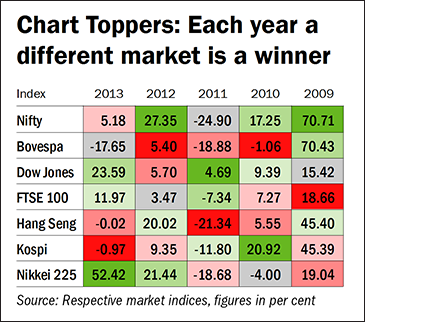
You can also minimise a single country concentration risk by spreading your investments. No country is an outperforming market each year and as global trends unfold, different markets get impacted differently. Markets which offer high returns also expose your portfolio to higher volatility. To mitigate the effect of volatility, diversify your portfolio across geographies.
Risk and returns
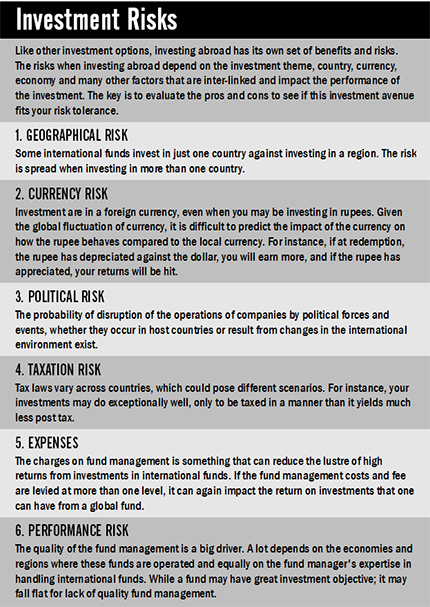
Most investors allocate only a small share of their portfolios to foreign assets, which is because of the investment behaviour, known as home bias. The fear of investing globally is because of the associated risks (See: Investment Risks), especially currency risk.
However, for all the lamentation for the rupee that one hears lately, there are benefits of currency rate fluctuations, just the way there are advantages of market volatility. For instance, a weak rupee against a strong dollar will result in returns being far different on investments outside India.
Making the right choice
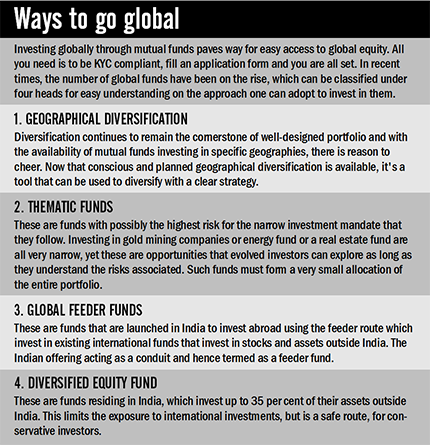
The existing international funds can be classified as those which invest in specific geographies, those that bet on themes, those that are predominantly invested in India with some global exposure and funds that are truly global and reside outside India (See: Ways to go global). There are benefits of opting for all the available options and as investors you should examine the investment objective, performance and associated risks when investing in these schemes.
Thematic funds, which constitute a major chunk of the international fund menu. Funds that focus on sectors or themes or particular assets must form a very small allocation of the entire portfolio. Ideally, these international funds, should not be a significant part of your investment portfolio as they are highly volatile.
One of the determining factors in the hunt for the right fund is deciding whether or not you want a fund with a 100 per cent international exposure or a fund predominantly invested in Indian stocks with a global flavour.
Unless you are looking at an exposure to a particular fund or theme, opt for funds which have a domestic and international exposure. There is a significant list in this category that you can pick from, and also evaluate how these funds have performed before zeroing on them. They are all equity diversified offerings that are completely un-biased towards any sector, theme, asset or region. Another aspect to consider when investing globally is to understand the tax implications of your investments (See: The Tax Conundrum).
The Tax Conundrum
Taxation on investments could be both long- and short-term and depends on the type of international fund that you invest in. For instance, in terms of taxation, capital gains arising from investing in pure global funds are taxed at a higher rate than domestic mutual funds.
The aberration exists, because for the purpose of arriving at tax liability; funds are classified under two heads: those that invest up to 35 per cent in international funds and those that invest a higher proportion. Funds that have less than 65 pet cent exposure to domestic equity are treated as debt funds for the purpose of taxation, which means both short-term and long-term tax is applicable when the investments in these funds are redeemed.
Such funds are taxed like debt funds, where the long-term gains would be taxed at a flat rate of 10 per cent without indexation or 20 per cent with indexation. The short-term gains will be added to your income and taxed as per the applicable slab rates. Whereas, funds with over 65 per cent investments in Indian equities are like diversified equity schemes and taxed accordingly. The funds that are treated as diversified equity funds, which means there is no capital gains on holdings of more than a year.
The Last Word
The case for diversifying one's investments globally is strong. When they first entered the markets, it was taken to mean straightforward geographical diversification. So if the stock markets of one region of the globe fared badly, then having some money in another region would offer some protection. However, geographical diversification as a defensive strategy ended during the global financial crisis of 2008. With all economies linked, the carnage was universal and having a little more in one market wouldn't have saved you much. In such a homogenous world, investing globally us an option seriously worth giving a second thought.
This article was originally published on February 04, 2014.
Ask Value Research 

 New episodes every Friday


 New Process Alert
 Seems like you've uploaded a wrong QR code. Please upload the QR code downloaded from MF Central platform.


