




The race to launch closed-end funds got hotter with the recent NFOs of six schemes, which should set the ball rolling for more such funds. In March 2013, six closed-end funds were launched. The launch of these schemes was in accordance with the Ministry of Finance's November 23, 2012, notification which extended inclusion of Exchange Traded Funds (ETFs) and mutual funds under the Rajiv Gandhi Equity Scheme (RGESS). In all, these six schemes under the RGESS collected a total of Rs 240 crore of retail investor money in this scheme with three year lock-in.
The recent fund launches are a culmination of changes in the fund management business over the past four years. The main change in the business model has been the abolition of entry loads that could be charged from investors and paid to distributors to incentivise them to go sell. Closed-end funds are different. In case of a closed-end fund, a fund house can charge 2.5 per cent of the amount managed per year from investors' funds.
In case of close-end funds, the investor is locked in for a long time. For instance, in case of a five-year closed-end fund, the 2.5 per cent annual charge means that the fund house knows that it is likely to be able to eventually charge around 12.5 per cent of the amount invested, perhaps more if the markets take off. This creates a basis for paying a large sales commission of say, 5 per cent, to attract investments.
In comparison, in open-ended funds, investors can withdraw their money any time, there is very little basis for paying an intermediary anything more than a small--perhaps half a per cent--commission for attracting investments. The unintended consequence of these two things could well be the return of closed-end funds.
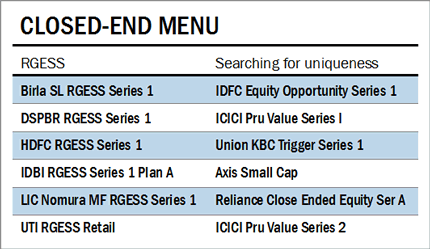
Marketing spiel
Fund managers argue that in a closed-end fund, they can do a better job because they are sure of the tenure for which the money is available to them. More than twenty years ago, closed-end funds were the norm in India. However, gradually, the advantages that open-ended funds had for investors won out and there was an almost total shift towards them.
Unlike open-ended funds, investors can invest in close-end funds only during the initial issue and withdraw when the tenure ends. There are also some other potential problems. The best way to invest in a fund is to do so gradually through a Systematic Investment Plan (SIP), something that is impossible when investing in closed-end funds. Moreover, you do not have the benefit of investing in a fund with a track record, which leaves investors in the uncomfortable position of having to invest based entirely on the fund company's track record on similar funds. It's ironic that closed-end funds are making a comeback in India as a consequence of regulatory changes that were meant to benefit investors.
Ask Value Research 
 New episodes every Friday

 New Process Alert
  Seems like you've uploaded a wrong QR code. Please upload the QR code downloaded from MF Central platform.


