


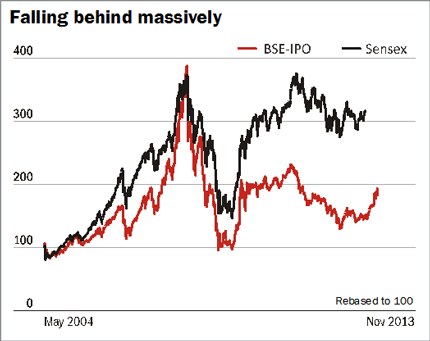
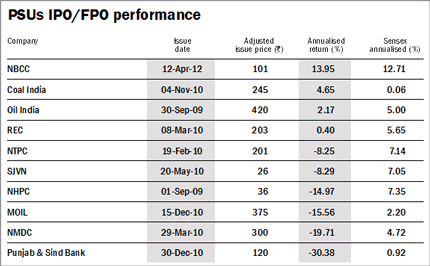
Since the economic turmoil of 2008-09, the primary market has taken a knock. In fact, the current level of the BSE-IPO index is same as that witnessed in January 2005, clearly outlining the struggling performance by the IPOs (Initial Public Offers). Since 2009, 112 companies have cumulatively lost Rs 2,63,554 crore of market capitalisation after launching their IPOs or FPOs (Follow-on Public Offers), which is equivalent to market cap of bottom 225 companies of BSE-500 companies. Even if we exclude the PSUs and FPOs, as they are big in terms of market capitalisation, 107 companies have together lost Rs 1 lakh crore of market capitalisation which is almost a whopping 50 per cent of their market capitalisation at the time of listing. Public sector companies have also not fared well in their respective IPOs and FPOs, although the loss is not of high magnitude. Only two out of the 12 issues have been able to beat Sensex returns: NBCC and Coal India.
Safety net
To safeguard retail investors and woo them to the primary market, Sebi came up with a strategy in 2012. As per the Sebi's proposal, IPOs were to provide a safety net to the investors. According to it, they were to be given an option to sell shares back to the issuers if the stock price fell more than 20 per cent below the issue price within three months of listing.
As per the IPO data, out the 148 companies with price history of more than 3 months, 34 per cent of the companies gave negative return of more than 20 per cent in three months. But the proposal did not get a favourable response, prompting Sebi to bring in convertible securities.
Convertibles
Sebi is now mulling bringing in convertible securities, to be issued by the IPO raiser. These convertibles will be a hybrid instrument of debt and equity and investors would be able to earn interest on these securities after issuance. Investors will have an option to convert bonds into shares if share price performs well or will be able to redeem bonds and get principal and interest if share price fares poorly.
Ask Value Research 

 New episodes every Friday



 New Process Alert
 Seems like you've uploaded a wrong QR code. Please upload the QR code downloaded from MF Central platform.


