




Our methodology of categorising a company as large, mid or small cap on the basis of market capitalisation is not fixed but changes with the market movement. This means when the overall market rises, the cutoff also rises and hence, a company moving at market pace remains in the same rank with the movement. Companies representing the top 70 per cent of the total market capitalisation of the whole stock universe are the labeled as large cap. The next 20 per cent are classified as mid caps while the bottom 10 per cent are small cap.
To move up the ladder the stock has to extraordinarily outperform and similarly, underperformance too should be significant enough to warrant a demotion. We checked how many companies changed their ranks in the last 5 years and got some interesting insights. 135 companies saw a fall in their ranks while just 47 moved up, despite markets giving a positive return. Also, 50 per cent companies that were a part of the mid cap universe in 2008, are now small cap.
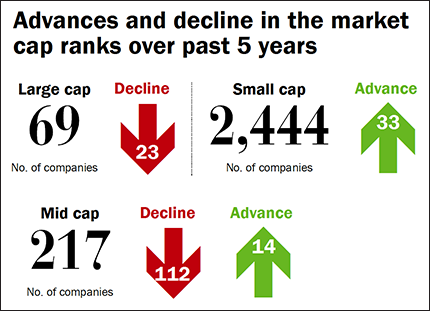
Expanding the ambit of the story further to take into account 10 years, there are four companies worth mentioning. While three have moved on from being a small cap to a large cap, one company saw its ranking coming down to small cap from large cap.
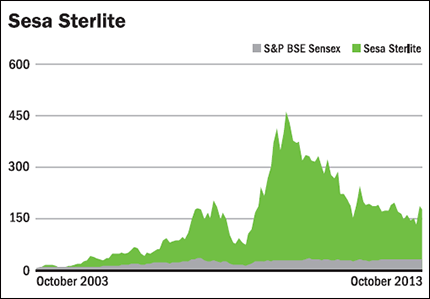
Sesa Sterlite is one of the largest private sector producers and exporters of iron ore in India. The company has leveraged upon its cost effectiveness which gives it a competitive advantage in the Asian market. Though last two years were bad due to mining ban, things are again looking up.
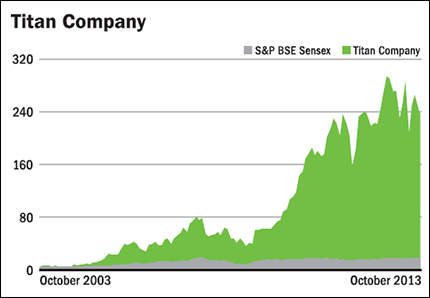
Titan owns brands such as Tanishq, Eye+ and Fasttrack. The company has grown on the back of constant demand for gold in India and has been diversifying its brands across the consumer segments. It was a small cap in 2003 and is now a large cap.
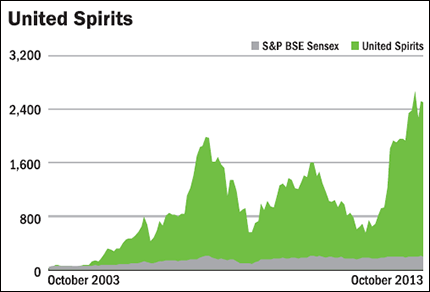
United Spirits owns 140 brands of liquor and has a 60 per cent market share. It has benefitted due to the absence of big players in the oraginsed liquor market in India. Recently, 25 per cent stake was bought by Diageo which can make it a global player.
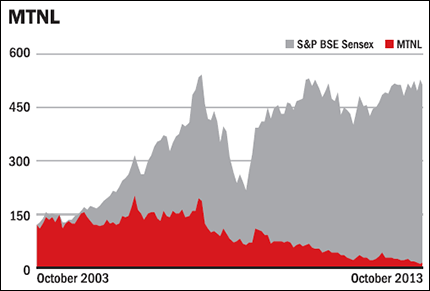
PSU company MTNL once had a monopoly in the four metro cities and grew unhindered. But after mobile phones became affordable and private players came in, MTNL lagged behind. Once a large cap, it has turned into a small cap now.
This story first appeared in the November 2013 issue of Wealth Insight.
Ask Value Research 
 New episodes every Friday


 New Process Alert
  Seems like you've uploaded a wrong QR code. Please upload the QR code downloaded from MF Central platform.


