




Navneet Publication (NPL) may not ring a bell outside the states of Gujarat and Maharashtra today, but will soon do as it goes about expanding its presence across the country. Set up by the Gala family in 1959, the company is a market leader in school book publishing in these two states besides having a dominant presence in stationary segment.
Its products are sold under the brand names of ‘Navneet’, ‘Vikas’, ‘Gala’, ‘FfUuNn’ and ‘Boss’. Besides the constant expansion in the domestic market, NPL also exports to the Middle East, Africa, US and Europe.
NPL also operates in eLearning solutions and direct education though this segment forms a tiny part of the business as it contributes just around 1 per cent of the revenues.
Strengths
NPL has strong brand visibility and recall value among the teachers and students and leads the publishing market with a share of around 60 per cent in its two operational states Gujarat and Maharashtra in the supplementary education books segment. Over the years the company has built goodwill and business relationship with private schools in these states.
* The company has a wide portfolio for its publishing segments with 5,000 plus titles published in five languages -- English, Gujarati, Hindi, Marathi, and Urdu. It publishes supplementary books such as guides, workbooks and question sets for state board students in Gujarat and Maharashtra
* Supplementaries, guides and workbooks books are difficult to do away with these days as the student-teacher ratio is high in a lot of schools and most students rely on them. Also, several books such as science practical books are not published by the government and hence students are dependent on the private players like NPL
* Stationery market is dominated by unorganised players in India which also makes it very competitive. NPL being a big brand, leverages upon gaps created by them and in addition to catering to domestic market, it also exports the same which account for 22 per cent of the revenue from stationery segment
Growth Drivers
India’s literacy rate has grown tremendously over the years but there is still a long way to go. Moreover, the ratio of enrolments in private schools is increasing in comparison to public schools in rural areas. With this growth the demand for study material, books and stationery will naturally grow.
* State governments have been revising the curricula frequently of late to make teaching in tune with the modern times. Growth opportunity will continue to be present for a few more years due to this
* After capturing Gujarat and Maharashtra, NPL started foraying into newer markets last year. The management has planned a capital expenditure of more than Rs 40 crore in FY13 of which Rs 15 crore has already been spent on expansion in Andhra Pradesh by acquiring K-12 Techno Services, the school management company; giving it access to 90 schools and 60,000 students. Further, Rs 10 crore has been planned to be spent on eSense, the e-learning solution segment of the company
* The state boards have a dominant presence of NCERT with little private publisher participation. But in recent times, private state board schools have started following the CBSE pattern and its linked curricula and hence have started choosing textbooks from private publishers as well
* The publishing industry is cyclical in nature with the state governments changing the syllabi every 4-5 years. While the demand picks up immediately after the introduction of the new syllabi, it slows down later. NPL is currently at the second phase of the growth cycle
Concerns
NPL’s plan to expand its operations internationally took a hit when it had to scale down operations of its subsidiary in Spain, Grafalco Ediciones SL, significantly. The company paid off all the liabilities and wrote off the losses in FY12. This happened due to subdued demand in European countries.
* The company was enjoying the export subsidy from the government which was recently repealed. Moreover, it is facing a tough competition in the stationery segment from China not only in the international market but domestic market as well. NPL is also competing with established players like Camlin and ITC apart from the hordes of unorganised players in India, making the segment a low margin business
* In the last few years NPL is not managing its receivables efficiently as the receivable days have gone up to 59 days in 2012 from 46 days in 2008.This, coupled with declining trend in payable days (18 days in FY10 to 9 days in FY12), is a point of concern for the management as this escalates the working capital requirements. This is evident from the loan book of the company (working capital rupee loans of Rs 30 crore)
Financials
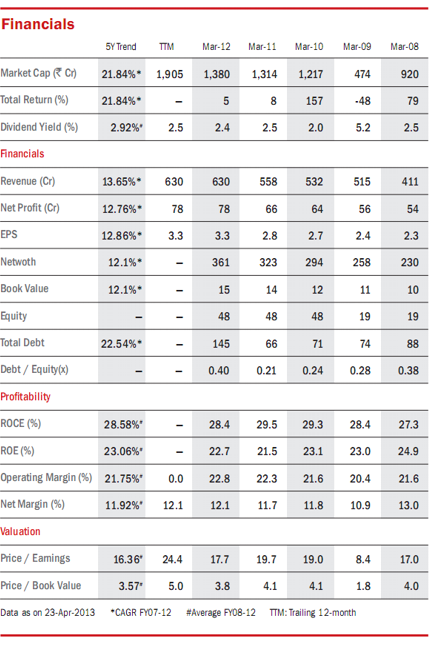
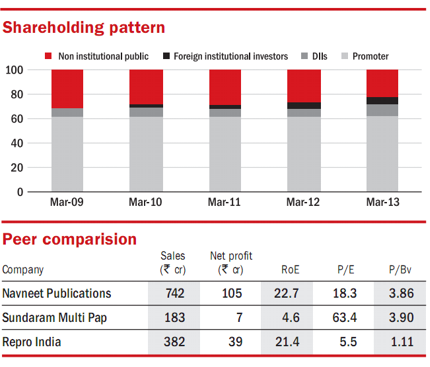
High inventory and loans and advances led to low cash from operating activities in FY2012. But this seems to be a one-time phenomenon and is expected to come back on track in the coming years as the management has attributed the cause for it to increased stationery order book from US. The company accelerated production to beat the proposed increase in excise duty, resulting in higher inventory levels. NPL’s publishing revenue has grown by 11 per cent with a high margin of 30 per cent while stationery business grew by 18 per cent with relatively low margin of 10 per cent. Return on equity is also healthy as it averages to 23 per cent over the last 5 years.
Valuations
At the current price of Rs 57 the stock is trading at price to earnings of 17.5 (pre-amalgamation) which is 10 per cent discount to its 5-year median of 19.4. The company declared last dividend of Rs 1.4 per share yielding 2.44 per cent. At the current level, the stock is looking a little undervalued and may take a while to unlock its value as it has had no momentum in the past couple of years.
This article was originally published on June 07, 2013.
Ask Value Research 

 New episodes every Friday

 New Process Alert
  Seems like you've uploaded a wrong QR code. Please upload the QR code downloaded from MF Central platform.


