




 VRO Team

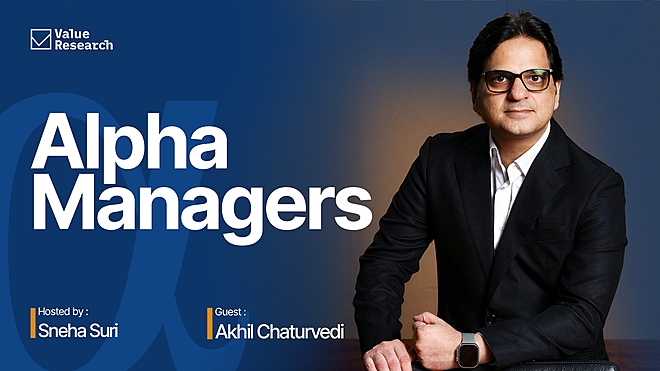
Motilal Oswal Large and Midcap Fund topped its category in 2023 and 2024, fell behind in 2025 and is back on top this year. I asked Akhil Chaturvedi, Executive Director and Chief Business Officer at Motilal Oswal AMC, whether that ride is a flaw or a feature.
Motilal Oswal is a growth house, and in 2025 the market rewarded PSUs, PSU banks, defence, metals and commodities. The fund held none of them. "Our positioning is not defensive," he said. From March 2026 the market rotated back to growth, and so did the fund. Over six and a half years it has delivered about 3 per cent compounded alpha, he said, and the NAV is close to 40, four times the launch price.
Will 2025 happen again? Absolutely, he said. In 2024 the market made new highs every other month, peaked in September, and within two months money had moved into value and defensives. Growth stocks spent 2025 consolidating while their earnings kept coming, which set up this year’s turn. So know which style your fund practises, expect bad years, and hold more than one style so your portfolio stays consistent even when each manager is not.
The fund is more volatile than its category. Chaturvedi says alpha comes from holding 35 stocks, not 60 or 70 that drift toward the index, and a tight portfolio will swing more in the short term. Risk is handled through allocation: weights sit between 2 and 4 per cent, with limits on sector bets, cut-loss rules and liquidity checks.
The portfolio is split roughly a third each across large, mid and small caps. He called that a coincidence of bottom-up stock picking. Large caps have gone to 45 or 50 per cent when mid and small caps looked expensive. After the 2025 correction and strong earnings since, the tilt is towards mid and small.
Banks are almost absent, at 17 per cent in the benchmark. Large banks are growing at 12 or 13 per cent, he said, while good NBFCs grow 10 to 15 points faster, and listed capital-market businesses offer a play on the financialisation of savings. Manufacturing and infrastructure make up 40 to 50 per cent of the portfolio. Consumption is played through discretionary rather than staples, and technology through product-led mid-cap IT rather than offshoring.
A portfolio P/E in the 40s does not worry him, because he sets it against delivered earnings growth of 30 to 35 per cent. That gives a PEG of about 1.3, inside the house’s comfort zone and, by his reckoning, 10 to 15 per cent cheaper than the market.
The house’s mid-cap and flexi-cap funds trailed their benchmarks last year. A manager change in February brought all three funds under Ajay Khandelwal, with tighter risk management, and both are back in the top quartile over six months.
Redemptions rose in the lean patch and are recovering. Across the house, 98 per cent of portfolios are beating the market over three and five years, he said. Investors who stayed through 2025 have been paid for their patience.
This article was originally published on September 23, 2026.
Ask Value Research 
 New episodes every Friday

 New Process Alert
  Seems like you've uploaded a wrong QR code. Please upload the QR code downloaded from MF Central platform.


