




 Ujjal Das/AI-Generated Image

Summary: PFRDA just did for NPS what SEBI did for mutual funds in 2017: standardised categories, readable names and a comparison screen before you pick a fund. For most subscribers, no action is needed. One word in the paperwork, though, could reset your vesting clock.
The pension regulator has done for the NPS what SEBI did for mutual funds in 2017. Two circulars issued by PFRDA on August 28, 2026 sort every NPS investment scheme into five types, force every pension-fund-launched scheme into one of five categories labelled A to E, and fix a naming format that discloses equity exposure in the name itself. The year-old distinction between Common Schemes and MSF schemes is gone.
For most subscribers, the reform requires no action. If you hold the NPS through Lifecycle or Active Choice, your account is untouched. If you bought one of the newer pension-fund-launched schemes, expect a rename within 30 days and possibly a merger within 45. The work left for every subscriber is fifteen minutes with the new map, because every NPS platform must now sell schemes in this format and no other.
Every scheme now has a fixed place and a readable name
The menu has five scheme types. Lifecycle schemes adjust your equity, corporate bond and government securities mix by age, across four variants (Aggressive, 75 High, 50 Moderate and 25 Low). Active Choice lets you set the mix, with equity capped at 75 per cent in Tier I and uncapped in Tier II. NPS Sanchay is the informal-sector composite scheme with equity capped at 25 per cent. MSF covers schemes launched by individual pension funds with PFRDA's approval. The 4A schemes, such as NPS Vatsalya, NPS Swasthya and NPS MSME, keep their own rules and charges.
MSF is where the reorganisation bites. Every such scheme must sit in exactly one of five categories, defined by its equity mandate.
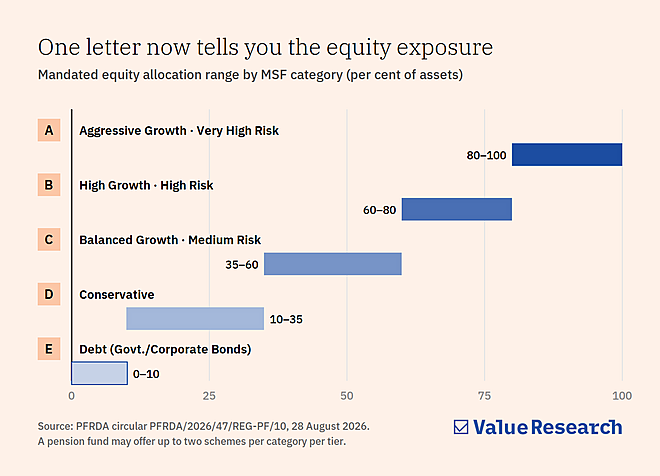
A scheme straddling two bands must be restructured into one within 30 days. A fund can offer at most two schemes per category per tier; extras must be merged or wound up within 45 days, after subscribers are informed.
The category letter goes into the name. The format is fixed: pension fund abbreviation, then “NPS”, then the letter, then the scheme name, with “Tier 2” appended where applicable. “XYZ NPS A Retirement Scheme” is a very-high-risk equity scheme from XYZ; “XYZ NPS E Retirement Scheme Tier 2” is a debt scheme in a Tier II account. A means the most equity, E the least, and you can read any scheme name in the system unaided.
You pick the fund last
The circulars also fix how schemes are sold. Every platform, including the CRAs, must make you pick the type of scheme first, then the category, and only then the pension fund. Before that final choice, it must display every scheme in the category from every fund side by side, with returns, benchmark returns, charges, riskometer, AUM and launch date. You choose the manager on evidence, which reverses how most NPS accounts have been sold.
Each scheme must carry a riskometer, a benchmark and a standard disclosure document, the NPS Scheme Essentials. Annual charges outside the 4A set run 0.24 to 0.32 per cent of AUM for point-of-presence subscribers and 0.04 to 0.12 per cent for direct ones, plus CRA charges of Rs 100 to Rs 500 and a trust fee of 0.003 per cent.
The holding rules: under one PRAN you can hold only one of Lifecycle or Active Choice at a time, but several MSF schemes together. You get two change requests per account per financial year; a combined change of fund and scheme counts as one.
A change keeps your clock; a merger adopts a new one
One provision can cost a careless subscriber. A change of scheme leaves your account's history intact: vesting and the partial-withdrawal count run from the original opening date, regardless of which scheme you move to. A merger of one scheme into another puts the merged money under the target scheme's conditions, including its vesting period and withdrawal limits. PFRDA's own illustration draws the line: a subscriber who opened Scheme A in April 2026 and switches to Scheme B in 2029 keeps the 2026 clock; one who merges A into B lives by B's rules. A switch preserves your history. A merger adopts the target's.
Winding-ups are tricky. If a scheme you hold is closed and you make no choice, you are migrated to the same fund's Life Cycle 50 Moderate scheme in Tier I, a 50 per cent equity glide path that may be nothing like what you bought.
A reform where you have to do nothing
This simplifies NPS. Standard categories, comparable names and a compulsory comparison screen bring NPS the transparency mutual fund investors have had since 2017. The rules skip government-sector accounts, and the 4A schemes stay on their own track. Learn the A-to-E ladder. When the rename letter arrives in September, read past the subject line for signs of restructuring or merger. Before you consolidate schemes, check whether the paperwork says change or merge. On that one word rests your vesting date.
Also read: The last big tax break left in the new regime
This article was originally published on September 01, 2026.
Ask Value Research 

 New episodes every Friday








 New Process Alert
  Seems like you've uploaded a wrong QR code. Please upload the QR code downloaded from MF Central platform.


