
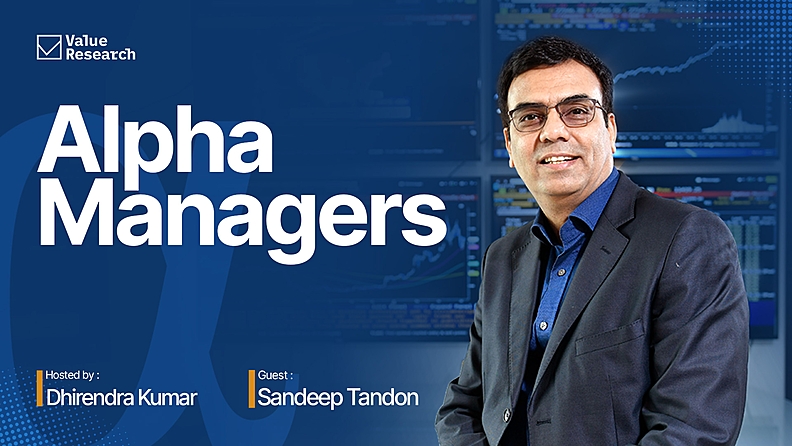
Growth Investor | 12-Aug-2026

Quant fell 16%, then rose 37%. Sandeep Tandon explains
The first conversation in our new interview series, with the man whose funds behave like no one else's in India
Quant Mutual Fund’s equity schemes fell between 10 and 16 per cent in the March 2026 quarter. In the June quarter they rose between 18 and 37 per cent. Same funds, same manager, three months apart.
An investor who bought the Quant Flexi Cap Fund in December 2025 watched 11 per cent of the money disappear in the first three months. Anyone who sold in March missed everything that followed.
This is why Sandeep Tandon is the first guest in Alpha Managers.
We choose the guest for this series the same way every time. We run the fund universe through our filters for quality, consistency and size, then go to the manager whose fund has produced the most alpha among the ones left. That method almost always seats a manager whose fund is running hot. That is deliberate.
Tandon founded Quant and runs it as chief investment officer. He built the analytics platform the firm trades on, starting in 1995 from his house.
We put the fall and the recovery to him directly and asked whether it is a design feature or a flaw. He says it is design. In a risk-on market, Quant builds extra alpha. In a risk-off market, it lies low and accepts that it will underperform.
Whether an ordinary investor can sit through the lying low is the question this conversation raises and does not settle.
| Quant scheme | March 2026 quarter | June 2026 quarter |
|---|---|---|
| Equity schemes, range across categories | -10% to -16% | +18% to +37% |
| Flexi Cap Fund | -11% | 24% |
| Long-only funds, average | -13% | 24% |
| SIF Equity Long Short | -12% | 17% |
| Teck Fund, the sharpest fall | -28.80% | 32% |
Below is the transcript of the video
____________________________________________________________________
“Timing is a risk-mitigation tool”
Dhirendra Kumar: Your framework says timing is a function of valuation, liquidity and risk appetite. Timing is the output, not the input. Explain that to someone who has been told all their life that timing the market is impossible.
Sandeep Tandon: Timing is a risk-mitigation tool for us. We do not call it timing. We call it timing analytics, and it is a function of risk appetite, liquidity and valuation. Those three are the components of our VLRT framework.
If all three are skewed to one side, timing is skewed too, and that helps us take a call. If multiple data points endorse the same thing, we take an aggressive bet, depending on whether the inflexion point is extreme euphoria or extreme capitulation.
Timing is the critical aspect of this business. It sits in the deep subconscious of every money manager, including the others. People do not want to accept that reality.
Dhirendra Kumar: Give me the last decision that changed because of it. What did you buy or sell because the reading turned you around?
Sandeep Tandon: We have been practising predictive analytics for nearly 30 years. We built our own analytics and risk-management platform, Quantamind. It started in 1995 from my house. We have invested more than $24 million in it.
When we started, we were pure valuation people. We looked at the balance sheet, the cash flow, the profit and loss account, and the industry. What is missing in that approach is that if it were so easy, a machine could give you the answer today. It is not that easy. So we also look at how liquidity is playing out, because liquidity drives the market, and at how sentiment is changing.
Take 2020. In 2012, we forecast how the market would behave from the end of 2019 to 2033, and how geopolitical volatility would spike in that period. We wrote in 2012 that there would be a meltdown in 2020. We talked about a crash.
Dhirendra Kumar: That turned out to be Covid. You are saying an event nobody could foresee was anticipated eight years earlier.
Sandeep Tandon: It is published in our 2018 book as well.
Look at it from a cycle perspective. We have thousands of years of wheat data, 600 years of soya data, 300 years of cotton data, 200 years of US yield data, 300 years of UK yield data. We go back and analyse the circumstances in which an event unfolded, then put those dependent and independent variables into a multivariate model.
History repeats or rhymes. This is a game of probability. Our predictive analytics is not a deterministic science. It is a probabilistic one. We are only quantifying the probability of something happening. We always say we are wrong 28 per cent of the time and right 72 per cent of the time, and when we are right, those are large calls.
Now come to 2020. By the end of March, valuations had become attractive after the crash. There was no certainty they could not correct further. So what mattered was liquidity and risk appetite. Liquidity had collapsed to a 40-year low globally, including India and the US. Risk appetite was at Lehman levels, which means nobody was in the mood to buy anything. By mid-April both had bottomed out and started inching up. That is a lethal combination for a bull run. Between 15 and 18 April we deployed our money. Our fund was very small then.
“Risk appetite is a mood. We turn it into a number.”
Dhirendra Kumar: Risk appetite is a mood. How do you turn a mood into a number, and what is the closest free proxy an ordinary investor can watch?
Sandeep Tandon: Risk appetite is a behavioural indicator. We combine behavioural analytics with the country’s macro data, and that combination gives us the measure. That is why we can quantify it.
Think of it as your conviction level. In January 2018, when the bull market peaked, everybody was euphoric. At the peak of a cycle, risk appetite is highest, and everybody is a long-term investor. You see it in the media noise, in the articles, in the upgrades, in the money pouring in, in how heavily subscriptions get filled. Those are the classic euphoric signs.
For a simple proxy, look at the derivatives data. Look at rolls. What percentage of positions are being rolled? Are people willing to roll at a narrow spread, or willing to pay a higher cost to roll? That reflects confidence.
Dhirendra Kumar: How is it reading today?
Sandeep Tandon: I look at these data points for inflection. Between March and July 2024, risk appetite drifted down, and the liquidity cycle peaked. That is why we turned cautious on India. We were the first to downgrade India.
The reverse happened at the end of March 2026. On 1 April, we wrote in our fact sheet that it was time to capitalise, not capitulate. Risk capital had hit its lowest point in years, and liquidity had started improving. We said to increase small-cap and mid-cap exposure, and that micro-cap would outperform small, and small would outperform mid. Over the last three or four months, that played out.
Today we have moved up from one extreme, but not to a level that gives me discomfort. Risk appetite and liquidity are both constructive. They are inching up, not running away. The easy phase of this bull run is over. From here, large caps may do better. Even the foreign investors are coming back into mid and small caps this time rather than large caps.
“It is not a flaw. It is how we operate.”
Dhirendra Kumar: In June 2024, you told investors that in the March 2023 quarter you were the worst performer in every equity category, and three quarters later you were back on top. It has happened again. Your equity schemes fell 10 to 16 per cent in the March 2026 quarter and rose 18 to 37 per cent in the June quarter. Is that a design feature or a flaw?
Sandeep Tandon: It is not a flaw. It is a question of how we operate. In a risk-on environment, we accumulate extra alpha. In a risk-off environment, we lie low. Since we implemented VLRT in April 2020, we have fallen sharply three times in six years and come back from the last position to number one each time.
The risk-off period is the challenging one. The idea is to protect, and protecting is not easy, because you do not have a proper hedging mechanism. You cannot short the market even when you are negative. So as a strategy, we have the potential to underperform in a risk-off period.
Over one, three, five and ten years our schemes have been in the top quartile. Over ten years, 80 to 90 per cent of our schemes are in the top quartile. Over three years, 70 per cent. Over one year, 99 per cent.
Dhirendra Kumar: I go to Value Research Online, click on Quant and look at your rankings. Over one month, most of your funds are at the bottom. Over one year, almost all of them are at the top. I find that unnerving, and a new investor who walks in and buys will find it more unnerving. What is happening inside the portfolio that produces both at once?
Sandeep Tandon: We are number one, and by a big margin. The gaps are two to three times the industry average.
We are proponents of a dynamic style of money management, and we are vocal about it. Buy and hold- that era has passed. It is a bold statement, but something has changed from 2020 to 2032 or 2033. In an environment of extremely high geopolitical volatility, buy and hold will not work.
Active management means we are not mimicking the index. We are nowhere near it. So when the market rallies, we beat the index decisively. When the market falls, we have the potential to fall more, because some of the stocks we actively manage may fall more.
People look at our absolute or relative return. Our risk-adjusted return is more meaningful. A lot of people think we are a very aggressive house. We are not. We are a risk-averse house. We are in the business of risk management, and if you manage risk properly, returns are the by-product.
Dhirendra Kumar: I have been running Value Research for 35 years, so I am curious about the spending. You said $20 million. How much of it is technology and how much is data?
Sandeep Tandon: Largely data and technology. It does not include employee salaries.
Dhirendra Kumar: How much went into buying raw historical data, and how much into building and testing the algorithms?
Sandeep Tandon: Raw data would be no more than 10 or 12 per cent. It was higher initially. As we understood the sources, we built a lot on our own.
Who should not buy these funds?
Dhirendra Kumar: Somebody bought your Flexi Cap Fund in December 2025 and was down 11 per cent in the first quarter. You invest, you face a decline like that, and you can be frightened for life. What should they have understood beforehand to make those three months bearable?
Sandeep Tandon: The market corrected in that phase. What we tell investors is that if you are putting money into equity, you should have a five- to six-year horizon. With that horizon, even if you come in at the peak of the cycle, you will still make money after six years.
The problem is that people come at the peak, when everybody is excited, and everybody is making money, without the risk appetite needed to hold the position. Then they give up at the bottom. That capitulation is what has to be avoided.
Dhirendra Kumar: Who should not buy your funds at all?
Sandeep Tandon: If you have a low risk appetite, look at the multi-asset funds. We do not deploy 100 per cent in equity there. Our Quant Multi Asset Fund has beaten the best of the benchmarks over one, three, five and ten years, whether small cap, mid cap, large cap or thematic.
Shorting, the SIF, and a product with no history
Dhirendra Kumar: What does shorting teach a money manager that 30 years of being long never did?
Sandeep Tandon: Before I managed other people’s money, I managed my own, and a large proprietary position. Shorting is something we are familiar with, and I was the risk manager of that entity.
In India, shorting is generally treated as hedging, and with leverage it becomes a deadly combination. With the SIF coming into the country for the first time and long-short strategies becoming possible, we start learning that you can create alpha on the short side too. That is an important mindset change. The industry lacks that experience, because all of us grew up with buy and hold, with everything being long term.
From a risk point of view, it is a good product that SEBI has given us. We can manage at least 25 per cent of the beta in the portfolio, which was the challenge in mid and small caps. People think the SIF carries higher risk. It is actually meant for more conservative investors, because we can control beta and deliver a superior risk-adjusted return.
Dhirendra Kumar: In the March 2026 quarter, your Quant SIF Equity Long Short fell nearly 12 per cent. Your Flexi Cap fell about 11 per cent. The long-short fund is allowed up to 25 per cent unhedged shorts. Why did the shorts not help?
Sandeep Tandon: Our Equity Long Short has given far better returns than our own Flexi Cap. Over three months, the Long Short returned 9 per cent against 5.3 per cent for the Flexi Cap. Over six months, both were around 14.2 per cent. Even where the six-month returns are similar, my risk-adjusted return is higher, because we did not take that risk.
These are unique products, and a lot of education is needed. People get worried the moment they hear the word derivatives. Derivatives are a good risk-management instrument, and SEBI does not allow us to take leverage in a SIF. Without the leverage element, this is a unique opportunity.
Dhirendra Kumar: Buffett called derivatives financial weapons of mass destruction.
Sandeep Tandon: He was the biggest user of derivative instruments, because he was running the biggest insurance company.
Dhirendra Kumar: He was underwriting risk and had that unusual float. But look at the June quarter. Your long-only funds are up 24 per cent, and your long-short is up 17 per cent. Same fall, less of the bounce. How do you make a case for the SIF now?
Sandeep Tandon: You should not look at one quarter. In a sharp bull run, a SIF will underperform by definition. The moment you run a 25 per cent short, your effective net long is 75 per cent. You cannot compare a 75 per cent long product with a 100 per cent long product in a bull market. It is bound to underperform, in the same way a hybrid fund underperforms a mid-cap or small-cap fund.
Every investor should assess their own risk appetite and their own horizon. Over five or six years I think these SIF products will deliver a much better risk-adjusted return. People focus on returns, absolute or relative. They understand risk-adjusted returns, but they do not practise looking at them. The SIF will build that habit.
Dhirendra Kumar: The numbers do not stack up yet. It is too narrow a period, and most of these strategies are not even a year old. What is the minimum period after which you would accept a judgment on them?
Sandeep Tandon: One year will give you some perspective. Enough clarity will emerge in three years from a cycle point of view. We use six years in our own analysis, because in six years you get at least three decisive up moves and three decisive down moves.
Once people realise, in three to six years, that the SIF has delivered a superior risk-adjusted return, there will be a tsunami of money shifting from mutual fund schemes to SIF schemes. We have already started saying you should hold 50 per cent in mutual fund schemes and 50 per cent in SIF. That gives better diversification, less volatility and a better risk-adjusted return. You can change the ratio to suit your risk appetite, but 50 per cent is the simple version.
Dhirendra Kumar: Your presentation suggests a 65-year-old should hold 80 per cent in SIF strategies and 20 per cent in equity mutual funds. That is a bold allocation for a product with virtually no history. Defend it.
Sandeep Tandon: On the equity side, I have no control unless I am sitting on a very large cash position. In a SIF, we have the luxury of creating shorts, and we talk about opportunities to short rather than running a long-short position continuously.
Second, look at hybrid as a category. It is promoted as a low-risk category. Returns are decent across the industry, and the risk taken is small. The risk-adjusted return of a SIF is already better than that of a hybrid fund. That is why we say a conservative investor should have a larger allocation to the SIF. The perceived risk is much higher than the real one. Mathematically and statistically, a SIF carries lower risk than a mutual fund scheme. Time will tell whether people get educated.
Dhirendra Kumar: Would you put your own parents’ money here?
Sandeep Tandon: Of course. It is already there. We also have a sizeable holding of our own in our SIF products, well beyond what the regulator requires.
From a small beginning to Rs 1 lakh crore
Dhirendra Kumar: You became one of the fastest-growing fund houses. People chased recent performance and poured money in like the Pied Piper. Then the market fell, and we saw the turbulence. Now the numbers are impressive again. Has money started flowing in?
Sandeep Tandon: Our inflows are net positive now. We have grown vertically, from a very small amount, to Rs 1 lakh crore in about four and a half years. That is a unique case study, not only in India but globally.
We also needed time to consolidate, expand the team, put more processes around the business and expand the board. We have been investing heavily over the last two years, because we never planned to grow like this. Sometimes consolidation is healthy.
People also have to understand how we operate. It is not simply that we underperform in a bear phase. Over six years, people have seen that we can come back from the last position to number one, because it is a process we run mathematically. We are not doing random things.
Dhirendra Kumar: What are the exact guardrails? What are you doing differently at Rs 1 lakh crore that you were not doing at the start?
Sandeep Tandon: We started like a startup. Startups and mutual funds are typically loss-making for the first seven to twelve years, and we worked with that mindset. We were nimble, and the cost structure reflected it.
Today Rajnish Kumar, the former SBI chairman, is our trustee chairman. Board meetings now run over two days, a preparatory and review meeting on one day and the board meeting on the next. It works like a listed company. On the AMC side, Nishith Mehta has joined, with experience in compliance, risk and governance.
We have engaged a chartered accountancy firm for our system audit, cyber audit, process audit and code audits. We are largely a technology company, so we have spent heavily on upgrading technology. We have brought in senior people in compliance, operations and finance. I do not take any dividend from the company. We are reinvesting everything, setting up larger offices and backup centres.
That is why we were lying low for two years, putting these processes in place. We did not spend time or energy on marketing.
The last question
Dhirendra Kumar: What is the question investors should be asking their fund manager, and what should they never do?
Sandeep Tandon: The first question an investor should ask is of themselves. What is my true risk appetite, and what is my investment horizon? You have to measure it. You select your funds on that basis, and the other answers follow.
I will also compliment retail investors. I have been in the market for 33 years, and I can say with confidence that the Indian retail investor has become very mature. Earlier, they came only at the peak of the cycle. Since 2020, they have understood compounding and the wealth effect. At our end we see more inflows when the market corrects and more outflows when it rallies sharply. That is behaviour, and we track it, because we are a behavioural house. Ninety-seven per cent of our assets are retail, one of the highest proportions in the industry, across more than one crore investors.
Dhirendra Kumar: And what should they never do?
Sandeep Tandon: They should not get stressed by the market. A lot of people take unwarranted stress. India is a growing economy. We are in a structural bull run until the demographic cycle peaks, somewhere between 2047 and 2050. Too much involvement with the market is not good for your health.
Other Videos


Up 8% when small caps were bleeding. How?
· 2,921 Views

'This decade may belong to mid-tier private banks'
· 2,505 Views

'The market is clearly far more attractive today'
· 1,608 Views

'Investing is a marathon, not a sprint'
· 3,323 Views


'Correction could be more prolonged in mid and small caps'
· 10,096 Views

'Large and mid caps look better placed than small caps'
· 9,504 Views

'Even after the correction, mid and small caps aren't cheap'
· 11,108 Views


'Small-cap index gave 20%+ returns over last 3 and 5 years'
· 16,718 Views

Why did Mirae's small-cap fund outperform in a tough 2025?
· 34,484 Views

'We don't see a major market downturn right now'
· 14,168 Views

'Half the battle is won if the buying price is right'
· 19,422 Views

'Margin of safety looks better on the large-cap side'
· 21,111 Views

'Growth is stronger, earnings are catching up'
· 37,295 Views

'More value has emerged in large caps this past year'
· 42,563 Views
 New Process Alert
  Seems like you've uploaded a wrong QR code. Please upload the QR code downloaded from MF Central platform.


