




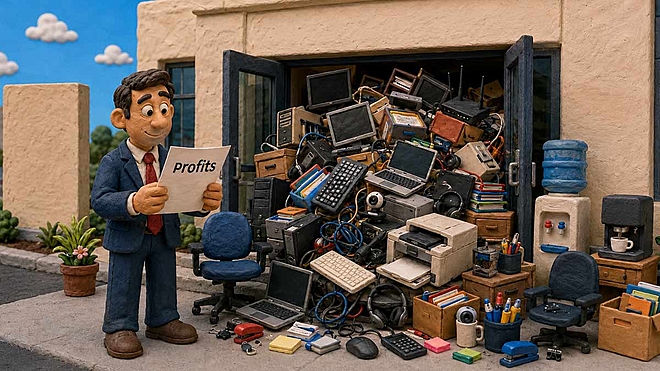
 Anand Kumar/AI-Generated Image

Summary: A stock screen identifies six large companies whose asset bases have more than tripled over three years. But a heavier balance sheet doesn't always mean more capacity or more profit. We unpack three of them to ask what really fuelled the growth, and whether it's earning its keep.
Some companies grow profits first. Others build the balance sheet first.
This screen hunts for companies with a market cap above Rs 5,000 crore whose net block has more than tripled in three years. At first glance, it reads like a capex screen. That's only half the story.
Not every company here has poured concrete for new factories. Some have bought businesses. Some have folded former joint ventures or associates into their accounts. Some have simply added right-of-use assets — the value of long-term leases now recorded on the balance sheet under current accounting rules. The route matters.
A larger asset base can create operating leverage: the power to grow profits faster than revenue once fixed costs are covered. But the same screen can deceive. Net block can swell because an accounting treatment changes, a lease structure shifts or an associate turns into a subsidiary, none of which adds a single unit of fresh operating capacity.
The real questions are simpler. What pushed the asset base up? Was it bought cheaply? And is it earning enough? The six companies below each answer differently. We've covered three.
When the balance sheet grows before profits
Asset growth is clear; the reason behind it needs checking
| Company | FY23 net block (Rs cr) | FY26 net block (Rs cr) | Increase in net block | Stock Rating |
|---|---|---|---|---|
| InterGlobe Aviation | 1,143 | 11,124 | 9.7 | 2 |
| Bajaj Auto | 2,792 | 13,313 | 4.8 | 4 |
| Torrent Pharma | 7,716 | 28,711 | 3.7 | 3 |
| PCBL Chemical | 1,890 | 6,332 | 3.4 | 2 |
| KIMS | 1,288 | 4,243 | 3.3 | 2 |
| GMR Power | 2,351 | 7,135 | 3 | 2 |
InterGlobe Aviation
InterGlobe Aviation runs ‘IndiGo’, India's largest airline, and its place on this list comes with a caveat. On paper, its property, plant and equipment (PPE) leapt from about Rs 1,111 crore in FY23 to Rs 11,087 crore in FY26, a tenfold jump. For an airline, though, PPE alone is a misleading lens.
IndiGo has long parked most of its operating assets under right-of-use assets, via operating leases and sale-and-leaseback deals in which an aircraft is sold to a financier and immediately leased back. In FY26, these still dwarfed PPE, at roughly Rs 52,054 crore. Add PPE, right-of-use assets and capital work in progress (CWIP) together, and the total asset base grew about 2.3 times since FY23, not anything close to tenfold.
What the screen is really catching is a change in how the fleet is financed. IndiGo is leaning towards more owned and finance-leased aircraft, which pushes assets into PPE without adding proportionate new capacity. Operationally, the fleet expanded from 304 to 441 aircraft and FY26 capacity rose 9.5 per cent: genuine growth, but not the scale the net block figure implies.
The shift can trim long-term costs and tighten fleet control, but it also raises capital intensity. IndiGo is the warning label on this screen: net block can climb because the financing strategy changed, not because operating capacity multiplied.
Bajaj Auto
Bajaj Auto makes motorcycles, three-wheelers and electric vehicles. But its consolidated asset expansion isn't mainly about EV capex or the Triumph partnership. The bigger event is KTM.
In FY26, Bajaj took control of the Pierer/KTM structure. KTM had been an associate, accounted for under the equity method; only Bajaj's share of KTM's profits was recorded, not its full balance sheet. Once Bajaj acquired control, KTM was consolidated directly into its accounts, bringing in Rs 4,207 crore of PPE, CWIP and right-of-use assets, along with Rs 9,338 crore of borrowings.
The operating question is whether Bajaj can convert KTM from a stressed global premium-motorcycle business into a profitable platform.
The core business looks sound. Standalone FY26 revenue rose 17 per cent to Rs 58,732 crore, earnings before interest, tax, depreciation and amortisation (EBITDA) climbed 19 per cent to Rs 12,019 crore, and profit after tax advanced 21 per cent to Rs 9,825 crore. Electric vehicle revenue crossed Rs 8,000 crore, more than 20 per cent of domestic sales, while KTM-Triumph global revenue came in around Rs 5,000 crore, up 40 per cent.
Bajaj is now running two stories at once: a healthy domestic franchise and a large overseas acquisition. The upside is premiumisation and a KTM turnaround. The risk is that KTM hands over debt and working-capital stress that the standalone business has to absorb.
PCBL Chemical
PCBL Chemical makes carbon black and specialty chemicals, and its asset expansion is both acquisition-led and capex-led.
The acquisition leg is Aquapharm, bought to push PCBL into water-treatment chemicals, oil-and-gas chemicals and other specialty applications. The capex leg is added carbon black and specialty black capacity. That makes PCBL a hybrid: part diversification, part capacity build-out.
The FY26 numbers show why the screen warrants caution. Consolidated revenue was around Rs 8,190 crore, down about 3 per cent. EBITDA came in at roughly Rs 1,081 crore, and profit after tax slid sharply to about Rs 198 crore. Carbon black volumes hit an all-time high of around 6.2 lakh tonnes, yet margins stayed weak. Aquapharm also struggled, posting revenue of about Rs 1,443 crore and fourth-quarter EBITDA of just Rs 29 crore.
The assets are in place; the operating leverage hasn't shown up. If carbon black margins, which are the gap between selling price and raw material costs, recover and Aquapharm improves, profit growth could outrun revenue growth handsomely from this depressed base. But carbon black is cyclical, import pressure caps pricing, and Aquapharm still has to justify its Rs 3,800-crore price tag. PCBL has built and bought the capacity. Now it has to earn on it.
Find the businesses that are actually earning on their assets
A screen can flag a growing balance sheet, but it can't tell you whether the growth is real or whether it's worth the price. Value Research Stock Advisor does that work for you by providing research-backed recommendations, clear buy-and-hold guidance and the reasoning behind every rating.
Subscribe to Stock Advisor today
Ask Value Research 

 New episodes every Friday













 New Process Alert
  Seems like you've uploaded a wrong QR code. Please upload the QR code downloaded from MF Central platform.


