 Widely read:


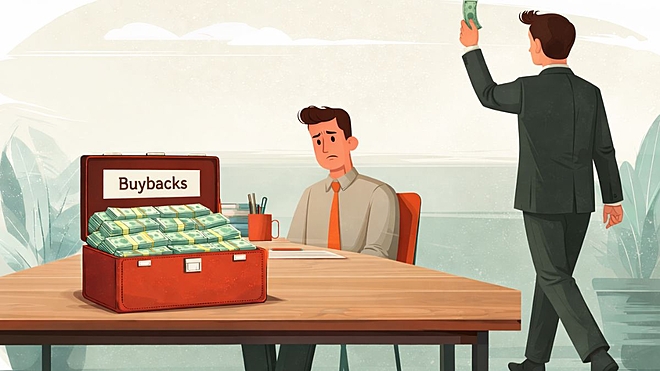

Summary: Buybacks always looked attractive but the tax bill often left investors worse off. Budget 2026 has fixed that. We break down what has changed, how much tax retail investors can save and why promoters no longer enjoy the same edge.
The Union Budget 2026–27 has changed how share buybacks will be taxed and for most retail investors, this is a long-overdue fix.
Buyback proceeds will now be taxed as capital gains, not as income. It’s a small change on paper but it makes a big difference to how much tax investors actually pay. To understand how, we first must look at how the existing taxation framework works.
How buybacks are taxed today
Until now, the entire amount received in a buyback was treated as income from other sources and taxed at the investor’s income-tax slab rate.
Suppose you owned 100 shares bought at Rs 2,000 each. The company announces a buyback at Rs 2,200, and your shares are accepted.
You receive Rs 2.2 lakh (ignoring the 10 per cent TDS for simplicity). Under the existing rules, you were required to pay tax on the entire Rs 2.2 lakh, even though your actual gain was only Rs 20,000.
If you were in the 30 per cent tax bracket, your immediate tax outgo was Rs 66,000.
There was, however, a second leg to this. The Rs 2 lakh you originally paid for the shares was treated as a capital loss. This loss could be adjusted against capital gains from other investments, reducing the overall tax bill.
Why this helped promoters more than retail investors
This structure worked only if you had capital gains elsewhere to adjust the loss against. Many retail investors don’t.
For them, the tax was real and immediate, while the capital loss often remained unused. In effect, investors ended up paying tax on the full cash they received, even though most of it was just their own money coming back.
Promoters, on the other hand, were better placed to benefit. They usually have multiple holdings and frequent capital gains, making it easier to absorb such losses over time. This kept buybacks tax-efficient for promoters and less so for minority shareholders.
What changes now
The new proposal fixes both these problems.
Buyback proceeds will now be taxed as capital gains, which means only the actual profit will be taxed, not the full amount received.
Using the above example, the taxable gain will now be Rs 20,000, not Rs 2.2 lakh. If this is treated as a long-term equity gain, the tax would be around Rs 2,500. Even as a short-term gain, it would be roughly Rs 4,000.
There is no capital loss to track, no need to find gains elsewhere to make the numbers work, and no slab-rate tax shock. Investors are simply taxed on what they actually earn.
Meanwhile, the rules get tightened for promoters. Buyback gains for promoters will face an additional tax layer, taking the effective rate to 22 per cent for domestic companies and 30 per cent for others. This reduces their scope for using buybacks mainly as a tax-planning tool.
What this means for you
For retail investors, especially those without regular capital market transactions, this is a clear improvement. The earlier “capital loss benefit” existed mostly on paper. Now, the tax outcome is straightforward and predictable.
For promoters, the change closes a loophole. The additional tax on buyback gains reduces the incentive to use buybacks mainly for tax efficiency. This helps ensure that buybacks are driven by capital allocation needs rather than tax planning.
Buybacks become fairer, cleaner and more evenly balanced between promoters and minority shareholders.
Also read: A reading of Budget 2026 through a stock investor's lens
Disclaimer: This content is for information only and should not be considered investment advice or a recommendation.
For grievances: [email protected]
Ask Value Research 
 New episodes every Friday









 New Process Alert
 Seems like you've uploaded a wrong QR code. Please upload the QR code downloaded from MF Central platform.


