




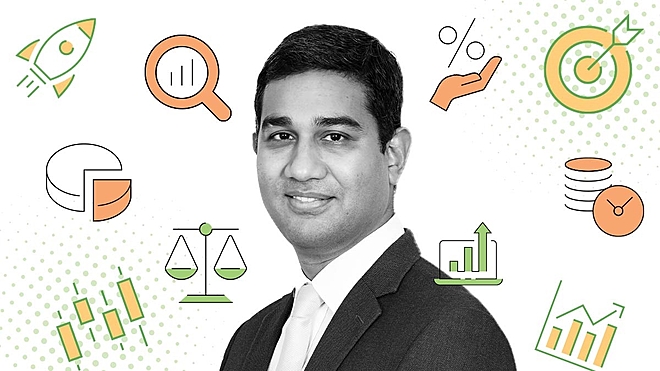

Summary: With global tech spending still uneven, SBI MF’s Vivek Gedda is cautiously optimistic. In this conversation, he explains why uncertainty may be easing, how margins are holding up, and how a broader view of innovation shapes his approach to tech investing.
At a time when global technology spending remains uneven, and expectations remain fragile, Vivek Gedda strikes a note of cautious optimism. The fund manager at SBI Mutual Fund, who oversees the SBI Technology Opportunities Fund and the SBI Innovative Opportunities Fund with a combined AUM of Rs 11,207 crore, believes the worst of the uncertainty may be moving behind us, even if a sharp growth rebound is unlikely just yet. While demand recovery is still tentative, margins appear better positioned, helped by productivity gains and currency support. Gedda’s investing framework rests on three non-negotiables: strong economic moats, favourable risk-reward, and high confidence in management and governance.
In this conversation, he explains how selective positioning, active bets and a broader definition of innovation have helped navigate a difficult phase for technology stocks.
From the perspective of Indian technology companies, how would you describe the current global tech environment, particularly regarding demand, margins and expectations?
In the context of IT services specifically, I don't think it's a rosy picture at this time. But I do think that things are improving at the margin. Two factors primarily influence enterprise spending. One, of course, is the overall macro sentiment, which seems to be just turning around at this point. The second aspect is the technology cycle.
We are at a very interesting juncture, with a tectonic shift in the technology cycle. But while that is playing out, the macro environment has not been very supportive. There has been a lot of uncertainty due to several factors, be it tariffs, visas, geopolitics and war, and some of that, I think, is starting to get behind us at this point in time. To that extent, more than the economic growth rate in key markets like the US, I think the uncertainty moving behind us could potentially help.
We are beginning to see early signs of that in the results announced by some of the large caps. I remember very clearly that, for multiple quarters, Infosys has been talking about a stable environment with no major changes. But for a change, in the latest earnings announcement, it sounded as if they had a sliver of hope, at least in two verticals, and they were sounding a lot more positive. That gives me a little more hope for 2026.
But that said, does that mean we are looking at a significant growth acceleration? I would caution against that, maybe not at this point in time, because there is enough math to suggest that the exit rates for new deals are not extremely conducive to strong growth in FY27. So even as things improve, we may be looking at only marginally better growth expectations than the street estimates, which remain closer to mid-single-digit growth for FY27.
From a margin perspective, I believe things are relatively much better positioned. While currency has been a big support, I also think much of the impact of deflation is already baked into some of these companies. With improved productivity and better revenue per employee, they should be able to manage margins. In fact, if you look at history, Indian IT companies have been very well calibrated during weak growth phases, and I think it is not any different this time around, either.
Walk us through your core investment framework? What are the non-negotiable principles that guide your decisions?
Firstly, there are certain scheme-based guardrails that one has to follow. But if I keep that aside and just think about the core overarching principles, they are very cliched, but they absolutely work. There are essentially three things that I focus on when I'm looking at a long-term fundamental thesis.
The first is that the business must have a very strong economic moat. Second, the valuation has to be conducive, and the risk-reward should be favourable. And third, there should be very high confidence in management and governance, in management's execution capability, as well as strong governance standards. These three principles are always top-of-mind and are the ones I would want to vet any investment idea against.
While the broader tech sector has struggled, your Technology Opportunities Fund has been relatively resilient in 2024 and 2025. What aspects of portfolio construction or stock selection have helped navigate this phase?
If I have to be bluntly honest, some of it is also luck, and I’ll tell you why. When I took over the fund, the idea was to move away from very traditional IT services companies and build exposure to many platform-based companies that I believe have strong moats and significant growth potential. In fact, this fits very well with the principles that I spoke about.
I had three buckets in mind while constructing the fund, and I continue to run it that way. The first bucket comprises some of these large-cap names, which carry a very high weight in the index. There, I am always looking at a relative call, trying to ensure that I pick the right stocks and then size them up meaningfully within the large-cap bucket.
The second bucket is focused on long-term structural platform companies with very high long-term growth and return potential and strong moats. The third bucket is where I am trying to play high-risk, high-reward names with a more tactical focus, where I believe there is strong near-term earnings growth and a high degree of confidence from a risk-reward perspective. That is where I would want to generate much more alpha with this framework.
What helped was that the weightage to IT services was much lower, and thankfully, some of the names that we managed to size up from a selection perspective did very well. That is what helped the tech fund navigate this phase.
An IT fund has always gone heavy on the top four or five IT companies, but your biggest allocations are quite different from the bunch. What prompted you to stay different from the rest, and how much did it contribute to your returns?
When I'm constructing this portfolio, I'm not trying to diversify across the large-cap names or hug the benchmark. I want to take very active calls on names where I believe they will outperform the other large-cap names in the benchmark.
So you will see that I may size up one or two names at any given time, and I expect those to outperform the rest of the pack. That is the objective, so that I can play the risk-reward much more actively. On the other hand, I also want to create a lot of room for some of the new-age names, which I think are very top-end technology companies with strong moats and which, over the long term, should deliver much superior returns for unit holders.
From that perspective, to make space for these names, we tend to have a much lower number of large-cap stocks and a relatively lower weight in them. And the third bucket I spoke about is one I've been actively pursuing, where I want to play mid-cap names with relatively large active bets so that, if my thesis works out, the impact is meaningful. I think these few tenets did help the tech fund, and I hope they continue to work going forward as well.
There’s an ongoing debate about whether AI is in a bubble. Where do you stand? And what would be the clear signal for you that we’ve crossed into bubble territory?
From my vantage point, calling AI a ‘bubble’ is very difficult. I don’t think I have figured out where and when an AI bubble can be easily identified. But what you may be referring to is the AI trade unwinding that has happened recently, at least in the US.
There is always a curve where you see a significant upward slope as soon as a new technology emerges, and then things cool off when people realise they first need to figure out what to do with it. I think many enterprises are currently in a phase where they are trying to understand what to do and how to implement it.
That, in my view, will be a short-lived period. I don’t think this is a bubble that is going to burst and vanish completely. I do believe the recovery will be fairly soon, because there are clear outcomes that some large global software companies have already demonstrated. Palantir, for example, is a clear example of how Gen AI has been used to drive enterprise-wide operational improvements. In that context, I think this is just a pause, if at all, and I am not sure if there is a bubble out there, or whether I am even in a position to clearly identify where one might be.
When you look at the current valuations of Nvidia and other FAANG stocks, do they suggest we are entering bubble territory because the valuations are so high?
If I think about some of these large names, be it Alphabet, Microsoft or Nvidia, you would be surprised to know that their valuations are actually much lower than some of the Indian IT names. It is just that earnings growth has been so massive, both historically and in terms of future expectations, that it appears optically expensive. Yet the valuation premium is not really significant.
In fact, I think the valuations aren't so rich for some of the names I just mentioned. There could be some companies, if I go further down the pecking order, where there is still a discovery process to determine which is potentially the best in areas like data warehousing. But as and when consolidation happens, I think there will be certain names that will look very attractive even at the current valuations in hindsight.
The SBI Innovation Fund has a much broader canvas than just traditional technology. How do you define ‘innovation’ in investible terms, and what kind of businesses qualify for the portfolio? Is it about new technologies, changing business models or simply companies benefiting from disruption?
Innovation is admittedly a very broad term, but we identify it through three buckets.
One: companies with a very innovative product or service. It could be anything, but it is either very new or clearly differentiated and miles ahead of others. The second bucket is companies with very innovative processes, which translate into simple metrics like a strong cost advantage or a business model that is very nimble and easy to adapt.
The third bucket is followers: companies that may not be the original innovators but can quickly pivot to a product or service in demand. Someone who can do that effectively is a follower of an innovator, but we would still classify them as an innovative company.
These are the three buckets. So far, people have found it difficult to imagine some very traditional businesses as innovative, but even there, you can see many companies fitting into these categories. It is not just about technology. For example, I don’t think most IT services companies would fall into the innovation bucket, except in some specific cases where they are doing something genuinely different.
Thankfully, we are now seeing a slew of very innovative and interesting companies coming to the public markets, and investors are beginning to understand that it is possible to place at least some of these names into these three buckets and play the moats they offer.
Also read: 'Small-cap index gave 20%+ returns over last 3 and 5 years'
Ask Value Research 
 New episodes every Friday




 New Process Alert
  Seems like you've uploaded a wrong QR code. Please upload the QR code downloaded from MF Central platform.


