


Income statement of a company has many non cash components; one of the biggest such recurring component is depreciation. Capital expenditure incurred on tangible assets such as machinery is stated in the balancesheet, and subsequently written off as depreciation over the course of its usage. Since the payment for buying such assets is made at one go, the subsequent write offs over the years are non cash and expenses that are not actually occurring year after year. If the amount of depreciation is huge, as it happens in case of manufacturing companies, the net profit is somewhat different than the actual cash earnings for that particular year. So, to arrive at actual annual growth we should compare earnings excluding such charges. So, we can calculate cash earnings per share (CEPS) by adding depreciation into the EPS.
Now the question that arises is why we should look at the cash EPS. Before answering the question, one should remember that depreciation is the amount charged over the asset’s useful life. So, what is the useful life of a machinery or an equipment? While a minimum time can be arrived at but it is difficult to say that after this many years a particular machinery or equipment will become redundant. This useful life is determined by the management and hence the amount of depreciation can also be manipulated by it. If the estimated life of the asset is increased then the depreciation comes down, thus further inflating the profits. But, vice versa may also happen. A company’s earnings before such charges sometimes give more insight about it.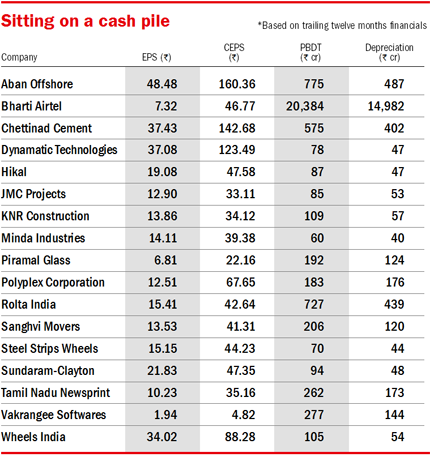
We have enumerated the companies where the difference between cash EPS and EPS is huge. That is, depreciation is more than 50 per cent of PBDT (profit before depreciation and taxes). Here the companies have earned more cash than what appears in the net profit.
Ask Value Research 

 New episodes every Friday


 New Process Alert
 Seems like you've uploaded a wrong QR code. Please upload the QR code downloaded from MF Central platform.


