 Widely read:


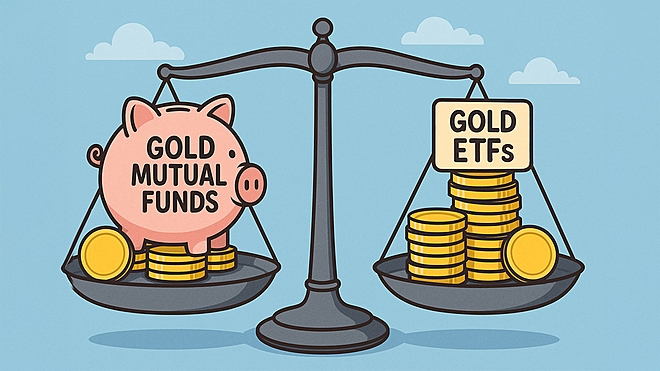 Nitin Yadav/AI-Generated Image
Summary: Gold ETFs look cheaper on paper. However, for most real investors, the numbers tell a different story. This piece breaks down why “lower expense ratio” isn’t always the winning choice.
On paper, gold ETFs (gold exchange-traded funds) look like the obvious winner. Their expense ratios are lower, they track gold closely, and they sit neatly in your demat account alongside your equity holdings. But for many investors—especially those using SIPs—the “cheaper” label falls apart the moment you look at how money actually moves in and out.
In practice, gold ETFs can cost you more than gold mutual funds, depending on how you invest.
What you’re really choosing between
A gold ETF is an exchange-traded product. It holds physical gold, trades on the NSE or BSE like a share and requires a demat + trading account. You pay the ETF’s expense ratio, plus brokerage, taxes and the bid–ask spread every time you transact.
A gold mutual fund (gold FoF) is an ordinary open-end fund that invests in an underlying gold ETF. You don’t need a demat account. SIPs can begin with a few hundred rupees and all transactions happen at NAV, which already reflects the underlying ETF’s costs and the fund’s own expenses
So in theory:
- Gold ETF → one layer of expenses + trading costs
- Gold mutual fund → higher annual costs + frictionless transactions for investors
Textbook logic says ETFs should be cheaper. Real-world behaviour complicates things.
The visible versus the invisible cost
The visible comparison is easy:
- ETFs publish lower expense ratios
- Gold mutual funds show higher expense ratios because they include their own cost plus the ETF’s cost
If you buy an ETF once and hold it for a decade, the lower annual expenses matter more than a couple of small trading costs. In that narrow scenario, ETFs genuinely win.
But that’s not how most people invest in gold.
With a gold ETF:
- Every purchase and sale becomes a separate trade
- You pay brokerage each time
- You face the bid–ask spread
- You may buy at a premium or sell at a discount to NAV
These costs don’t show up in the expense ratio. They show up in your price at which you transact.
With a gold mutual fund, each SIP or redemption happens at NAV. No spreads, no brokerage, no minimum charges. The fund handles the ETF trades in bulk.
This makes the ETF’s “cheaper” label far less reliable for small, recurring investors.
Two investors, two very different outcomes
Investor A: The lump-sum allocator
- Invests Rs 3–4 lakh at once
- Already uses demat and low-cost brokers
- Chooses a liquid ETF with good volumes
Here, the ETF makes sense. The one-time friction is small and doesn’t repeat. Over years, the lower expense ratio dominates.
Investor B: The small-ticket SIP investor
- Invests Rs 2,000–Rs 3,000 per month
- Is otherwise a mutual-fund SIP investor
- Uses a broker with minimum per-trade fees
For Investor B, each SIP instalment triggers brokerage, taxes and spreads. Repeated 12 times a year, this drag can wipe out—or even exceed—the savings from a lower ETF expense ratio.
If the same SIP runs through a gold mutual fund, those trading costs sit inside the annual expense ratio, making the experience simpler and often cheaper.
The lesson: ETF versus fund is not about personality. It is about your pattern of cash flows.
Behaviour and convenience also have a cost
A few soft factors matter more than investors realise:
- Demat dependence: If you don’t use a demat regularly, opening one just for gold adds overhead.
- Operational friction: SIPs, switches and redemptions are simpler on mutual fund platforms. ETFs require market-hour execution.
- Behavioural risk: Because ETFs trade like shares, some investors start treating gold like a trading position. More churn means more friction and poorer results.
None of this appears on cost tables, but all of it affects your final outcome.
A simple framework to choose
Instead of debating which structure is “better”, ask three narrower questions.
1. How will you invest: lump sum or SIP?
- Mostly lump sums → ETF is usually more efficient
- Mostly small, recurring SIPs → gold mutual fund often wins once all costs are accounted for
2. Do you already use demat?
- Yes → ETF is operationally easy
- No → forcing a demat setup just for gold is rarely worth it
3. What are your actual platform charges?
- Check brokerage slabs, minimum per-trade fees and demat maintenance
- For mutual funds, look at the direct plan expense ratio
Answering these usually makes the right choice obvious.
The real risk in the “cheaper” label
The danger isn’t picking the “wrong” product. It’s focusing on the wrong metric.
Whether you choose a gold ETF or a gold mutual fund, the bigger questions are:
- How much gold do you actually need in your portfolio?
- Is it part of a broader asset-allocation plan, or just a reaction to headlines?
- Are you prepared to hold it through long stretches when gold underperforms equity?
Gold is a diversifier, not a long-term compounder. A small difference in annual expenses matters, but not as much as using gold purposefully in your overall plan.
For large, infrequent allocations through demat, ETFs will remain the economic choice. For small SIP investors, gold mutual funds may deliver the same exposure at a lower all-in cost while fitting seamlessly into the way they already invest.
The label “cheaper” is only accurate if it survives contact with your actual investing behaviour.
If you’re unsure which gold mutual funds are worth considering, Value Research Fund Advisor’s Analyst’s Choice gives you a shortlist of funds our experts have already vetted for quality, costs and consistency—a simple way to pick the right gold option with confidence.
Disclaimer: This content is for information only and should not be considered investment advice or a recommendation.
For grievances: [email protected]
Ask Value Research 
 New episodes every Friday










 New Process Alert
 Seems like you've uploaded a wrong QR code. Please upload the QR code downloaded from MF Central platform.


