




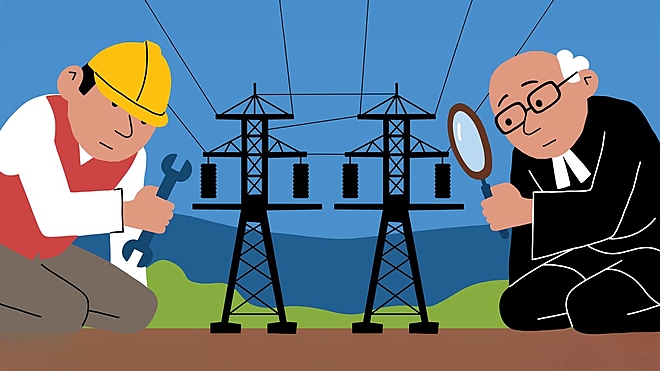
 Illustration: Anand Kumar
Summary: The world thinks the AI boom belongs to coders. It doesn’t. It belongs to the countries that can generate and move energy at scale. This piece reveals why power, not software, will decide the future of AI, and the Indian companies best placed to benefit from the global kilowatt arms race.
Summary: The world thinks the AI boom belongs to coders. It doesn’t. It belongs to the countries that can generate and move energy at scale. This piece reveals why power, not software, will decide the future of AI, and the Indian companies best placed to benefit from the global kilowatt arms race. The market is fixated on AI software. This is a distraction. The best algorithm will not win the race for AI supremacy; it will be won by the nation that can supply the cheapest, most abundant and most reliable electricity. It is not a battle of silicon; it is a kilowatt war. For the past two years, investors have been mesmerised by the generative AI narrative, chasing software models and calculating Nvidia chip orders. Then, in November 2025, Nvidia’s CEO, Jensen Huang, dropped a bombshell. Speaking at a Financial Times conference, Huang made a statement that has sent a shockwave throughout Western capital markets: “China is going to win the AI race.” His reasoning had nothing to do with software. It was about power. Huang pointed to China’s massive state subsidies for energy, which make electricity for its tech champions essentially ‘free’. This isn’t just a tech skirmish over who builds the best chatbot. It is a new, great-power contest, where electricity has become the ultimate strategic input, the new oil. The engineer vs the lawyer To understand the chasm between the US and Chinese strategies, one must read Dan Wang’s Breakneck: China’s Quest to Engineer the Future. Wang’s thesis is stark: America has become a ‘lawyerly society’ while China has perfected the ‘engineering state’. The US, Wang argues, is dominated by an elite class of lawyers, consultants and financiers. Its instinct is to obstruct. It solves problems through litigation, regulation, sanctions and export controls. It excels at creating complex rules and then arguing about them. China, by contrast, is run by engineers. Its instinct is to build. It responds to problems by pouring concrete, stringing transmission lines and scaling up manufacturin
This article was originally published on December 01, 2025.

 New episodes every Friday











 New Process Alert
  Seems like you've uploaded a wrong QR code. Please upload the QR code downloaded from MF Central platform.


