 Widely read:


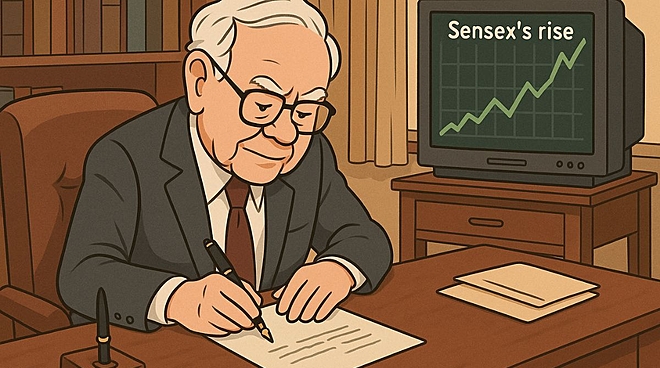 Aditya Roy/AI-Generated Image

What would you do if your main investment fell 50 per cent?
Most of us panic at a 10 per cent market fall. Legendary investor Warren Buffett has lived through several 50 per cent declines in Berkshire Hathaway, the company he has run for decades. In his final annual letter, he mentions those falls almost casually.
At Value Research, we frequently observe investors reacting in the opposite way when the index stumbles. A routine correction feels like a crisis, and people rush to book profits.
Between Buffett’s calm and the history of the Indian market — especially the Sensex rising nearly 800 times since 1979 — there are five clear messages on how to live with volatility.
Markets fall hard, then recover fully
Serious setbacks are built into equity investing. Buffett’s reminder that Berkshire has seen steep declines is not an admission of failure. Indian markets say the same thing. The Sensex has climbed from about 100 to above 80,000 through scams, global crises and a pandemic. Each crash felt like the end when it happened. None of them changed the long-term direction.
Temperament matters more than prediction
It is your behaviour, not your forecast, that usually decides outcomes. Buffett is clear on one point: the future will always surprise us. He does not waste time guessing the next trigger. Whenever the Sensex swings sharply, the questions are almost always about prediction. Is this the top? Is this just a dip? Should I move to safety now?
Most of us do not lose money simply because the market falls. We struggle because it is hard to stay invested while prices are falling.
Choose the right heroes
Who you copy matters more than you think. Buffett’s advice is simple: get the right heroes and copy them. His heroes are people who think long term, stay rational and do not flinch at noise. Many investors, in contrast, chase different heroes — the neighbour who says he exited at the top or the loudest voice in a WhatsApp group.
You can’t control luck, but you can control your plan
Buffett often says success requires a dose of luck. That’s a reminder to build systems that protect you when luck runs out. If you can’t control events, control how you are exposed to them.
You need a structure that stops you from reacting badly in bad months. For most investors, that means planning, not cleverness. You build a portfolio you can live with in bad months, not just in good ones.
If you had Rs 10 lakh in the market during one of the worst months of the past two decades, it could have fallen to about Rs 7.6 lakh. But in a balanced portfolio — say with an aggressive hybrid fund — you might have seen it fall only to about Rs 8.2 lakh.
Think in decades, not headlines
Finally, stretch your time frame beyond the next scare or election cycle. In his letter, Buffett talks about Berkshire needing just a few CEOs over the next century.
Most investors think in shorter cycles — the next correction, the next policy move, the next scary headline. Yet the same long-term Sensex chart that looks frightening up close tells a different story when you zoom out.
Prices will fall. Headlines will sound alarming. Markets have always recovered and moved on to new highs. Volatility is the price you pay for returns that beat inflation and fixed deposits. The real question is not whether the market will recover. It is whether you will stay invested long enough to benefit from that recovery.
That’s why your focus should be less on timing the market and more on building a portfolio you can stick with. For mutual fund investors, that means choosing the right set of funds for your goals, risk appetite and time horizon — not just the flavour of the season. For equity investors, it means identifying businesses you can hold through thick and thin, without second-guessing every headline.
With Value Research Fund Advisor, you get clear, data-backed fund recommendations to build your mutual fund portfolio—one that balances growth with resilience. And if you prefer direct stocks, Value Research Stock Advisor helps you discover fundamentally strong companies to buy and hold for the long run.
Because the best way to ride out market swings isn't prediction, it's preparation.
This article was originally published on November 20, 2025.
Disclaimer: This content is for information only and should not be considered investment advice or a recommendation.
For grievances: [email protected]
Ask Value Research 
 New episodes every Friday









 New Process Alert
 Seems like you've uploaded a wrong QR code. Please upload the QR code downloaded from MF Central platform.


